

308
Biologically Inspired Robotics
In the mechanical configuration of Figure 16.3 the sensor resolution of 1
μm yields an angular resolution of 0.01 degrees in the primary position. The
workspace is characterized by maximal deflections of 40 and 35 degrees in
horizontal and vertical directions, respectively.
16.3.3 Eye and Head Tracker
Eye trackers are usually characterized by their accuracy as well as their
spatial and temporal resolution. The accuracy of an eye tracker cannot
exceed the accuracy with which the human eye is positioned on visual targets. Human refixations usually have a standard deviation on the order of
1 degrees (Eggert 2007). With our eye and head tracker we have measured
differences of 0.6 ± 0.27 degrees between visual targets on the screen and the
corresponding intersections of subjects’ gaze vectors with the screen plane
(Schneider et al. 2005). The spatial resolution, given as the standard deviation of eye position values during a fixation, is 0.02 degrees. The temporal
resolution is determined by the high-speed FireWire cameras, which can be
operated at frame rates of up to 600 Hz. Such a sampling rate allows measurement of saccades, the fastest human eye movements.
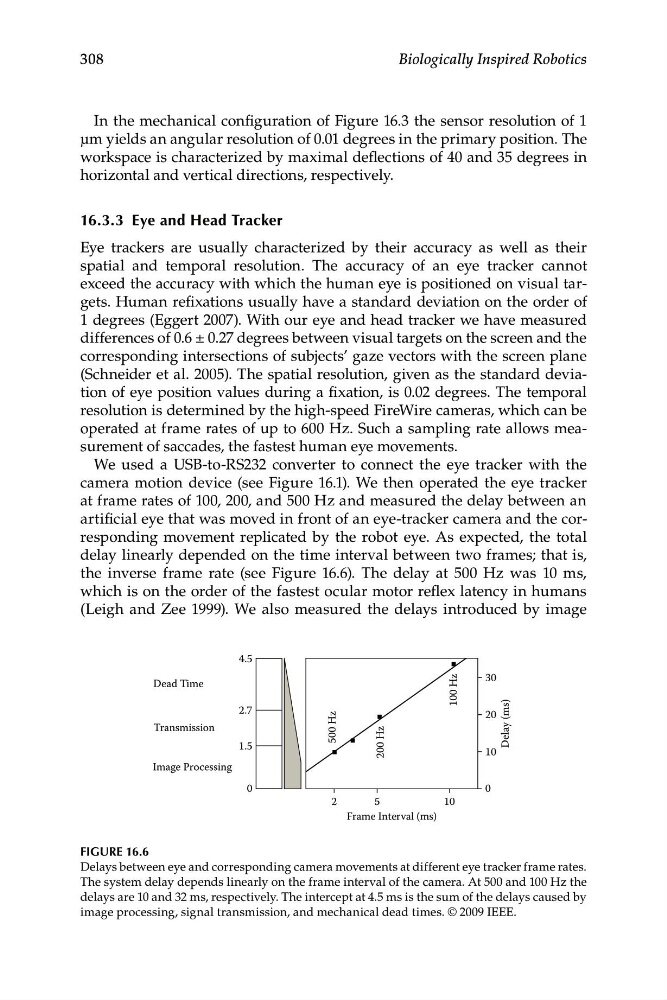
We used a USB-to-RS232 converter to connect the eye tracker with the
camera motion device (see Figure 16.1). We then operated the eye tracker
at frame rates of 100, 200, and 500 Hz and measured the delay between an
artificial eye that was moved in front of an eye-tracker camera and the corresponding movement replicated by the robot eye. As expected, the total
delay linearly depended on the time interval between two frames; that is,
the inverse frame rate (see Figure 16.6). The delay at 500 Hz was 10 ms,
which is on the order of the fastest ocular motor reflex latency in humans
(Leigh and Zee 1999). We also measured the delays introduced by image
4.5
Dead Time
2.7
Transmission
1.5
Image Processing
0
30
20
Delay (ms)
10
0
200 Hz
500 Hz
100 Hz
2
5
10
Frame Interval (ms)
FIGURE 16.6
Delays between eye and corresponding camera movements at different eye tracker frame rates.
The system delay depends linearly on the frame interval of the camera. At 500 and 100 Hz the
delays are 10 and 32 ms, respectively. The intercept at 4.5 ms is the sum of the delays caused by
image processing, signal transmission, and mechanical dead times. © 2009 IEEE.