

307
A Test Environment for Studying Robotic Eye Movements
10
0
–10
–20
Magnitude (dB)
–30
–40
0
–50
–100
Camera
Eye plant
Phase (°)
–150
0.1
1
10
100
Frequency (Hz)
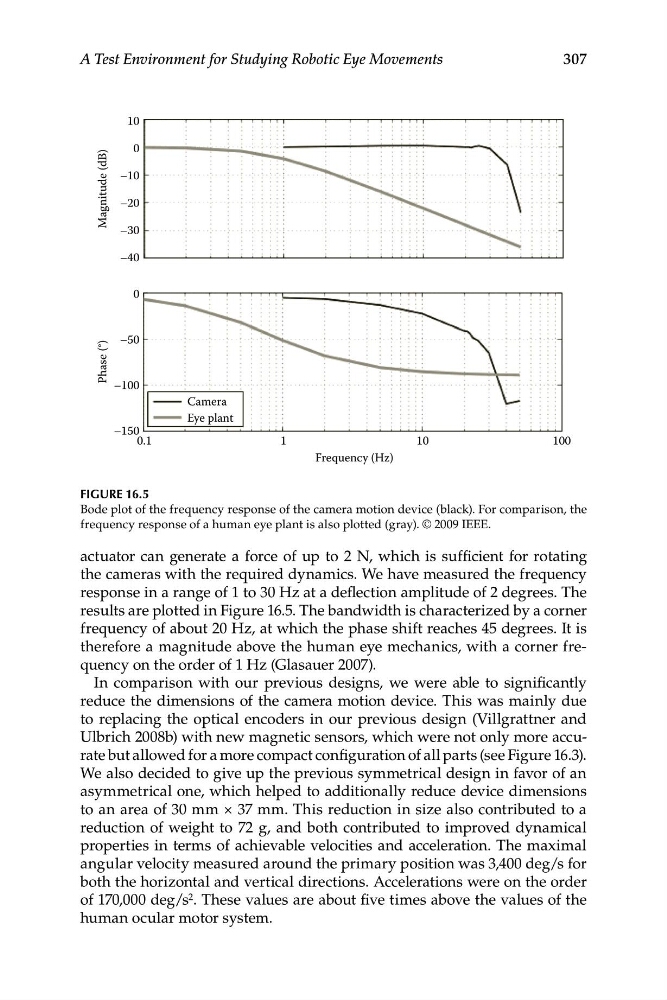
FIGURE 16.5
Bode plot of the frequency response of the camera motion device (black). For comparison, the
frequency response of a human eye plant is also plotted (gray). © 2009 IEEE.
actuator can generate a force of up to 2 N, which is sufficient for rotating
the cameras with the required dynamics. We have measured the frequency
response in a range of 1 to 30 Hz at a deflection amplitude of 2 degrees. The
results are plotted in Figure 16.5. The bandwidth is characterized by a corner
frequency of about 20 Hz, at which the phase shift reaches 45 degrees. It is
therefore a magnitude above the human eye mechanics, with a corner frequency on the order of 1 Hz (Glasauer 2007).
In comparison with our previous designs, we were able to significantly
reduce the dimensions of the camera motion device. This was mainly due
to replacing the optical encoders in our previous design (Villgrattner and
Ulbrich 2008b) with new magnetic sensors, which were not only more accurate but allowed for a more compact configuration of all parts (see Figure 16.3).
We also decided to give up the previous symmetrical design in favor of an
asymmetrical one, which helped to additionally reduce device dimensions
to an area of 30 mm × 37 mm. This reduction in size also contributed to a
reduction of weight to 72 g, and both contributed to improved dynamical
properties in terms of achievable velocities and acceleration. The maximal
angular velocity measured around the primary position was 3,400 deg/s for
both the horizontal and vertical directions. Accelerations were on the order
of 170,000 deg/s 2 . These values are about five times above the values of the
human ocular motor system.
A Test Environment for Studying Robotic Eye Movements
10
0
–10
–20
Magnitude (dB)
–30
–40
0
–50
–100
Camera
Eye plant
Phase (°)
–150
0.1
1
10
100
Frequency (Hz)
FIGURE 16.5
Bode plot of the frequency response of the camera motion device (black). For comparison, the
frequency response of a human eye plant is also plotted (gray). © 2009 IEEE.
actuator can generate a force of up to 2 N, which is sufficient for rotating
the cameras with the required dynamics. We have measured the frequency
response in a range of 1 to 30 Hz at a deflection amplitude of 2 degrees. The
results are plotted in Figure 16.5. The bandwidth is characterized by a corner
frequency of about 20 Hz, at which the phase shift reaches 45 degrees. It is
therefore a magnitude above the human eye mechanics, with a corner frequency on the order of 1 Hz (Glasauer 2007).
In comparison with our previous designs, we were able to significantly
reduce the dimensions of the camera motion device. This was mainly due
to replacing the optical encoders in our previous design (Villgrattner and
Ulbrich 2008b) with new magnetic sensors, which were not only more accurate but allowed for a more compact configuration of all parts (see Figure 16.3).
We also decided to give up the previous symmetrical design in favor of an
asymmetrical one, which helped to additionally reduce device dimensions
to an area of 30 mm × 37 mm. This reduction in size also contributed to a
reduction of weight to 72 g, and both contributed to improved dynamical
properties in terms of achievable velocities and acceleration. The maximal
angular velocity measured around the primary position was 3,400 deg/s for
both the horizontal and vertical directions. Accelerations were on the order
of 170,000 deg/s 2 . These values are about five times above the values of the
human ocular motor system.