

291
Development of Hand Rehabilitation System for Paralysis Patients
Injured
finger
Healthy
finger
Extension
Stop
Flexion
Extension
Stop
Flexion
Extension
Stop
Flexion
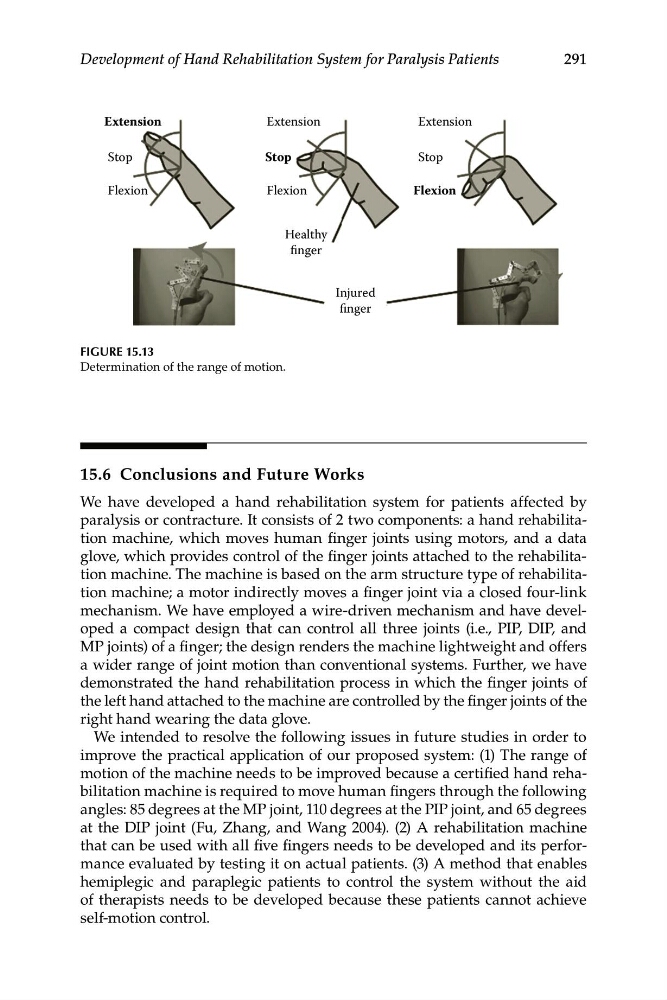
FIGURE 15.13
Determination of the range of motion.
15.6 Conclusions and Future Works
We have developed a hand rehabilitation system for patients affected by
paralysis or contracture. It consists of 2 two components: a hand rehabilitation machine, which moves human finger joints using motors, and a data
glove, which provides control of the finger joints attached to the rehabilitation machine. The machine is based on the arm structure type of rehabilitation machine; a motor indirectly moves a finger joint via a closed four-link
mechanism. We have employed a wire-driven mechanism and have developed a compact design that can control all three joints (i.e., PIP, DIP, and
MP joints) of a finger; the design renders the machine lightweight and offers
a wider range of joint motion than conventional systems. Further, we have
demonstrated the hand rehabilitation process in which the finger joints of
the left hand attached to the machine are controlled by the finger joints of the
right hand wearing the data glove.
We intended to resolve the following issues in future studies in order to
improve the practical application of our proposed system: (1) The range of
motion of the machine needs to be improved because a certified hand rehabilitation machine is required to move human fingers through the following
angles: 85 degrees at the MP joint, 110 degrees at the PIP joint, and 65 degrees
at the DIP joint (Fu, Zhang, and Wang 2004). (2) A rehabilitation machine
that can be used with all five fingers needs to be developed and its performance evaluated by testing it on actual patients. (3) A method that enables
hemiplegic and paraplegic patients to control the system without the aid
of therapists needs to be developed because these patients cannot achieve
self-motion control.
Development of Hand Rehabilitation System for Paralysis Patients
Injured
finger
Healthy
finger
Extension
Stop
Flexion
Extension
Stop
Flexion
Extension
Stop
Flexion
FIGURE 15.13
Determination of the range of motion.
15.6 Conclusions and Future Works
We have developed a hand rehabilitation system for patients affected by
paralysis or contracture. It consists of 2 two components: a hand rehabilitation machine, which moves human finger joints using motors, and a data
glove, which provides control of the finger joints attached to the rehabilitation machine. The machine is based on the arm structure type of rehabilitation machine; a motor indirectly moves a finger joint via a closed four-link
mechanism. We have employed a wire-driven mechanism and have developed a compact design that can control all three joints (i.e., PIP, DIP, and
MP joints) of a finger; the design renders the machine lightweight and offers
a wider range of joint motion than conventional systems. Further, we have
demonstrated the hand rehabilitation process in which the finger joints of
the left hand attached to the machine are controlled by the finger joints of the
right hand wearing the data glove.
We intended to resolve the following issues in future studies in order to
improve the practical application of our proposed system: (1) The range of
motion of the machine needs to be improved because a certified hand rehabilitation machine is required to move human fingers through the following
angles: 85 degrees at the MP joint, 110 degrees at the PIP joint, and 65 degrees
at the DIP joint (Fu, Zhang, and Wang 2004). (2) A rehabilitation machine
that can be used with all five fingers needs to be developed and its performance evaluated by testing it on actual patients. (3) A method that enables
hemiplegic and paraplegic patients to control the system without the aid
of therapists needs to be developed because these patients cannot achieve
self-motion control.