

289
Development of Hand Rehabilitation System for Paralysis Patients
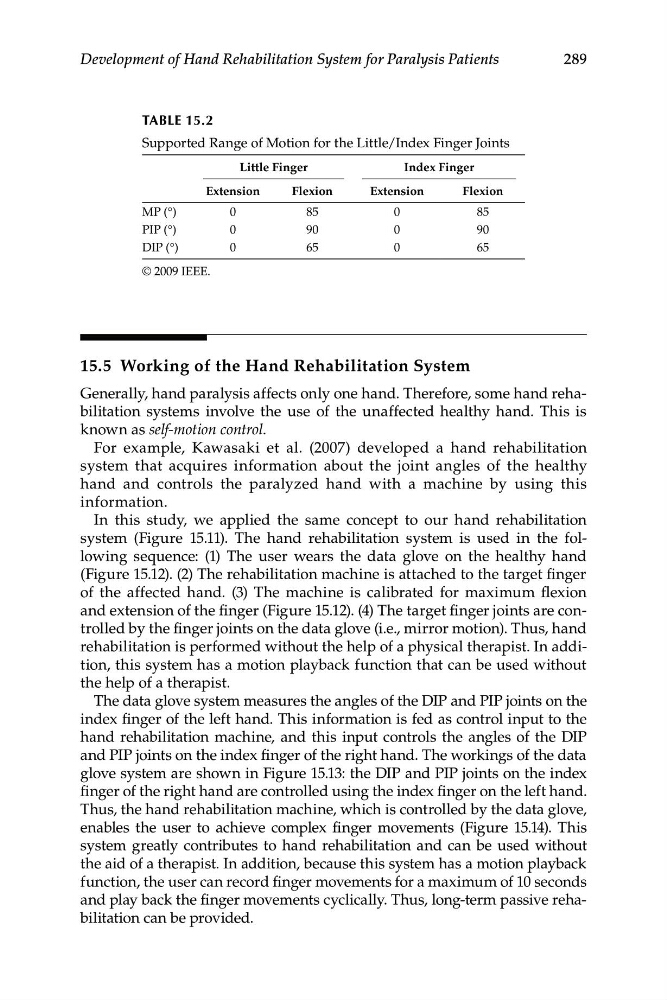
TABLE 15.2
Supported Range of Motion for the Little/Index Finger Joints
Little Finger
Index Finger
Extension
Flexion
Extension
Flexion
MP (°)
0
85
0
85
PIP (°)
0
90
0
90
DIP (°)
0
© 2009 IEEE.
65
0
65
15.5 Working of the Hand Rehabilitation System
Generally, hand paralysis affects only one hand. Therefore, some hand rehabilitation systems involve the use of the unaffected healthy hand. This is
known as self-motion control.
For example, Kawasaki et al. (2007) developed a hand rehabilitation
system that acquires information about the joint angles of the healthy
hand and controls the paralyzed hand with a machine by using this
information.
In this study, we applied the same concept to our hand rehabilitation
system (Figure 15.11). The hand rehabilitation system is used in the following sequence: (1) The user wears the data glove on the healthy hand
(Figure 15.12). (2) The rehabilitation machine is attached to the target finger
of the affected hand. (3) The machine is calibrated for maximum flexion
and extension of the finger (Figure 15.12). (4) The target finger joints are controlled by the finger joints on the data glove (i.e., mirror motion). Thus, hand
rehabilitation is performed without the help of a physical therapist. In addition, this system has a motion playback function that can be used without
the help of a therapist.
The data glove system measures the angles of the DIP and PIP joints on the
index finger of the left hand. This information is fed as control input to the
hand rehabilitation machine, and this input controls the angles of the DIP
and PIP joints on the index finger of the right hand. The workings of the data
glove system are shown in Figure 15.13: the DIP and PIP joints on the index
finger of the right hand are controlled using the index finger on the left hand.
Thus, the hand rehabilitation machine, which is controlled by the data glove,
enables the user to achieve complex finger movements (Figure 15.14). This
system greatly contributes to hand rehabilitation and can be used without
the aid of a therapist. In addition, because this system has a motion playback
function, the user can record finger movements for a maximum of 10 seconds
and play back the finger movements cyclically. Thus, long-term passive rehabilitation can be provided.