

TABLE 15.1
Specifications of Hand
Rehabilitation System
Weight
Exoskeleton: 51 g
Motor unit: 83 g
Arm length
DIP: 20.0 mm
PIP: 25.0 mm
MP: 35 mm
Width
17.5 mm
© 2009 IEEE.
287
Development of Hand Rehabilitation System for Paralysis Patients
50 (mm)
Motor unit
Exoskeleton
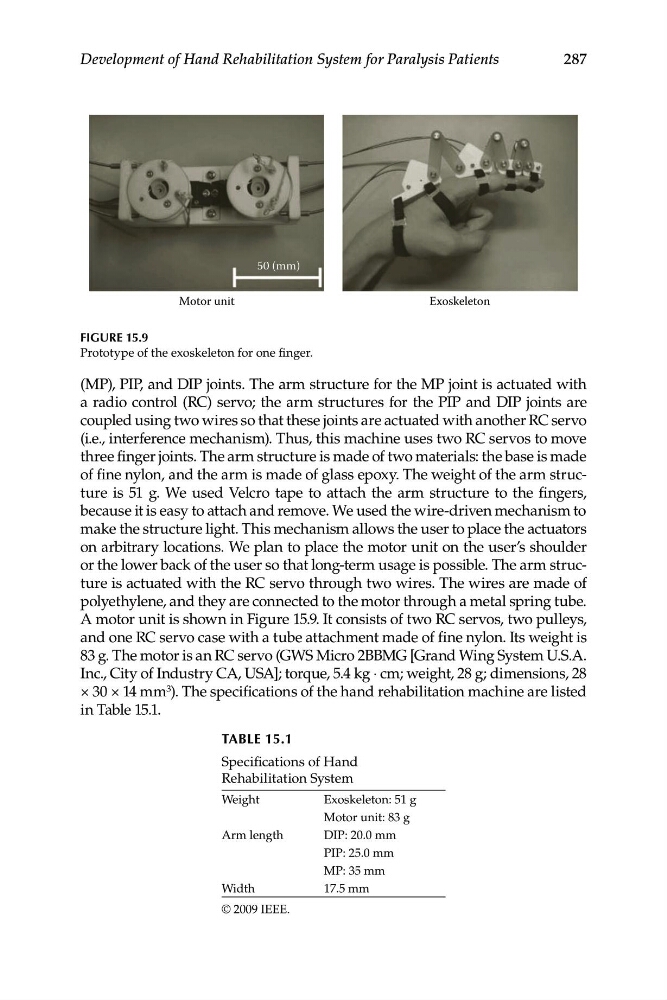
FIGURE 15.9
Prototype of the exoskeleton for one finger.
(MP), PIP, and DIP joints. The arm structure for the MP joint is actuated with
a radio control (RC) servo; the arm structures for the PIP and DIP joints are
coupled using two wires so that these joints are actuated with another RC servo
(i.e., interference mechanism). Thus, this machine uses two RC servos to move
three finger joints. The arm structure is made of two materials: the base is made
of fine nylon, and the arm is made of glass epoxy. The weight of the arm structure is 51 g. We used Velcro tape to attach the arm structure to the fingers,
because it is easy to attach and remove. We used the wire-driven mechanism to
make the structure light. This mechanism allows the user to place the actuators
on arbitrary locations. We plan to place the motor unit on the user’s shoulder
or the lower back of the user so that long-term usage is possible. The arm structure is actuated with the RC servo through two wires. The wires are made of
polyethylene, and they are connected to the motor through a metal spring tube.
A motor unit is shown in Figure 15.9. It consists of two RC servos, two pulleys,
and one RC servo case with a tube attachment made of fine nylon. Its weight is
83 g. The motor is an RC servo (GWS Micro 2BBMG [Grand Wing System U.S.A.
Inc., City of Industry CA, USA]; torque, 5.4 kg ⋅ cm; weight, 28 g; dimensions, 28
× 30 × 14 mm 3 ). The specifications of the hand rehabilitation machine are listed
in Table 15.1.
Specifications of Hand
Rehabilitation System
Weight
Exoskeleton: 51 g
Motor unit: 83 g
Arm length
DIP: 20.0 mm
PIP: 25.0 mm
MP: 35 mm
Width
17.5 mm
© 2009 IEEE.
287
Development of Hand Rehabilitation System for Paralysis Patients
50 (mm)
Motor unit
Exoskeleton
FIGURE 15.9
Prototype of the exoskeleton for one finger.
(MP), PIP, and DIP joints. The arm structure for the MP joint is actuated with
a radio control (RC) servo; the arm structures for the PIP and DIP joints are
coupled using two wires so that these joints are actuated with another RC servo
(i.e., interference mechanism). Thus, this machine uses two RC servos to move
three finger joints. The arm structure is made of two materials: the base is made
of fine nylon, and the arm is made of glass epoxy. The weight of the arm structure is 51 g. We used Velcro tape to attach the arm structure to the fingers,
because it is easy to attach and remove. We used the wire-driven mechanism to
make the structure light. This mechanism allows the user to place the actuators
on arbitrary locations. We plan to place the motor unit on the user’s shoulder
or the lower back of the user so that long-term usage is possible. The arm structure is actuated with the RC servo through two wires. The wires are made of
polyethylene, and they are connected to the motor through a metal spring tube.
A motor unit is shown in Figure 15.9. It consists of two RC servos, two pulleys,
and one RC servo case with a tube attachment made of fine nylon. Its weight is
83 g. The motor is an RC servo (GWS Micro 2BBMG [Grand Wing System U.S.A.
Inc., City of Industry CA, USA]; torque, 5.4 kg ⋅ cm; weight, 28 g; dimensions, 28
× 30 × 14 mm 3 ). The specifications of the hand rehabilitation machine are listed
in Table 15.1.