

279
Development of Hand Rehabilitation System for Paralysis Patients
of machines is the manner in which the machine is attached to the human
body. With the endoskeleton type, actuators are attached directly to the skeleton and the joints are actuated by the actuators directly. With the exoskeleton
type, a link mechanism is attached to the body and the joints are actuated by
the actuators, which are operated by a link mechanism. The endoskeleton-type
machines generally use pneumatic actuators as substitutes for human muscles. A pneumatic actuator consists of rubber, a tube, and an air compressor.
Because the drive unit (i.e., the rubber) is assembled separately, the pneumatic
actuator has the advantages of high driving capability and a lightweight drive
source (i.e., the air compressor; Noritsugu 2008). However, the actuator shape
limits the number of places where the actuator can be attached; that is, this
type of machine is not suitable for hand rehabilitation because it is difficult to
attach a pneumatic actuator within the limited space available on a human finger. Exoskeleton-type machines are generally heavier than endoskeleton-type
machines. However, the link mechanism enables the placement of the actuators anywhere on the human body. Thus, exoskeleton-type machines are
potentially suitable for use for any part of the human body; therefore, we used
an exoskeleton-type machine for our hand rehabilitation system.
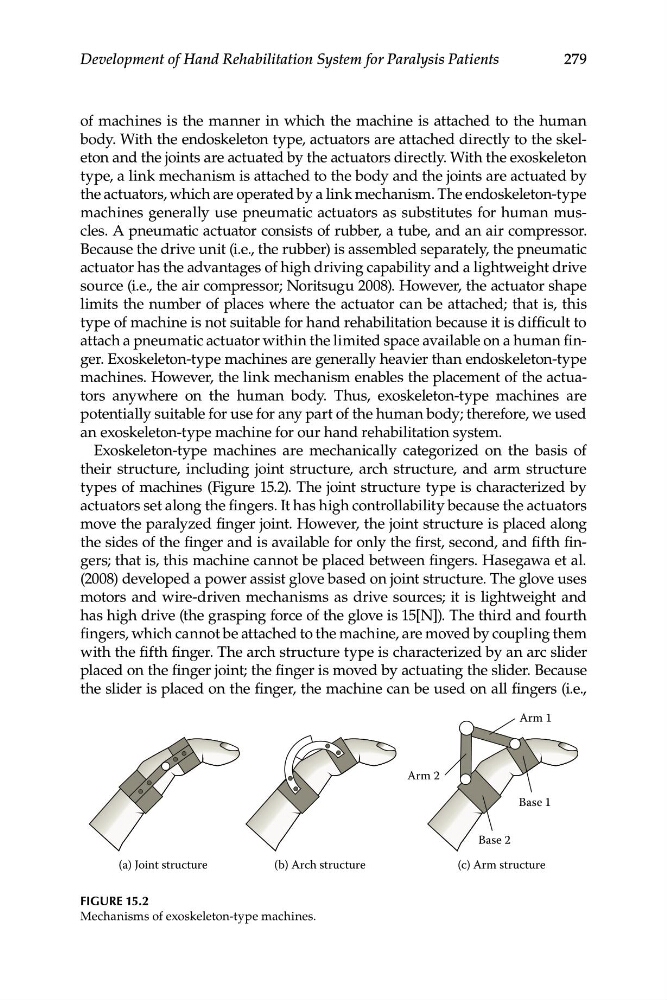
Exoskeleton-type machines are mechanically categorized on the basis of
their structure, including joint structure, arch structure, and arm structure
types of machines (Figure 15.2). The joint structure type is characterized by
actuators set along the fingers. It has high controllability because the actuators
move the paralyzed finger joint. However, the joint structure is placed along
the sides of the finger and is available for only the first, second, and fifth fingers; that is, this machine cannot be placed between fingers. Hasegawa et al.
(2008) developed a power assist glove based on joint structure. The glove uses
motors and wire-driven mechanisms as drive sources; it is lightweight and
has high drive (the grasping force of the glove is 15[N]). The third and fourth
fingers, which cannot be attached to the machine, are moved by coupling them
with the fifth finger. The arch structure type is characterized by an arc slider
placed on the finger joint; the finger is moved by actuating the slider. Because
the slider is placed on the finger, the machine can be used on all fingers (i.e.,
Arm 1
Base 1
Base 2
Arm 2
(a) Joint structure
(b) Arch structure
(c) Arm structure
FIGURE 15.2
Mechanisms of exoskeleton-type machines.