

278
Biologically Inspired Robotics
distal interphalangeal (DIP) and proximal interphalangeal (PIP) joints.
These mechanisms render the machine lightweight, resulting in a wider
range of motion than that obtainable in conventional systems. The
design specifications for the mechanisms and the experimental results
are described in this chapter.
15.1 Introduction
As the development of various technologies in medical applications becomes
more rapid, machine-assisted physical rehabilitation, which requires
long-term recurrent movements, is in increasing demand. For example,
hand rehabilitation is an important process because hand movement is one
of the most basic actions performed in daily life. Generally, hand paralysis or contracture is treated with the assistance of a physical therapist. The
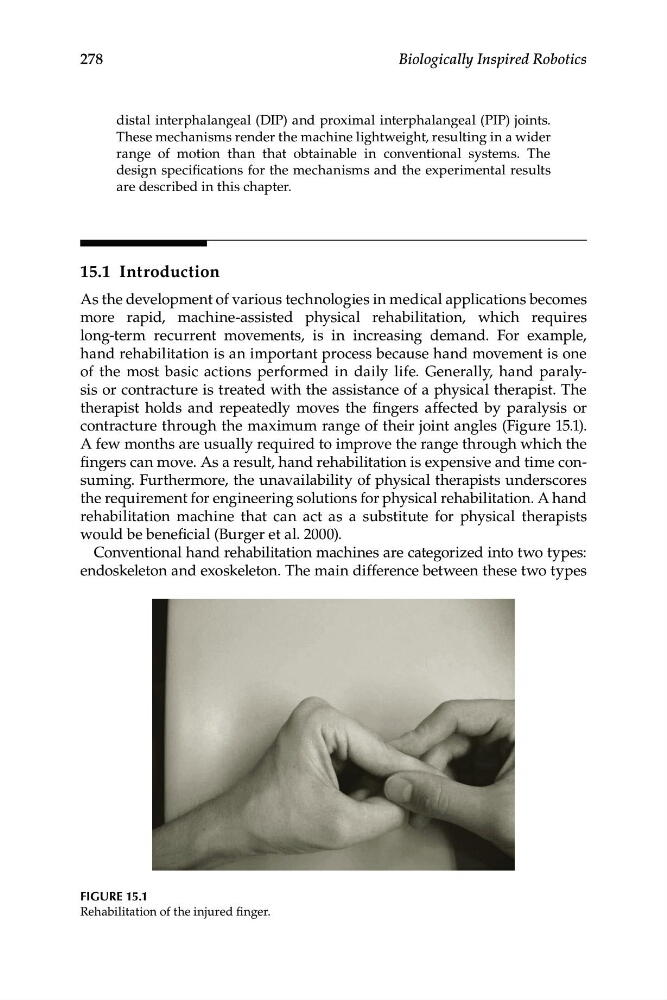
therapist holds and repeatedly moves the fingers affected by paralysis or
contracture through the maximum range of their joint angles (Figure 15.1).
A few months are usually required to improve the range through which the
fingers can move. As a result, hand rehabilitation is expensive and time consuming. Furthermore, the unavailability of physical therapists underscores
the requirement for engineering solutions for physical rehabilitation. A hand
rehabilitation machine that can act as a substitute for physical therapists
would be beneficial (Burger et al. 2000).
Conventional hand rehabilitation machines are categorized into two types:
endoskeleton and exoskeleton. The main difference between these two types
FIGURE 15.1
Rehabilitation of the injured finger.
Biologically Inspired Robotics
distal interphalangeal (DIP) and proximal interphalangeal (PIP) joints.
These mechanisms render the machine lightweight, resulting in a wider
range of motion than that obtainable in conventional systems. The
design specifications for the mechanisms and the experimental results
are described in this chapter.
15.1 Introduction
As the development of various technologies in medical applications becomes
more rapid, machine-assisted physical rehabilitation, which requires
long-term recurrent movements, is in increasing demand. For example,
hand rehabilitation is an important process because hand movement is one
of the most basic actions performed in daily life. Generally, hand paralysis or contracture is treated with the assistance of a physical therapist. The
therapist holds and repeatedly moves the fingers affected by paralysis or
contracture through the maximum range of their joint angles (Figure 15.1).
A few months are usually required to improve the range through which the
fingers can move. As a result, hand rehabilitation is expensive and time consuming. Furthermore, the unavailability of physical therapists underscores
the requirement for engineering solutions for physical rehabilitation. A hand
rehabilitation machine that can act as a substitute for physical therapists
would be beneficial (Burger et al. 2000).
Conventional hand rehabilitation machines are categorized into two types:
endoskeleton and exoskeleton. The main difference between these two types
FIGURE 15.1
Rehabilitation of the injured finger.