

273
Mathematical Modeling of Brain Circuitry
Bode Diagram
10
–2
10
–1
10
0
10
1
10
2
10
3
Frequency (rad/sec)
–180
–90
0
90
–50
–40
–30
–20
–10
0
10
Phase (deg)
Magnitude (dB)
10
4
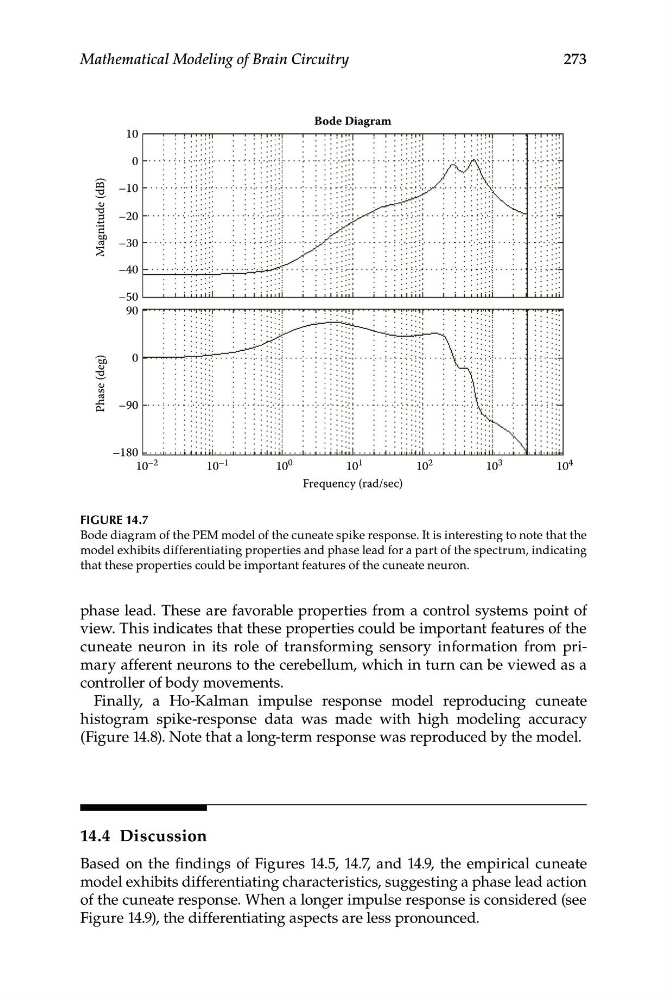
FIGURE 14.7
Bode diagram of the PEM model of the cuneate spike response. It is interesting to note that the
model exhibits differentiating properties and phase lead for a part of the spectrum, indicating
that these properties could be important features of the cuneate neuron.
phase lead. These are favorable properties from a control systems point of
view. This indicates that these properties could be important features of the
cuneate neuron in its role of transforming sensory information from primary afferent neurons to the cerebellum, which in turn can be viewed as a
controller of body movements.
Finally, a Ho-Kalman impulse response model reproducing cuneate
histogram spike-response data was made with high modeling accuracy
(Figure 14.8). Note that a long-term response was reproduced by the model.
14.4 Discussion
Based on the findings of Figures 14.5, 14.7, and 14.9, the empirical cuneate
model exhibits differentiating characteristics, suggesting a phase lead action
of the cuneate response. When a longer impulse response is considered (see
Figure 14.9), the differentiating aspects are less pronounced.
Mathematical Modeling of Brain Circuitry
Bode Diagram
10
–2
10
–1
10
0
10
1
10
2
10
3
Frequency (rad/sec)
–180
–90
0
90
–50
–40
–30
–20
–10
0
10
Phase (deg)
Magnitude (dB)
10
4
FIGURE 14.7
Bode diagram of the PEM model of the cuneate spike response. It is interesting to note that the
model exhibits differentiating properties and phase lead for a part of the spectrum, indicating
that these properties could be important features of the cuneate neuron.
phase lead. These are favorable properties from a control systems point of
view. This indicates that these properties could be important features of the
cuneate neuron in its role of transforming sensory information from primary afferent neurons to the cerebellum, which in turn can be viewed as a
controller of body movements.
Finally, a Ho-Kalman impulse response model reproducing cuneate
histogram spike-response data was made with high modeling accuracy
(Figure 14.8). Note that a long-term response was reproduced by the model.
14.4 Discussion
Based on the findings of Figures 14.5, 14.7, and 14.9, the empirical cuneate
model exhibits differentiating characteristics, suggesting a phase lead action
of the cuneate response. When a longer impulse response is considered (see
Figure 14.9), the differentiating aspects are less pronounced.