

256
Biologically Inspired Robotics
Power Supply
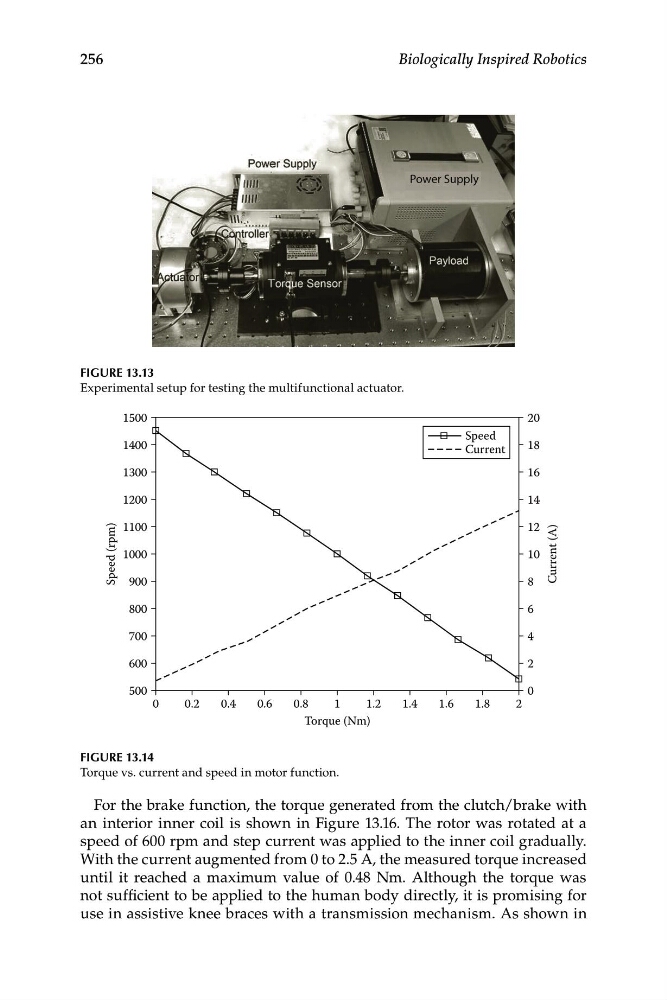
FIGURE 13.13
Experimental setup for testing the multifunctional actuator.
500
600
700
800
900
1000
Speed (rpm)
1100
1200
1300
1400
1500
0
2
4
6
8
10
Current (A)
12
14
16
18
Speed
Current
20
0
0.2
0.4
0.6
0.8
1
1.2
1.4
1.6
1.8
2
Torque (Nm)
FIGURE 13.14
Torque vs. current and speed in motor function.
For the brake function, the torque generated from the clutch/brake with
an interior inner coil is shown in Figure 13.16. The rotor was rotated at a
speed of 600 rpm and step current was applied to the inner coil gradually.
With the current augmented from 0 to 2.5 A, the measured torque increased
until it reached a maximum value of 0.48 Nm. Although the torque was
not sufficient to be applied to the human body directly, it is promising for
use in assistive knee braces with a transmission mechanism. As shown in
Biologically Inspired Robotics
Power Supply
FIGURE 13.13
Experimental setup for testing the multifunctional actuator.
500
600
700
800
900
1000
Speed (rpm)
1100
1200
1300
1400
1500
0
2
4
6
8
10
Current (A)
12
14
16
18
Speed
Current
20
0
0.2
0.4
0.6
0.8
1
1.2
1.4
1.6
1.8
2
Torque (Nm)
FIGURE 13.14
Torque vs. current and speed in motor function.
For the brake function, the torque generated from the clutch/brake with
an interior inner coil is shown in Figure 13.16. The rotor was rotated at a
speed of 600 rpm and step current was applied to the inner coil gradually.
With the current augmented from 0 to 2.5 A, the measured torque increased
until it reached a maximum value of 0.48 Nm. Although the torque was
not sufficient to be applied to the human body directly, it is promising for
use in assistive knee braces with a transmission mechanism. As shown in