

210
Biologically Inspired Robotics
(a)
(b)
(c)
(d)
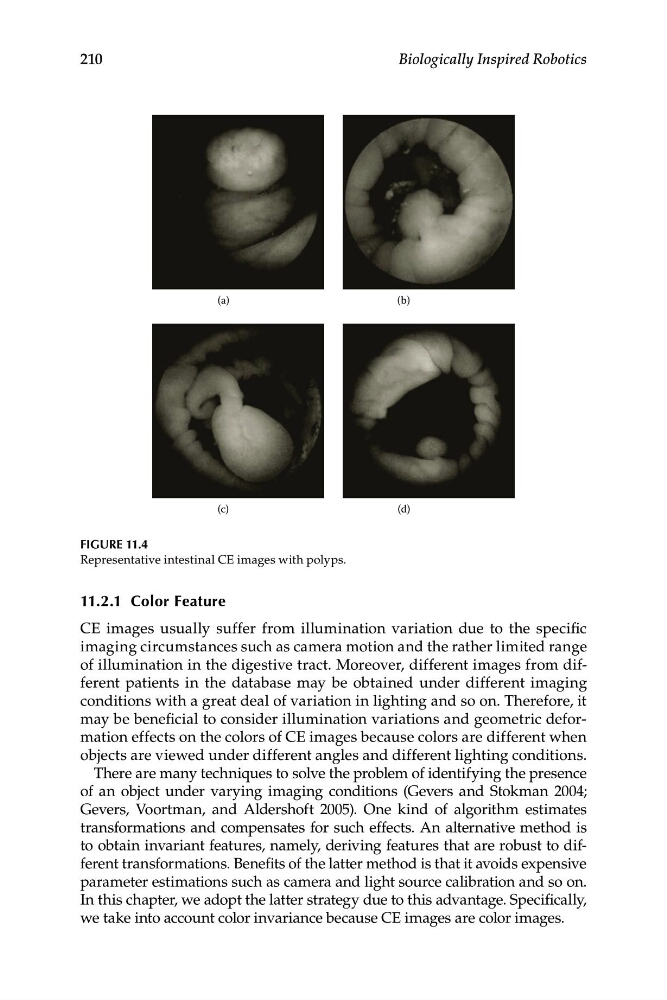
FIGURE 11.4
Representative intestinal CE images with polyps.
11.2.1 Color Feature
CE images usually suffer from illumination variation due to the specific
imaging circumstances such as camera motion and the rather limited range
of illumination in the digestive tract. Moreover, different images from different patients in the database may be obtained under different imaging
conditions with a great deal of variation in lighting and so on. Therefore, it
may be beneficial to consider illumination variations and geometric deformation effects on the colors of CE images because colors are different when
objects are viewed under different angles and different lighting conditions.
There are many techniques to solve the problem of identifying the presence
of an object under varying imaging conditions (Gevers and Stokman 2004;
Gevers, Voortman, and Aldershoft 2005). One kind of algorithm estimates
transformations and compensates for such effects. An alternative method is
to obtain invariant features, namely, deriving features that are robust to different transformations. Benefits of the latter method is that it avoids expensive
parameter estimations such as camera and light source calibration and so on.
In this chapter, we adopt the latter strategy due to this advantage. Specifically,
we take into account color invariance because CE images are color images.
Biologically Inspired Robotics
(a)
(b)
(c)
(d)
FIGURE 11.4
Representative intestinal CE images with polyps.
11.2.1 Color Feature
CE images usually suffer from illumination variation due to the specific
imaging circumstances such as camera motion and the rather limited range
of illumination in the digestive tract. Moreover, different images from different patients in the database may be obtained under different imaging
conditions with a great deal of variation in lighting and so on. Therefore, it
may be beneficial to consider illumination variations and geometric deformation effects on the colors of CE images because colors are different when
objects are viewed under different angles and different lighting conditions.
There are many techniques to solve the problem of identifying the presence
of an object under varying imaging conditions (Gevers and Stokman 2004;
Gevers, Voortman, and Aldershoft 2005). One kind of algorithm estimates
transformations and compensates for such effects. An alternative method is
to obtain invariant features, namely, deriving features that are robust to different transformations. Benefits of the latter method is that it avoids expensive
parameter estimations such as camera and light source calibration and so on.
In this chapter, we adopt the latter strategy due to this advantage. Specifically,
we take into account color invariance because CE images are color images.