

172
Biologically Inspired Robotics
Z
δ
δ
h
h
r
z = f(ρ)
Sample
R
δ
h
ρ
Substrate
θ
(a)
(b)
(c)
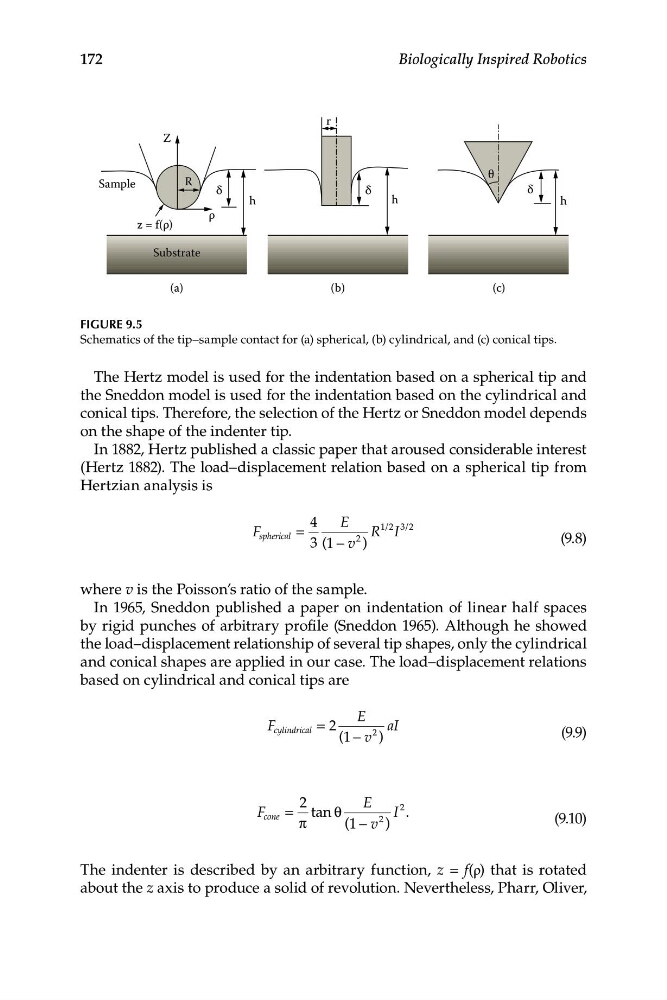
FIGURE 9.5
Schematics of the tip–sample contact for (a) spherical, (b) cylindrical, and (c) conical tips.
The Hertz model is used for the indentation based on a spherical tip and
the Sneddon model is used for the indentation based on the cylindrical and
conical tips. Therefore, the selection of the Hertz or Sneddon model depends
on the shape of the indenter tip.
In 1882, Hertz published a classic paper that aroused considerable interest
(Hertz 1882). The load–displacement relation based on a spherical tip from
Hertzian analysis is
4
E
1 2 3 2
/
/
F
=
R I
spherical
2
(9.8)
3 (1 − v )
where v is the Poisson’s ratio of the sample.
In 1965, Sneddon published a paper on indentation of linear half spaces
by rigid punches of arbitrary profile (Sneddon 1965). Although he showed
the load–displacement relationship of several tip shapes, only the cylindrical
and conical shapes are applied in our case. The load–displacement relations
based on cylindrical and conical tips are
E
F
= 2
aI
cylindrical
2
(9.9)
(1 − v )
2
E
2
F cone = tan θ
I .
2
(9.10)
π
(1 − v )
The indenter is described by an arbitrary function, z = f(ρ) that is rotated
about the z axis to produce a solid of revolution. Nevertheless, Pharr, Oliver,
Biologically Inspired Robotics
Z
δ
δ
h
h
r
z = f(ρ)
Sample
R
δ
h
ρ
Substrate
θ
(a)
(b)
(c)
FIGURE 9.5
Schematics of the tip–sample contact for (a) spherical, (b) cylindrical, and (c) conical tips.
The Hertz model is used for the indentation based on a spherical tip and
the Sneddon model is used for the indentation based on the cylindrical and
conical tips. Therefore, the selection of the Hertz or Sneddon model depends
on the shape of the indenter tip.
In 1882, Hertz published a classic paper that aroused considerable interest
(Hertz 1882). The load–displacement relation based on a spherical tip from
Hertzian analysis is
4
E
1 2 3 2
/
/
F
=
R I
spherical
2
(9.8)
3 (1 − v )
where v is the Poisson’s ratio of the sample.
In 1965, Sneddon published a paper on indentation of linear half spaces
by rigid punches of arbitrary profile (Sneddon 1965). Although he showed
the load–displacement relationship of several tip shapes, only the cylindrical
and conical shapes are applied in our case. The load–displacement relations
based on cylindrical and conical tips are
E
F
= 2
aI
cylindrical
2
(9.9)
(1 − v )
2
E
2
F cone = tan θ
I .
2
(9.10)
π
(1 − v )
The indenter is described by an arbitrary function, z = f(ρ) that is rotated
about the z axis to produce a solid of revolution. Nevertheless, Pharr, Oliver,