

2.5
Modeling results
Experimental data
0
2
4
6
8
10
12
14
16
18
2
1.5
1
0.5
0
Stretching Force (pN)
Axial Deformation (μm)
160
Biologically Inspired Robotics
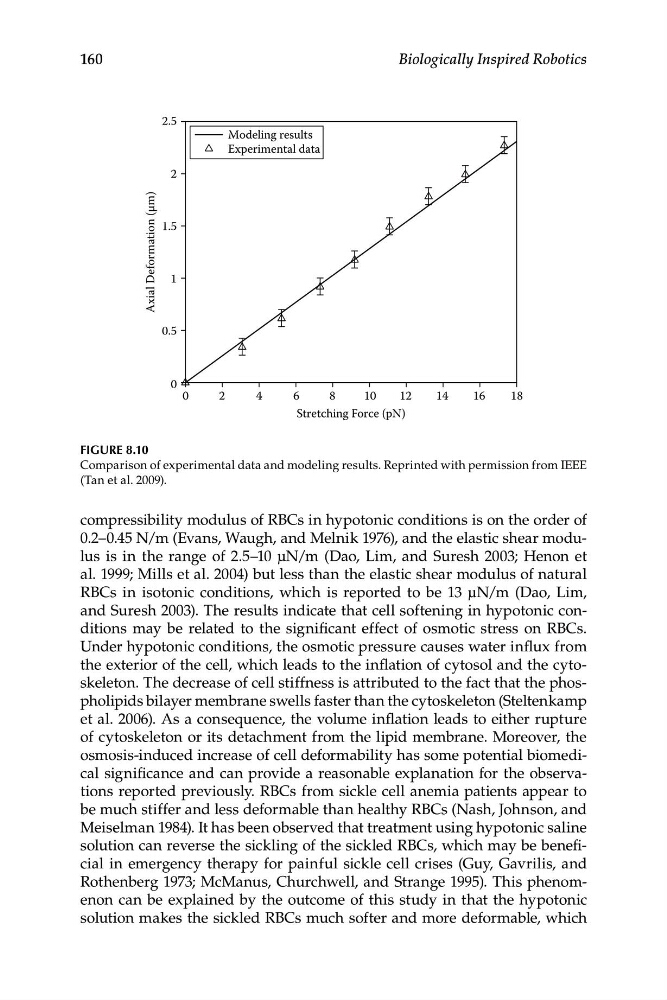
FIGURE 8.10
Comparison of experimental data and modeling results. Reprinted with permission from IEEE
(Tan et al. 2009).
compressibility modulus of RBCs in hypotonic conditions is on the order of
0.2–0.45 N/m (Evans, Waugh, and Melnik 1976), and the elastic shear modulus is in the range of 2.5–10 μN/m (Dao, Lim, and Suresh 2003; Henon et
al. 1999; Mills et al. 2004) but less than the elastic shear modulus of natural
RBCs in isotonic conditions, which is reported to be 13 μN/m (Dao, Lim,
and Suresh 2003). The results indicate that cell softening in hypotonic conditions may be related to the significant effect of osmotic stress on RBCs.
Under hypotonic conditions, the osmotic pressure causes water influx from
the exterior of the cell, which leads to the inflation of cytosol and the cytoskeleton. The decrease of cell stiffness is attributed to the fact that the phospholipids bilayer membrane swells faster than the cytoskeleton (Steltenkamp
et al. 2006). As a consequence, the volume inflation leads to either rupture
of cytoskeleton or its detachment from the lipid membrane. Moreover, the
osmosis-induced increase of cell deformability has some potential biomedical significance and can provide a reasonable explanation for the observations reported previously. RBCs from sickle cell anemia patients appear to
be much stiffer and less deformable than healthy RBCs (Nash, Johnson, and
Meiselman 1984). It has been observed that treatment using hypotonic saline
solution can reverse the sickling of the sickled RBCs, which may be beneficial in emergency therapy for painful sickle cell crises (Guy, Gavrilis, and
Rothenberg 1973; McManus, Churchwell, and Strange 1995). This phenomenon can be explained by the outcome of this study in that the hypotonic
solution makes the sickled RBCs much softer and more deformable, which
Modeling results
Experimental data
0
2
4
6
8
10
12
14
16
18
2
1.5
1
0.5
0
Stretching Force (pN)
Axial Deformation (μm)
160
Biologically Inspired Robotics
FIGURE 8.10
Comparison of experimental data and modeling results. Reprinted with permission from IEEE
(Tan et al. 2009).
compressibility modulus of RBCs in hypotonic conditions is on the order of
0.2–0.45 N/m (Evans, Waugh, and Melnik 1976), and the elastic shear modulus is in the range of 2.5–10 μN/m (Dao, Lim, and Suresh 2003; Henon et
al. 1999; Mills et al. 2004) but less than the elastic shear modulus of natural
RBCs in isotonic conditions, which is reported to be 13 μN/m (Dao, Lim,
and Suresh 2003). The results indicate that cell softening in hypotonic conditions may be related to the significant effect of osmotic stress on RBCs.
Under hypotonic conditions, the osmotic pressure causes water influx from
the exterior of the cell, which leads to the inflation of cytosol and the cytoskeleton. The decrease of cell stiffness is attributed to the fact that the phospholipids bilayer membrane swells faster than the cytoskeleton (Steltenkamp
et al. 2006). As a consequence, the volume inflation leads to either rupture
of cytoskeleton or its detachment from the lipid membrane. Moreover, the
osmosis-induced increase of cell deformability has some potential biomedical significance and can provide a reasonable explanation for the observations reported previously. RBCs from sickle cell anemia patients appear to
be much stiffer and less deformable than healthy RBCs (Nash, Johnson, and
Meiselman 1984). It has been observed that treatment using hypotonic saline
solution can reverse the sickling of the sickled RBCs, which may be beneficial in emergency therapy for painful sickle cell crises (Guy, Gavrilis, and
Rothenberg 1973; McManus, Churchwell, and Strange 1995). This phenomenon can be explained by the outcome of this study in that the hypotonic
solution makes the sickled RBCs much softer and more deformable, which