

110
Biologically Inspired Robotics
Cable-and-housing
group to the
robotic head
Electrical cable group
Steel box
Sound absorbing
material
Anti-vibration pad
Driving cable
Amplifier
Driving cable
with housing
Power supply
Motor & gearbox
Pulley
Electrical cable
Mounting plates
or supporting rod
Sealed hole
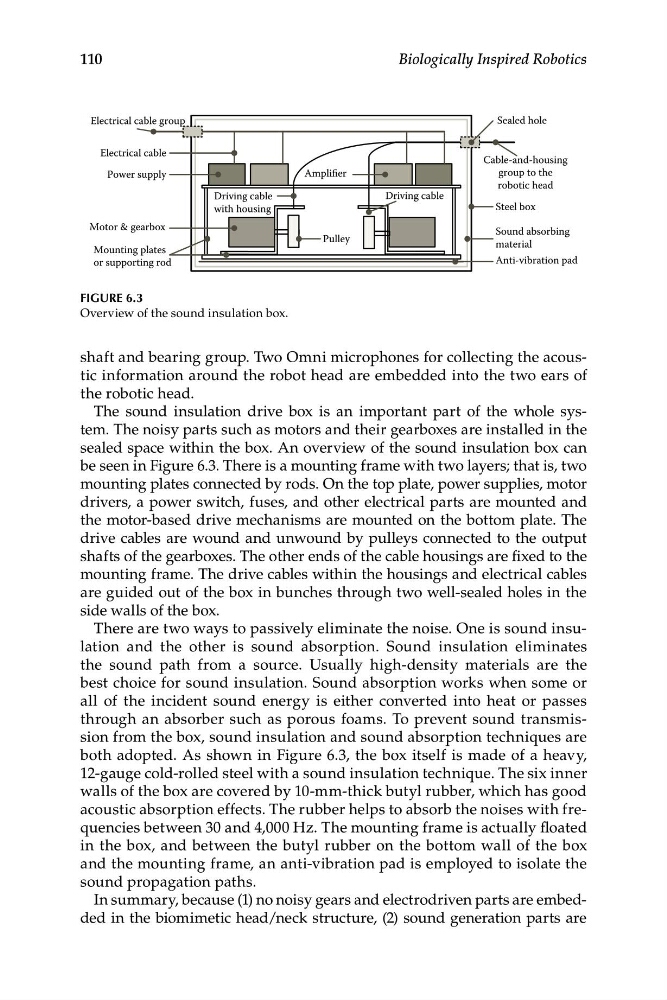
FIGURE 6.3
Overview of the sound insulation box.
shaft and bearing group. Two Omni microphones for collecting the acoustic information around the robot head are embedded into the two ears of
the robotic head.
The sound insulation drive box is an important part of the whole system. The noisy parts such as motors and their gearboxes are installed in the
sealed space within the box. An overview of the sound insulation box can
be seen in Figure 6.3. There is a mounting frame with two layers; that is, two
mounting plates connected by rods. On the top plate, power supplies, motor
drivers, a power switch, fuses, and other electrical parts are mounted and
the motor-based drive mechanisms are mounted on the bottom plate. The
drive cables are wound and unwound by pulleys connected to the output
shafts of the gearboxes. The other ends of the cable housings are fixed to the
mounting frame. The drive cables within the housings and electrical cables
are guided out of the box in bunches through two well-sealed holes in the
side walls of the box.
There are two ways to passively eliminate the noise. One is sound insulation and the other is sound absorption. Sound insulation eliminates
the sound path from a source. Usually high-density materials are the
best choice for sound insulation. Sound absorption works when some or
all of the incident sound energy is either converted into heat or passes
through an absorber such as porous foams. To prevent sound transmission from the box, sound insulation and sound absorption techniques are
both adopted. As shown in Figure 6.3, the box itself is made of a heavy,
12-gauge cold-rolled steel with a sound insulation technique. The six inner
walls of the box are covered by 10-mm-thick butyl rubber, which has good
acoustic absorption effects. The rubber helps to absorb the noises with frequencies between 30 and 4,000 Hz. The mounting frame is actually floated
in the box, and between the butyl rubber on the bottom wall of the box
and the mounting frame, an anti-vibration pad is employed to isolate the
sound propagation paths.
In summary, because (1) no noisy gears and electrodriven parts are embedded in the biomimetic head/neck structure, (2) sound generation parts are
Biologically Inspired Robotics
Cable-and-housing
group to the
robotic head
Electrical cable group
Steel box
Sound absorbing
material
Anti-vibration pad
Driving cable
Amplifier
Driving cable
with housing
Power supply
Motor & gearbox
Pulley
Electrical cable
Mounting plates
or supporting rod
Sealed hole
FIGURE 6.3
Overview of the sound insulation box.
shaft and bearing group. Two Omni microphones for collecting the acoustic information around the robot head are embedded into the two ears of
the robotic head.
The sound insulation drive box is an important part of the whole system. The noisy parts such as motors and their gearboxes are installed in the
sealed space within the box. An overview of the sound insulation box can
be seen in Figure 6.3. There is a mounting frame with two layers; that is, two
mounting plates connected by rods. On the top plate, power supplies, motor
drivers, a power switch, fuses, and other electrical parts are mounted and
the motor-based drive mechanisms are mounted on the bottom plate. The
drive cables are wound and unwound by pulleys connected to the output
shafts of the gearboxes. The other ends of the cable housings are fixed to the
mounting frame. The drive cables within the housings and electrical cables
are guided out of the box in bunches through two well-sealed holes in the
side walls of the box.
There are two ways to passively eliminate the noise. One is sound insulation and the other is sound absorption. Sound insulation eliminates
the sound path from a source. Usually high-density materials are the
best choice for sound insulation. Sound absorption works when some or
all of the incident sound energy is either converted into heat or passes
through an absorber such as porous foams. To prevent sound transmission from the box, sound insulation and sound absorption techniques are
both adopted. As shown in Figure 6.3, the box itself is made of a heavy,
12-gauge cold-rolled steel with a sound insulation technique. The six inner
walls of the box are covered by 10-mm-thick butyl rubber, which has good
acoustic absorption effects. The rubber helps to absorb the noises with frequencies between 30 and 4,000 Hz. The mounting frame is actually floated
in the box, and between the butyl rubber on the bottom wall of the box
and the mounting frame, an anti-vibration pad is employed to isolate the
sound propagation paths.
In summary, because (1) no noisy gears and electrodriven parts are embedded in the biomimetic head/neck structure, (2) sound generation parts are