

108
Biologically Inspired Robotics
Noisy parts
Cable-and-housing
group
Head
Electrical cable group
PCI-based
motion
controller
USB
USB-based I/O board
USB-based M-Audio
Acoustic signal
Neck status
USB cable
USB cable
PC
Sound insulation box
Robot body
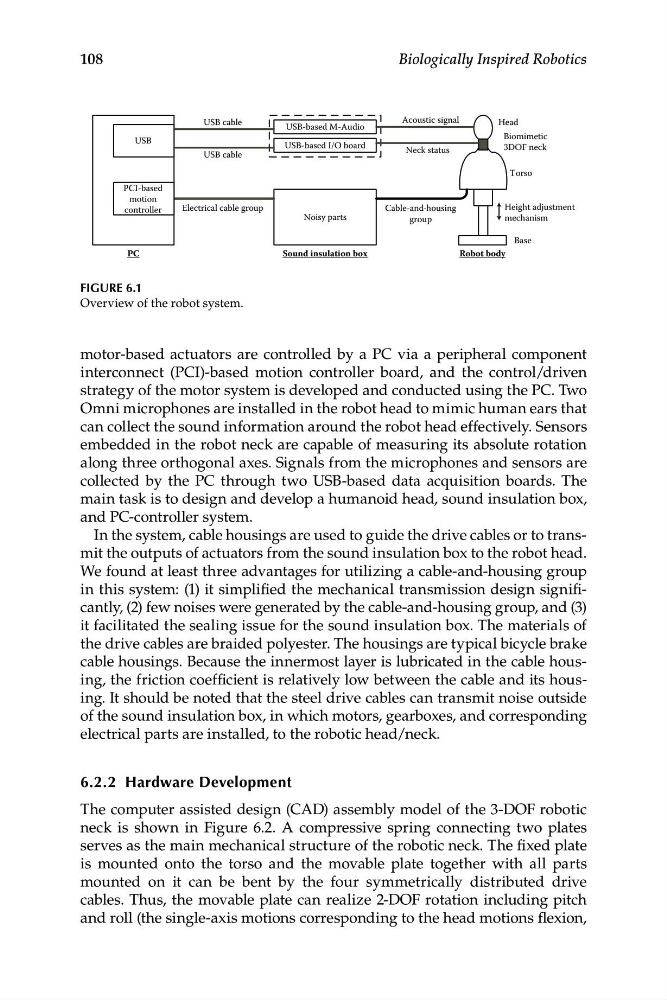
FIGURE 6.1
Overview of the robot system.
Biomimetic
3DOF neck
Torso
Height adjustment
mechanism
Base
motor-based actuators are controlled by a PC via a peripheral component
interconnect (PCI)-based motion controller board, and the control/driven
strategy of the motor system is developed and conducted using the PC. Two
Omni microphones are installed in the robot head to mimic human ears that
can collect the sound information around the robot head effectively. Sensors
embedded in the robot neck are capable of measuring its absolute rotation
along three orthogonal axes. Signals from the microphones and sensors are
collected by the PC through two USB-based data acquisition boards. The
main task is to design and develop a humanoid head, sound insulation box,
and PC-controller system.
In the system, cable housings are used to guide the drive cables or to transmit the outputs of actuators from the sound insulation box to the robot head.
We found at least three advantages for utilizing a cable-and-housing group
in this system: (1) it simplified the mechanical transmission design significantly, (2) few noises were generated by the cable-and-housing group, and (3)
it facilitated the sealing issue for the sound insulation box. The materials of
the drive cables are braided polyester. The housings are typical bicycle brake
cable housings. Because the innermost layer is lubricated in the cable housing, the friction coefficient is relatively low between the cable and its housing. It should be noted that the steel drive cables can transmit noise outside
of the sound insulation box, in which motors, gearboxes, and corresponding
electrical parts are installed, to the robotic head/neck.
6.2.2 Hardware Development
The computer assisted design (CAD) assembly model of the 3-DOF robotic
neck is shown in Figure 6.2. A compressive spring connecting two plates
serves as the main mechanical structure of the robotic neck. The fixed plate
is mounted onto the torso and the movable plate together with all parts
mounted on it can be bent by the four symmetrically distributed drive
cables. Thus, the movable plate can realize 2-DOF rotation including pitch
and roll (the single-axis motions corresponding to the head motions flexion,
Biologically Inspired Robotics
Noisy parts
Cable-and-housing
group
Head
Electrical cable group
PCI-based
motion
controller
USB
USB-based I/O board
USB-based M-Audio
Acoustic signal
Neck status
USB cable
USB cable
PC
Sound insulation box
Robot body
FIGURE 6.1
Overview of the robot system.
Biomimetic
3DOF neck
Torso
Height adjustment
mechanism
Base
motor-based actuators are controlled by a PC via a peripheral component
interconnect (PCI)-based motion controller board, and the control/driven
strategy of the motor system is developed and conducted using the PC. Two
Omni microphones are installed in the robot head to mimic human ears that
can collect the sound information around the robot head effectively. Sensors
embedded in the robot neck are capable of measuring its absolute rotation
along three orthogonal axes. Signals from the microphones and sensors are
collected by the PC through two USB-based data acquisition boards. The
main task is to design and develop a humanoid head, sound insulation box,
and PC-controller system.
In the system, cable housings are used to guide the drive cables or to transmit the outputs of actuators from the sound insulation box to the robot head.
We found at least three advantages for utilizing a cable-and-housing group
in this system: (1) it simplified the mechanical transmission design significantly, (2) few noises were generated by the cable-and-housing group, and (3)
it facilitated the sealing issue for the sound insulation box. The materials of
the drive cables are braided polyester. The housings are typical bicycle brake
cable housings. Because the innermost layer is lubricated in the cable housing, the friction coefficient is relatively low between the cable and its housing. It should be noted that the steel drive cables can transmit noise outside
of the sound insulation box, in which motors, gearboxes, and corresponding
electrical parts are installed, to the robotic head/neck.
6.2.2 Hardware Development
The computer assisted design (CAD) assembly model of the 3-DOF robotic
neck is shown in Figure 6.2. A compressive spring connecting two plates
serves as the main mechanical structure of the robotic neck. The fixed plate
is mounted onto the torso and the movable plate together with all parts
mounted on it can be bent by the four symmetrically distributed drive
cables. Thus, the movable plate can realize 2-DOF rotation including pitch
and roll (the single-axis motions corresponding to the head motions flexion,