

97
A School of Robotic Fish for Pollution Detection in Port
Download Code
RS485
RS485
Sonar comm.
module
RS232
RS232
RS232
12C bus
Almodule
Hydrodynamics
Gumstix LINUX PC 600 MHz
Gumstix LINUX PC 600 MHz
Download
code
Chemical
sensors
Robotic fish
controller
PIC18lf252
Navigation
sensors
Sensor node
IR x4
Servo x3
DC motor x2
Gy ro/accelerometer
pressure, etc
PIC18lf252
PIC18lf252
PIC18lf252
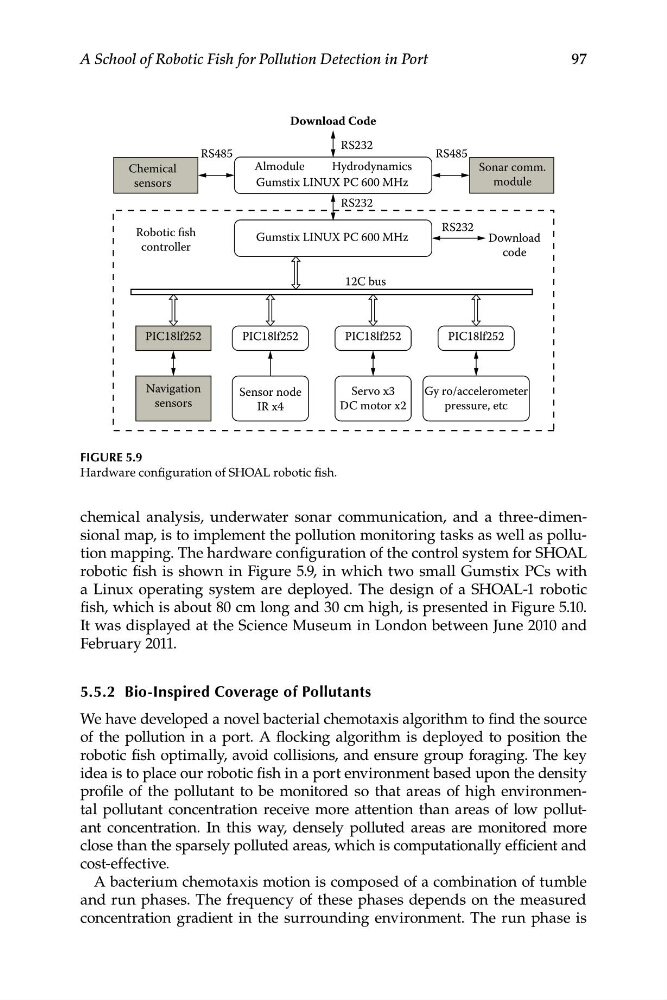
FIGURE 5.9
Hardware configuration of SHOAL robotic fish.
chemical analysis, underwater sonar communication, and a three-dimensional map, is to implement the pollution monitoring tasks as well as pollution mapping. The hardware configuration of the control system for SHOAL
robotic fish is shown in Figure 5.9, in which two small Gumstix PCs with
a Linux operating system are deployed. The design of a SHOAL-1 robotic
fish, which is about 80 cm long and 30 cm high, is presented in Figure 5.10.
It was displayed at the Science Museum in London between June 2010 and
February 2011.
5.5.2 Bio-Inspired Coverage of Pollutants
We have developed a novel bacterial chemotaxis algorithm to find the source
of the pollution in a port. A flocking algorithm is deployed to position the
robotic fish optimally, avoid collisions, and ensure group foraging. The key
idea is to place our robotic fish in a port environment based upon the density
profile of the pollutant to be monitored so that areas of high environmental pollutant concentration receive more attention than areas of low pollutant concentration. In this way, densely polluted areas are monitored more
close than the sparsely polluted areas, which is computationally efficient and
cost-effective.
A bacterium chemotaxis motion is composed of a combination of tumble
and run phases. The frequency of these phases depends on the measured
concentration gradient in the surrounding environment. The run phase is
A School of Robotic Fish for Pollution Detection in Port
Download Code
RS485
RS485
Sonar comm.
module
RS232
RS232
RS232
12C bus
Almodule
Hydrodynamics
Gumstix LINUX PC 600 MHz
Gumstix LINUX PC 600 MHz
Download
code
Chemical
sensors
Robotic fish
controller
PIC18lf252
Navigation
sensors
Sensor node
IR x4
Servo x3
DC motor x2
Gy ro/accelerometer
pressure, etc
PIC18lf252
PIC18lf252
PIC18lf252
FIGURE 5.9
Hardware configuration of SHOAL robotic fish.
chemical analysis, underwater sonar communication, and a three-dimensional map, is to implement the pollution monitoring tasks as well as pollution mapping. The hardware configuration of the control system for SHOAL
robotic fish is shown in Figure 5.9, in which two small Gumstix PCs with
a Linux operating system are deployed. The design of a SHOAL-1 robotic
fish, which is about 80 cm long and 30 cm high, is presented in Figure 5.10.
It was displayed at the Science Museum in London between June 2010 and
February 2011.
5.5.2 Bio-Inspired Coverage of Pollutants
We have developed a novel bacterial chemotaxis algorithm to find the source
of the pollution in a port. A flocking algorithm is deployed to position the
robotic fish optimally, avoid collisions, and ensure group foraging. The key
idea is to place our robotic fish in a port environment based upon the density
profile of the pollutant to be monitored so that areas of high environmental pollutant concentration receive more attention than areas of low pollutant concentration. In this way, densely polluted areas are monitored more
close than the sparsely polluted areas, which is computationally efficient and
cost-effective.
A bacterium chemotaxis motion is composed of a combination of tumble
and run phases. The frequency of these phases depends on the measured
concentration gradient in the surrounding environment. The run phase is