

95
A School of Robotic Fish for Pollution Detection in Port
⎧ ⎪
min(cy , cy ⋅ e
− k t
( − t 1 )
0
1
)
t ∈ ⎣ ⎡ t , t
Cy( )
t
)
= ⎨
0 1
⎪ (
⎩ cy 1 − cy c 2 )(t − t 2 ) ( t 1 − t 2 ) + cy 2
t ∈⎡ ⎣ t 1 , t 2 ⎤ ⎦
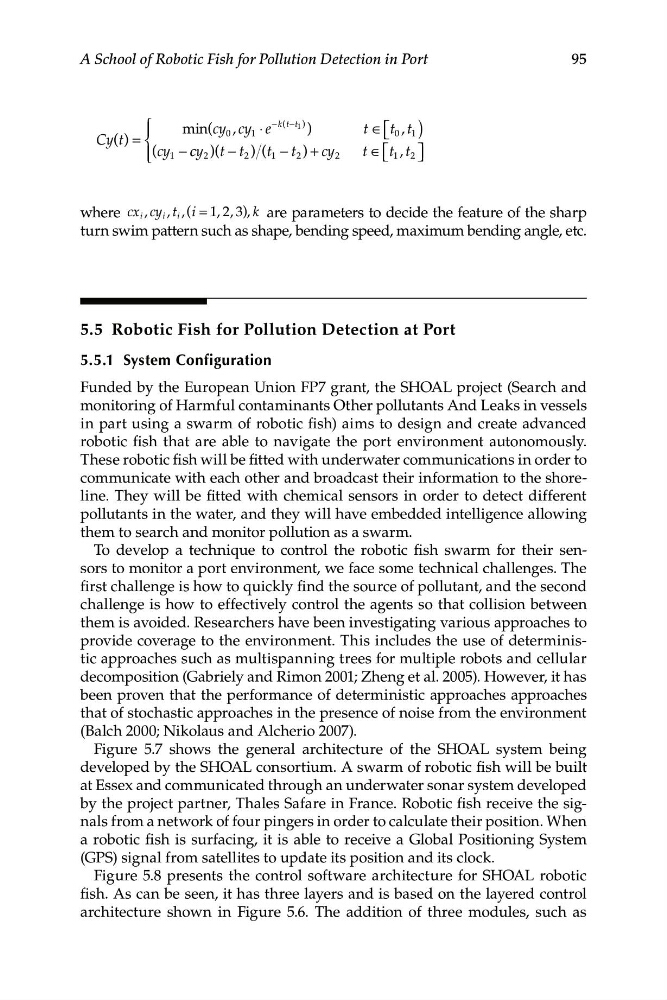
where cx i , cy i ,t i ,(i = 1 2 3
, , ),k are parameters to decide the feature of the sharp
turn swim pattern such as shape, bending speed, maximum bending angle, etc.
5.5 Robotic Fish for Pollution Detection at Port
5.5.1 System Configuration
Funded by the European Union FP7 grant, the SHOAL project (Search and
monitoring of Harmful contaminants Other pollutants And Leaks in vessels
in part using a swarm of robotic fish) aims to design and create advanced
robotic fish that are able to navigate the port environment autonomously.
These robotic fish will be fitted with underwater communications in order to
communicate with each other and broadcast their information to the shoreline. They will be fitted with chemical sensors in order to detect different
pollutants in the water, and they will have embedded intelligence allowing
them to search and monitor pollution as a swarm.
To develop a technique to control the robotic fish swarm for their sensors to monitor a port environment, we face some technical challenges. The
first challenge is how to quickly find the source of pollutant, and the second
challenge is how to effectively control the agents so that collision between
them is avoided. Researchers have been investigating various approaches to
provide coverage to the environment. This includes the use of deterministic approaches such as multispanning trees for multiple robots and cellular
decomposition (Gabriely and Rimon 2001; Zheng et al. 2005). However, it has
been proven that the performance of deterministic approaches approaches
that of stochastic approaches in the presence of noise from the environment
(Balch 2000; Nikolaus and Alcherio 2007).
Figure 5.7 shows the general architecture of the SHOAL system being
developed by the SHOAL consortium. A swarm of robotic fish will be built
at Essex and communicated through an underwater sonar system developed
by the project partner, Thales Safare in France. Robotic fish receive the signals from a network of four pingers in order to calculate their position. When
a robotic fish is surfacing, it is able to receive a Global Positioning System
(GPS) signal from satellites to update its position and its clock.
Figure 5.8 presents the control software architecture for SHOAL robotic
fish. As can be seen, it has three layers and is based on the layered control
architecture shown in Figure 5.6. The addition of three modules, such as
A School of Robotic Fish for Pollution Detection in Port
⎧ ⎪
min(cy , cy ⋅ e
− k t
( − t 1 )
0
1
)
t ∈ ⎣ ⎡ t , t
Cy( )
t
)
= ⎨
0 1
⎪ (
⎩ cy 1 − cy c 2 )(t − t 2 ) ( t 1 − t 2 ) + cy 2
t ∈⎡ ⎣ t 1 , t 2 ⎤ ⎦
where cx i , cy i ,t i ,(i = 1 2 3
, , ),k are parameters to decide the feature of the sharp
turn swim pattern such as shape, bending speed, maximum bending angle, etc.
5.5 Robotic Fish for Pollution Detection at Port
5.5.1 System Configuration
Funded by the European Union FP7 grant, the SHOAL project (Search and
monitoring of Harmful contaminants Other pollutants And Leaks in vessels
in part using a swarm of robotic fish) aims to design and create advanced
robotic fish that are able to navigate the port environment autonomously.
These robotic fish will be fitted with underwater communications in order to
communicate with each other and broadcast their information to the shoreline. They will be fitted with chemical sensors in order to detect different
pollutants in the water, and they will have embedded intelligence allowing
them to search and monitor pollution as a swarm.
To develop a technique to control the robotic fish swarm for their sensors to monitor a port environment, we face some technical challenges. The
first challenge is how to quickly find the source of pollutant, and the second
challenge is how to effectively control the agents so that collision between
them is avoided. Researchers have been investigating various approaches to
provide coverage to the environment. This includes the use of deterministic approaches such as multispanning trees for multiple robots and cellular
decomposition (Gabriely and Rimon 2001; Zheng et al. 2005). However, it has
been proven that the performance of deterministic approaches approaches
that of stochastic approaches in the presence of noise from the environment
(Balch 2000; Nikolaus and Alcherio 2007).
Figure 5.7 shows the general architecture of the SHOAL system being
developed by the SHOAL consortium. A swarm of robotic fish will be built
at Essex and communicated through an underwater sonar system developed
by the project partner, Thales Safare in France. Robotic fish receive the signals from a network of four pingers in order to calculate their position. When
a robotic fish is surfacing, it is able to receive a Global Positioning System
(GPS) signal from satellites to update its position and its clock.
Figure 5.8 presents the control software architecture for SHOAL robotic
fish. As can be seen, it has three layers and is based on the layered control
architecture shown in Figure 5.6. The addition of three modules, such as