

94
Biologically Inspired Robotics
3. Burst: The fish shows sudden straight acceleration; that is, cyclic fast
undulation. The burst-and-coast swim pattern is commonly used in
fish life for energy savings expected up to 50%.
4. Sharp turn: Generates a sudden angular acceleration for avoiding predators or obstacles, including two types: C-shaped and S-shaped.
5. Brake: The fish generates a sudden straight deceleration by its special
tail motion, usually in combination with pectoral and pelvic fins.
6. Coast: A kind of motion in which the fish body is kept motionless
and straight.
7. Ascend–descend: A kind of motion in which a robotic fish can change
its depth in water.
A detailed description of these swimming patterns can be found in Hu et al.
(2006). Here we only explain two swimming patterns for simplicity.
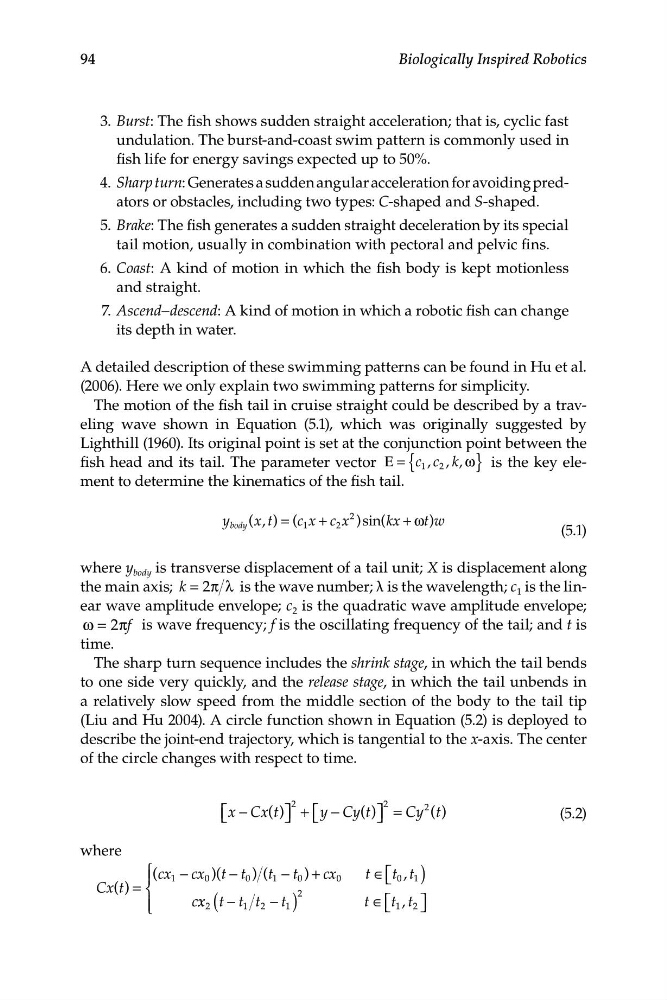
The motion of the fish tail in cruise straight could be described by a traveling wave shown in Equation (5.1), which was originally suggested by
Lighthill (1960). Its original point is set at the conjunction point between the
fish head and its tail. The parameter vector Ε = { c c
1 , ,
2 k ,ω } is the key element to determine the kinematics of the fish tail.
y
2
body ( ,
x t) = ( c 1 x+ c 2 x )sin ( kx+ ωt )w
(5.1)
where y body is transverse displacement of a tail unit; X is displacement along
the main axis; N = π λ is the wave number; λ is the wavelength; c 1 is the linear wave amplitude envelope; c 2 is the quadratic wave amplitude envelope;
ω = πI is wave frequency; f is the oscillating frequency of the tail; and t is
time.
The sharp turn sequence includes the shrink stage, in which the tail bends
to one side very quickly, and the release stage, in which the tail unbends in
a relatively slow speed from the middle section of the body to the tail tip
(Liu and Hu 2004). A circle function shown in Equation (5.2) is deployed to
describe the joint-end trajectory, which is tangential to the x-axis. The center
of the circle changes with respect to time.
⎡ −
2
2
⎣ x C x( )
t ⎤ ⎦ + ⎡ ⎣ y C
− y( )
t ⎦ ⎤ = Cy
2 ( )
t
(5.2)
where
⎧ ⎪ (cx 1 − cx 0 ) ( t − t 0 )( t 1 − t 0 ) + cx 0
t ∈⎡ ⎣ t 0 , t 1 )
Cx( )
t = ⎨
cx x t −
2
⎪
2 ( t 1
t 2 − t 1 )
t ∈ ⎣ ⎡t 1 , t
⎩
2 ⎦ ⎤
Biologically Inspired Robotics
3. Burst: The fish shows sudden straight acceleration; that is, cyclic fast
undulation. The burst-and-coast swim pattern is commonly used in
fish life for energy savings expected up to 50%.
4. Sharp turn: Generates a sudden angular acceleration for avoiding predators or obstacles, including two types: C-shaped and S-shaped.
5. Brake: The fish generates a sudden straight deceleration by its special
tail motion, usually in combination with pectoral and pelvic fins.
6. Coast: A kind of motion in which the fish body is kept motionless
and straight.
7. Ascend–descend: A kind of motion in which a robotic fish can change
its depth in water.
A detailed description of these swimming patterns can be found in Hu et al.
(2006). Here we only explain two swimming patterns for simplicity.
The motion of the fish tail in cruise straight could be described by a traveling wave shown in Equation (5.1), which was originally suggested by
Lighthill (1960). Its original point is set at the conjunction point between the
fish head and its tail. The parameter vector Ε = { c c
1 , ,
2 k ,ω } is the key element to determine the kinematics of the fish tail.
y
2
body ( ,
x t) = ( c 1 x+ c 2 x )sin ( kx+ ωt )w
(5.1)
where y body is transverse displacement of a tail unit; X is displacement along
the main axis; N = π λ is the wave number; λ is the wavelength; c 1 is the linear wave amplitude envelope; c 2 is the quadratic wave amplitude envelope;
ω = πI is wave frequency; f is the oscillating frequency of the tail; and t is
time.
The sharp turn sequence includes the shrink stage, in which the tail bends
to one side very quickly, and the release stage, in which the tail unbends in
a relatively slow speed from the middle section of the body to the tail tip
(Liu and Hu 2004). A circle function shown in Equation (5.2) is deployed to
describe the joint-end trajectory, which is tangential to the x-axis. The center
of the circle changes with respect to time.
⎡ −
2
2
⎣ x C x( )
t ⎤ ⎦ + ⎡ ⎣ y C
− y( )
t ⎦ ⎤ = Cy
2 ( )
t
(5.2)
where
⎧ ⎪ (cx 1 − cx 0 ) ( t − t 0 )( t 1 − t 0 ) + cx 0
t ∈⎡ ⎣ t 0 , t 1 )
Cx( )
t = ⎨
cx x t −
2
⎪
2 ( t 1
t 2 − t 1 )
t ∈ ⎣ ⎡t 1 , t
⎩
2 ⎦ ⎤