

88
Biologically Inspired Robotics
(e)
Undulatory
Anguilliform
Subcarangiform
Thunniform
Carangiform
Ostraciiform
Oscillatory
(a)
(b)
(c)
(d)
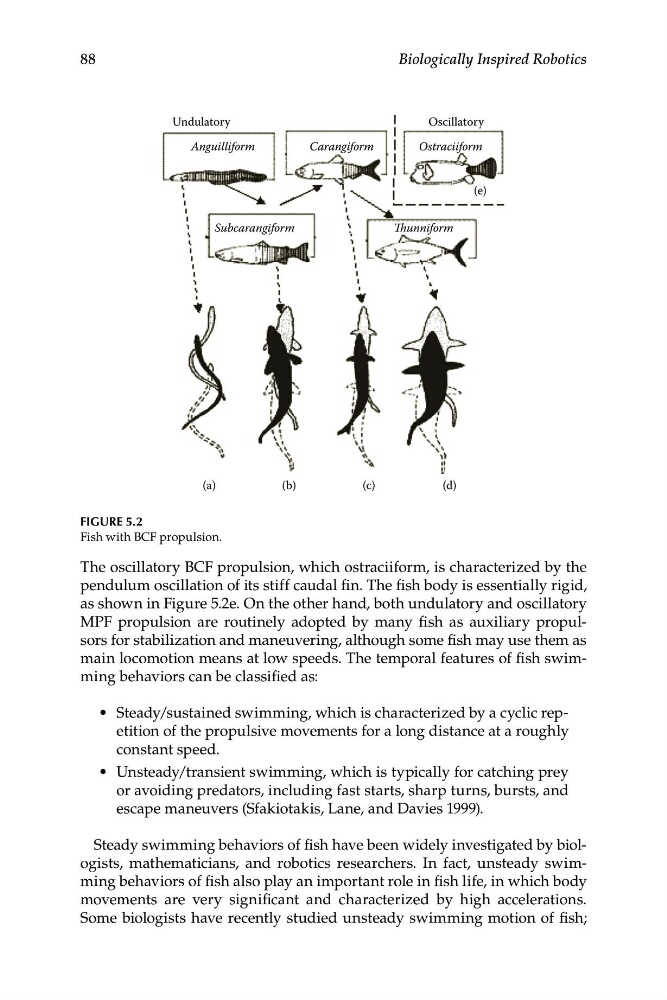
FIGURE 5.2
Fish with BCF propulsion.
The oscillatory BCF propulsion, which ostraciiform, is characterized by the
pendulum oscillation of its stiff caudal fin. The fish body is essentially rigid,
as shown in Figure 5.2e. On the other hand, both undulatory and oscillatory
MPF propulsion are routinely adopted by many fish as auxiliary propulsors for stabilization and maneuvering, although some fish may use them as
main locomotion means at low speeds. The temporal features of fish swimming behaviors can be classified as:
• Steady/sustained swimming, which is characterized by a cyclic repetition of the propulsive movements for a long distance at a roughly
constant speed.
• Unsteady/transient swimming, which is typically for catching prey
or avoiding predators, including fast starts, sharp turns, bursts, and
escape maneuvers (Sfakiotakis, Lane, and Davies 1999).
Steady swimming behaviors of fish have been widely investigated by biologists, mathematicians, and robotics researchers. In fact, unsteady swimming behaviors of fish also play an important role in fish life, in which body
movements are very significant and characterized by high accelerations.
Some biologists have recently studied unsteady swimming motion of fish;
Biologically Inspired Robotics
(e)
Undulatory
Anguilliform
Subcarangiform
Thunniform
Carangiform
Ostraciiform
Oscillatory
(a)
(b)
(c)
(d)
FIGURE 5.2
Fish with BCF propulsion.
The oscillatory BCF propulsion, which ostraciiform, is characterized by the
pendulum oscillation of its stiff caudal fin. The fish body is essentially rigid,
as shown in Figure 5.2e. On the other hand, both undulatory and oscillatory
MPF propulsion are routinely adopted by many fish as auxiliary propulsors for stabilization and maneuvering, although some fish may use them as
main locomotion means at low speeds. The temporal features of fish swimming behaviors can be classified as:
• Steady/sustained swimming, which is characterized by a cyclic repetition of the propulsive movements for a long distance at a roughly
constant speed.
• Unsteady/transient swimming, which is typically for catching prey
or avoiding predators, including fast starts, sharp turns, bursts, and
escape maneuvers (Sfakiotakis, Lane, and Davies 1999).
Steady swimming behaviors of fish have been widely investigated by biologists, mathematicians, and robotics researchers. In fact, unsteady swimming behaviors of fish also play an important role in fish life, in which body
movements are very significant and characterized by high accelerations.
Some biologists have recently studied unsteady swimming motion of fish;