

87
A School of Robotic Fish for Pollution Detection in Port
layered control architecture for the realization of fish swim behaviors in our
robotic fish. Section 5.5 presents a brief introduction of our robotic fish used
in pollution detection. Finally, a brief summary is presented in Section 5.6.
5.2 Inspired from Nature
Today, biological fish exhibit a large variety of swimming behaviors that are
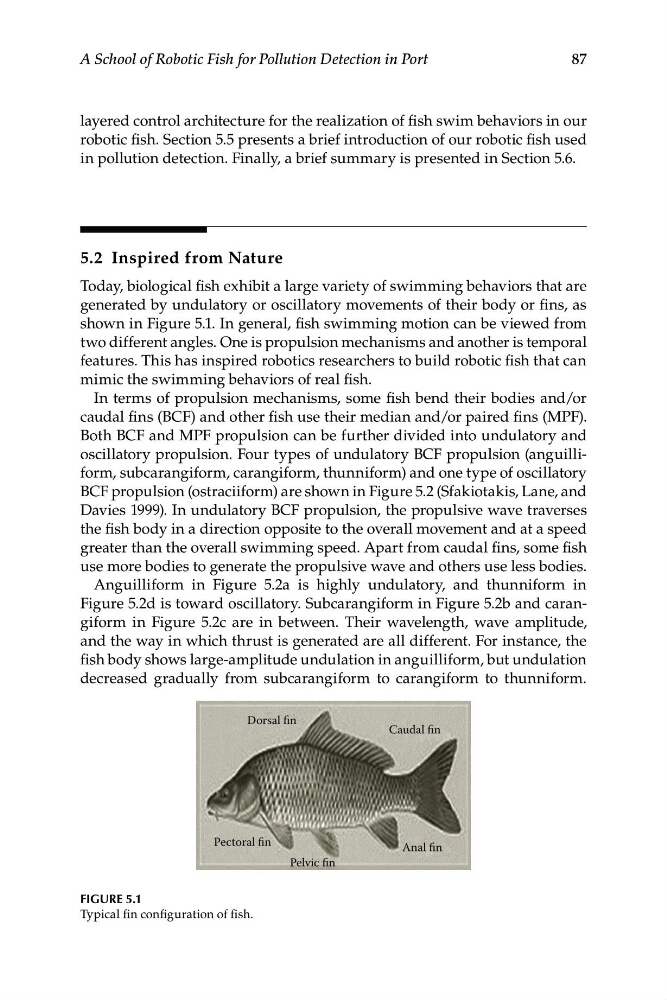
generated by undulatory or oscillatory movements of their body or fins, as
shown in Figure 5.1. In general, fish swimming motion can be viewed from
two different angles. One is propulsion mechanisms and another is temporal
features. This has inspired robotics researchers to build robotic fish that can
mimic the swimming behaviors of real fish.
In terms of propulsion mechanisms, some fish bend their bodies and/or
caudal fins (BCF) and other fish use their median and/or paired fins (MPF).
Both BCF and MPF propulsion can be further divided into undulatory and
oscillatory propulsion. Four types of undulatory BCF propulsion (anguilliform, subcarangiform, carangiform, thunniform) and one type of oscillatory
BCF propulsion (ostraciiform) are shown in Figure 5.2 (Sfakiotakis, Lane, and
Davies 1999). In undulatory BCF propulsion, the propulsive wave traverses
the fish body in a direction opposite to the overall movement and at a speed
greater than the overall swimming speed. Apart from caudal fins, some fish
use more bodies to generate the propulsive wave and others use less bodies.
Anguilliform in Figure 5.2a is highly undulatory, and thunniform in
Figure 5.2d is toward oscillatory. Subcarangiform in Figure 5.2b and carangiform in Figure 5.2c are in between. Their wavelength, wave amplitude,
and the way in which thrust is generated are all different. For instance, the
fish body shows large-amplitude undulation in anguilliform, but undulation
decreased gradually from subcarangiform to carangiform to thunniform.
Dorsal fin
Caudal fin
Pectoral fin
Anal fin
Pelvic fin
FIGURE 5.1
Typical fin configuration of fish.