

54
3 Confinement Effects on the Reactivity in Ultrathin …
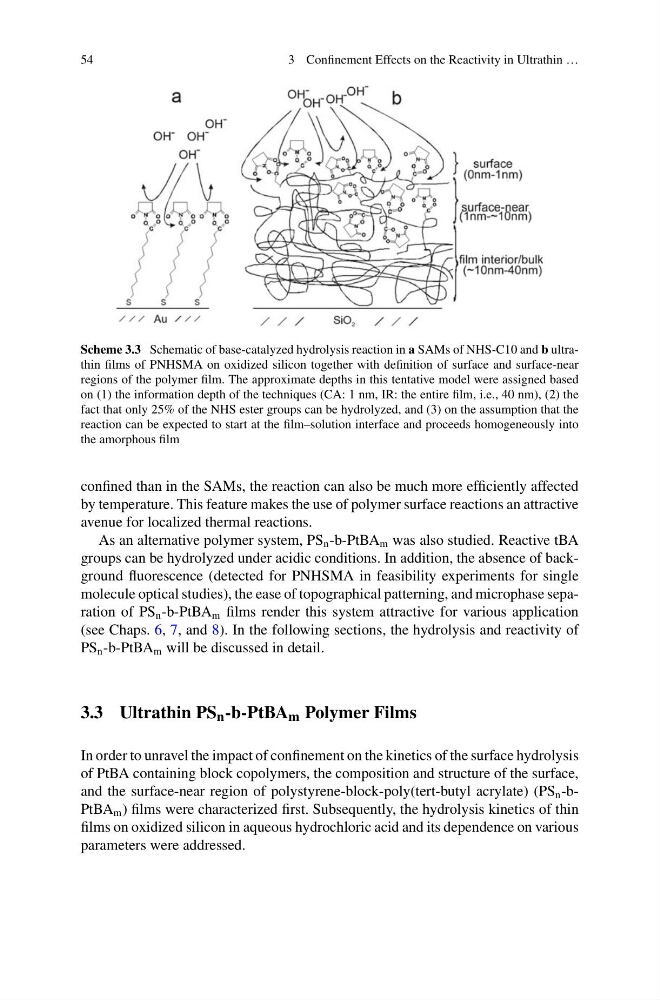
Scheme 3.3 Schematic of base-catalyzed hydrolysis reaction in a SAMs of NHS-C10 and b ultrathin films of PNHSMA on oxidized silicon together with definition of surface and surface-near
regions of the polymer film. The approximate depths in this tentative model were assigned based
on (1) the information depth of the techniques (CA: 1 nm, IR: the entire film, i.e., 40 nm), (2) the
fact that only 25% of the NHS ester groups can be hydrolyzed, and (3) on the assumption that the
reaction can be expected to start at the film–solution interface and proceeds homogeneously into
the amorphous film
confined than in the SAMs, the reaction can also be much more efficiently affected
by temperature. This feature makes the use of polymer surface reactions an attractive
avenue for localized thermal reactions.
As an alternative polymer system, PS n -b-PtBA m was also studied. Reactive tBA
groups can be hydrolyzed under acidic conditions. In addition, the absence of background fluorescence (detected for PNHSMA in feasibility experiments for single
molecule optical studies), the ease of topographical patterning, and microphase separation of PS n -b-PtBA m films render this system attractive for various application
(see Chaps. 6, 7, and 8). In the following sections, the hydrolysis and reactivity of
PS n -b-PtBA m will be discussed in detail.
3.3 Ultrathin PS n -b-PtBA m Polymer Films
In order to unravel the impact of confinement on the kinetics of the surface hydrolysis
of PtBA containing block copolymers, the composition and structure of the surface,
and the surface-near region of polystyrene-block-poly(tert-butyl acrylate) (PS n -bPtBA m ) films were characterized first. Subsequently, the hydrolysis kinetics of thin
films on oxidized silicon in aqueous hydrochloric acid and its dependence on various
parameters were addressed.
3 Confinement Effects on the Reactivity in Ultrathin …
Scheme 3.3 Schematic of base-catalyzed hydrolysis reaction in a SAMs of NHS-C10 and b ultrathin films of PNHSMA on oxidized silicon together with definition of surface and surface-near
regions of the polymer film. The approximate depths in this tentative model were assigned based
on (1) the information depth of the techniques (CA: 1 nm, IR: the entire film, i.e., 40 nm), (2) the
fact that only 25% of the NHS ester groups can be hydrolyzed, and (3) on the assumption that the
reaction can be expected to start at the film–solution interface and proceeds homogeneously into
the amorphous film
confined than in the SAMs, the reaction can also be much more efficiently affected
by temperature. This feature makes the use of polymer surface reactions an attractive
avenue for localized thermal reactions.
As an alternative polymer system, PS n -b-PtBA m was also studied. Reactive tBA
groups can be hydrolyzed under acidic conditions. In addition, the absence of background fluorescence (detected for PNHSMA in feasibility experiments for single
molecule optical studies), the ease of topographical patterning, and microphase separation of PS n -b-PtBA m films render this system attractive for various application
(see Chaps. 6, 7, and 8). In the following sections, the hydrolysis and reactivity of
PS n -b-PtBA m will be discussed in detail.
3.3 Ultrathin PS n -b-PtBA m Polymer Films
In order to unravel the impact of confinement on the kinetics of the surface hydrolysis
of PtBA containing block copolymers, the composition and structure of the surface,
and the surface-near region of polystyrene-block-poly(tert-butyl acrylate) (PS n -bPtBA m ) films were characterized first. Subsequently, the hydrolysis kinetics of thin
films on oxidized silicon in aqueous hydrochloric acid and its dependence on various
parameters were addressed.