

3.2 Ultrathin PNHSMA Polymer Films
53
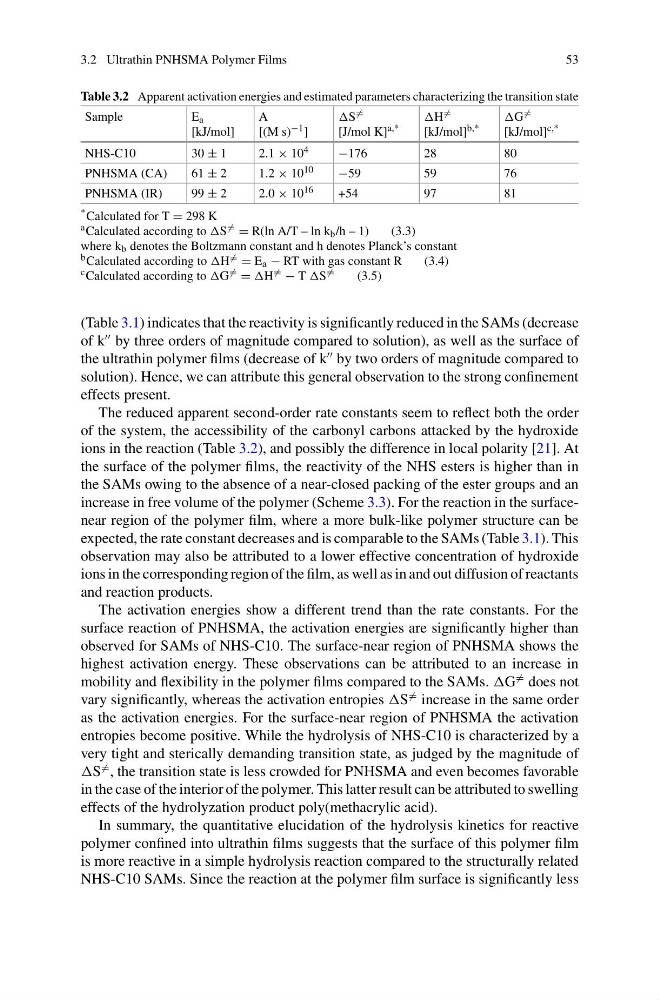
Table 3.2 Apparent activation energies and estimated parameters characterizing the transition state
Sample
E a
[kJ/mol]
A
[(M s) −1 ]
S =
[J/mol K] a,*
H =
[kJ/mol] b,*
G =
[kJ/mol] c,*
NHS-C10
30 ± 1
2.1 × 10 4
−176
28
80
PNHSMA (CA)
61 ± 2
1.2 × 10 10
−59
59
76
PNHSMA (IR)
99 ± 2
2.0 × 10 16
+54
97
81
* Calculated for T = 298 K
a Calculated according to S = = R(ln A/T – ln k b /h – 1)
(3.3)
where k b denotes the Boltzmann constant and h denotes Planck’s constant
b Calculated according to H = = E a − RT with gas constant R
(3.4)
c Calculated according to G = = H = − T S =
(3.5)
(Table 3.1) indicates that the reactivity is significantly reduced in the SAMs (decrease
of k
by three orders of magnitude compared to solution), as well as the surface of
the ultrathin polymer films (decrease of k
by two orders of magnitude compared to
solution). Hence, we can attribute this general observation to the strong confinement
effects present.
The reduced apparent second-order rate constants seem to reflect both the order
of the system, the accessibility of the carbonyl carbons attacked by the hydroxide
ions in the reaction (Table 3.2), and possibly the difference in local polarity [21]. At
the surface of the polymer films, the reactivity of the NHS esters is higher than in
the SAMs owing to the absence of a near-closed packing of the ester groups and an
increase in free volume of the polymer (Scheme 3.3). For the reaction in the surfacenear region of the polymer film, where a more bulk-like polymer structure can be
expected, the rate constant decreases and is comparable to the SAMs (Table 3.1). This
observation may also be attributed to a lower effective concentration of hydroxide
ions in the corresponding region of the film, as well as in and out diffusion of reactants
and reaction products.
The activation energies show a different trend than the rate constants. For the
surface reaction of PNHSMA, the activation energies are significantly higher than
observed for SAMs of NHS-C10. The surface-near region of PNHSMA shows the
highest activation energy. These observations can be attributed to an increase in
mobility and flexibility in the polymer films compared to the SAMs. G
= does not
vary significantly, whereas the activation entropies S
= increase in the same order
as the activation energies. For the surface-near region of PNHSMA the activation
entropies become positive. While the hydrolysis of NHS-C10 is characterized by a
very tight and sterically demanding transition state, as judged by the magnitude of
S
= , the transition state is less crowded for PNHSMA and even becomes favorable
in the case of the interior of the polymer. This latter result can be attributed to swelling
effects of the hydrolyzation product poly(methacrylic acid).
In summary, the quantitative elucidation of the hydrolysis kinetics for reactive
polymer confined into ultrathin films suggests that the surface of this polymer film
is more reactive in a simple hydrolysis reaction compared to the structurally related
NHS-C10 SAMs. Since the reaction at the polymer film surface is significantly less
53
Table 3.2 Apparent activation energies and estimated parameters characterizing the transition state
Sample
E a
[kJ/mol]
A
[(M s) −1 ]
S =
[J/mol K] a,*
H =
[kJ/mol] b,*
G =
[kJ/mol] c,*
NHS-C10
30 ± 1
2.1 × 10 4
−176
28
80
PNHSMA (CA)
61 ± 2
1.2 × 10 10
−59
59
76
PNHSMA (IR)
99 ± 2
2.0 × 10 16
+54
97
81
* Calculated for T = 298 K
a Calculated according to S = = R(ln A/T – ln k b /h – 1)
(3.3)
where k b denotes the Boltzmann constant and h denotes Planck’s constant
b Calculated according to H = = E a − RT with gas constant R
(3.4)
c Calculated according to G = = H = − T S =
(3.5)
(Table 3.1) indicates that the reactivity is significantly reduced in the SAMs (decrease
of k
by three orders of magnitude compared to solution), as well as the surface of
the ultrathin polymer films (decrease of k
by two orders of magnitude compared to
solution). Hence, we can attribute this general observation to the strong confinement
effects present.
The reduced apparent second-order rate constants seem to reflect both the order
of the system, the accessibility of the carbonyl carbons attacked by the hydroxide
ions in the reaction (Table 3.2), and possibly the difference in local polarity [21]. At
the surface of the polymer films, the reactivity of the NHS esters is higher than in
the SAMs owing to the absence of a near-closed packing of the ester groups and an
increase in free volume of the polymer (Scheme 3.3). For the reaction in the surfacenear region of the polymer film, where a more bulk-like polymer structure can be
expected, the rate constant decreases and is comparable to the SAMs (Table 3.1). This
observation may also be attributed to a lower effective concentration of hydroxide
ions in the corresponding region of the film, as well as in and out diffusion of reactants
and reaction products.
The activation energies show a different trend than the rate constants. For the
surface reaction of PNHSMA, the activation energies are significantly higher than
observed for SAMs of NHS-C10. The surface-near region of PNHSMA shows the
highest activation energy. These observations can be attributed to an increase in
mobility and flexibility in the polymer films compared to the SAMs. G
= does not
vary significantly, whereas the activation entropies S
= increase in the same order
as the activation energies. For the surface-near region of PNHSMA the activation
entropies become positive. While the hydrolysis of NHS-C10 is characterized by a
very tight and sterically demanding transition state, as judged by the magnitude of
S
= , the transition state is less crowded for PNHSMA and even becomes favorable
in the case of the interior of the polymer. This latter result can be attributed to swelling
effects of the hydrolyzation product poly(methacrylic acid).
In summary, the quantitative elucidation of the hydrolysis kinetics for reactive
polymer confined into ultrathin films suggests that the surface of this polymer film
is more reactive in a simple hydrolysis reaction compared to the structurally related
NHS-C10 SAMs. Since the reaction at the polymer film surface is significantly less