

3.2 Ultrathin PNHSMA Polymer Films
47
3.2 Ultrathin PNHSMA Polymer Films
Firstly, the reaction kinetics of the hydrolysis of NHS ester groups in PNHSMA films
was studied as a function of temperature. The analysis was mainly performed by IR
and CA and yielded apparent rate constants and activation energies.
3.2.1 Characterization of the Hydrolysis of PNHSMA Films
The reaction of PNHSMA film in base solution to form the corresponding carboxylate
is shown in Scheme 3.1.
Smooth films of the NHS ester methacrylate polymer PNHSMA on oxidized
silicon with a thickness of 40 ± 5 nm were obtained by spin-coating from DMF.
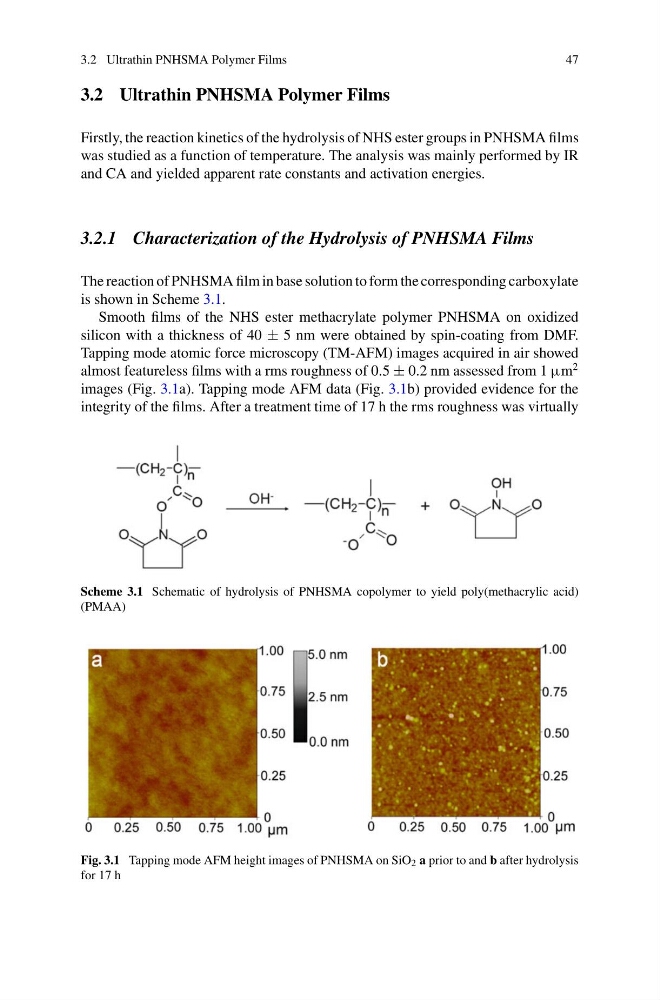
Tapping mode atomic force microscopy (TM-AFM) images acquired in air showed
almost featureless films with a rms roughness of 0.5 ± 0.2 nm assessed from 1 μm
2
images (Fig. 3.1a). Tapping mode AFM data (Fig. 3.1b) provided evidence for the
integrity of the films. After a treatment time of 17 h the rms roughness was virtually
Scheme 3.1 Schematic of hydrolysis of PNHSMA copolymer to yield poly(methacrylic acid)
(PMAA)
Fig. 3.1 Tapping mode AFM height images of PNHSMA on SiO 2 a prior to and b after hydrolysis
for 17 h
47
3.2 Ultrathin PNHSMA Polymer Films
Firstly, the reaction kinetics of the hydrolysis of NHS ester groups in PNHSMA films
was studied as a function of temperature. The analysis was mainly performed by IR
and CA and yielded apparent rate constants and activation energies.
3.2.1 Characterization of the Hydrolysis of PNHSMA Films
The reaction of PNHSMA film in base solution to form the corresponding carboxylate
is shown in Scheme 3.1.
Smooth films of the NHS ester methacrylate polymer PNHSMA on oxidized
silicon with a thickness of 40 ± 5 nm were obtained by spin-coating from DMF.
Tapping mode atomic force microscopy (TM-AFM) images acquired in air showed
almost featureless films with a rms roughness of 0.5 ± 0.2 nm assessed from 1 μm
2
images (Fig. 3.1a). Tapping mode AFM data (Fig. 3.1b) provided evidence for the
integrity of the films. After a treatment time of 17 h the rms roughness was virtually
Scheme 3.1 Schematic of hydrolysis of PNHSMA copolymer to yield poly(methacrylic acid)
(PMAA)
Fig. 3.1 Tapping mode AFM height images of PNHSMA on SiO 2 a prior to and b after hydrolysis
for 17 h