

28
2 Surface Reactions and Fabrication of Bioreactive Platforms …
Plasma polymerization has been studied intensively since the 1950s. Plasma polymers can be applied successfully in the surface modification of solids (mainly conventional polymers) as protective layers, in electronic devices, and in the biological field.
Many different organic compounds could be applied as monomer for plasma polymerization, such as di(ethylene glycol) vinyl ether (EO 2 ), allylamine (AA), and maleic
anhydride (MA). Because of the complex nature of the plasma deposition process, the
functional groups of the monomers are often lost during polymerization. The physical and chemical properties of the plasma polymerized films for given feed gases
and the deposition rate of plasma polymerization depend on many factors, which
are feed gas composition, reactor type, frequency and power of the excitation signal,
flow rate of feed gases, plasma pressure, substrate position, substrate temperature,
and so on.
Since the application of plasma polymers as biomaterials has to be investigated in
solvent environment, the variation of the chemical structure, the swelling behavior,
the optical properties, and the morphology have been studied in detail by XPS,
FTIR spectroscopy, and AFM. The property changes play an important role for
understanding the behavior of proteins, cells, and DNA on platforms based on plasma
polymer films.
For example, Zhang et al. [41] described the fabrication, characterization, and
optimization of amino groups derivatized polymer coatings prepared by pulsedplasma polymerization for applications as adhesion layers in DNA immobilization.
The successful DNA attachment on amino-functionalized surfaces was found to
depend on the macromolecular architecture of the plasma films and on the amino
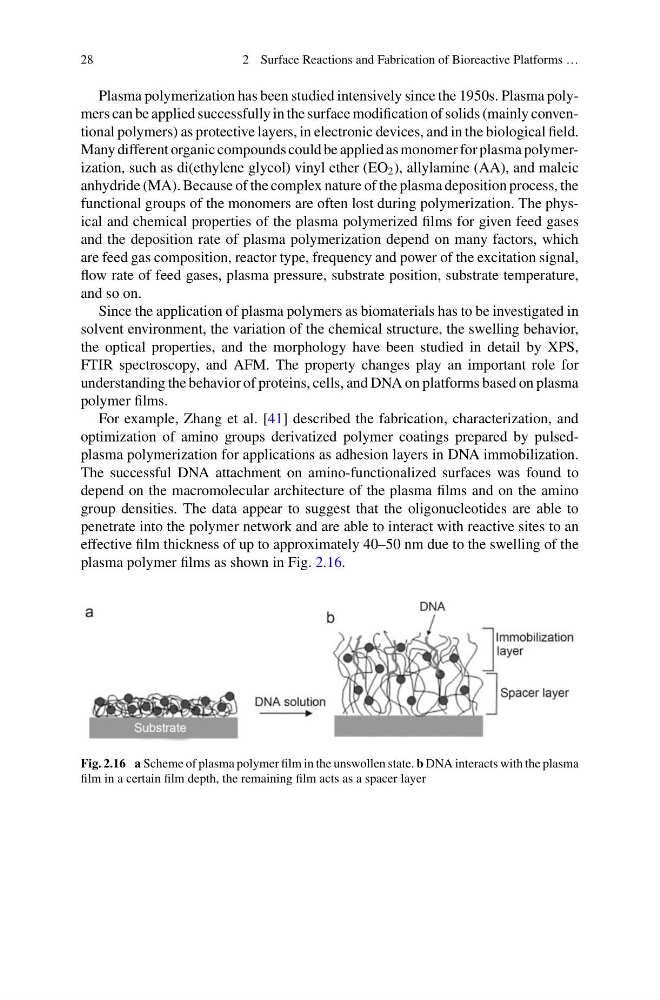
group densities. The data appear to suggest that the oligonucleotides are able to
penetrate into the polymer network and are able to interact with reactive sites to an
effective film thickness of up to approximately 40–50 nm due to the swelling of the
plasma polymer films as shown in Fig. 2.16.
Fig. 2.16 a Scheme of plasma polymer film in the unswollen state. b DNA interacts with the plasma
film in a certain film depth, the remaining film acts as a spacer layer
2 Surface Reactions and Fabrication of Bioreactive Platforms …
Plasma polymerization has been studied intensively since the 1950s. Plasma polymers can be applied successfully in the surface modification of solids (mainly conventional polymers) as protective layers, in electronic devices, and in the biological field.
Many different organic compounds could be applied as monomer for plasma polymerization, such as di(ethylene glycol) vinyl ether (EO 2 ), allylamine (AA), and maleic
anhydride (MA). Because of the complex nature of the plasma deposition process, the
functional groups of the monomers are often lost during polymerization. The physical and chemical properties of the plasma polymerized films for given feed gases
and the deposition rate of plasma polymerization depend on many factors, which
are feed gas composition, reactor type, frequency and power of the excitation signal,
flow rate of feed gases, plasma pressure, substrate position, substrate temperature,
and so on.
Since the application of plasma polymers as biomaterials has to be investigated in
solvent environment, the variation of the chemical structure, the swelling behavior,
the optical properties, and the morphology have been studied in detail by XPS,
FTIR spectroscopy, and AFM. The property changes play an important role for
understanding the behavior of proteins, cells, and DNA on platforms based on plasma
polymer films.
For example, Zhang et al. [41] described the fabrication, characterization, and
optimization of amino groups derivatized polymer coatings prepared by pulsedplasma polymerization for applications as adhesion layers in DNA immobilization.
The successful DNA attachment on amino-functionalized surfaces was found to
depend on the macromolecular architecture of the plasma films and on the amino
group densities. The data appear to suggest that the oligonucleotides are able to
penetrate into the polymer network and are able to interact with reactive sites to an
effective film thickness of up to approximately 40–50 nm due to the swelling of the
plasma polymer films as shown in Fig. 2.16.
Fig. 2.16 a Scheme of plasma polymer film in the unswollen state. b DNA interacts with the plasma
film in a certain film depth, the remaining film acts as a spacer layer