

2.2 Surface Reactions of Organic and Polymeric Films
25
used to grow polymer brushes. Of these, controlled radical polymerizations have
become the most popular routes, mostly because of their tolerance to a wide range
of functional monomers and less stringent experimental conditions. The different
controlled polymerizations for brush growth have been used. It includes living ring
opening polymerization, living anionic polymerization, living cationic polymerization, ring opening metathesis polymerization, nitroxide-mediated polymerization
(NMP), reversible addition-fragmentation chain transfer polymerization, and atom
transfer radical polymerization (ATRP).
In recent years ATRP has become the most widely employed technique for the
formation of polymer brushes via surface-initiated polymerization. ATRP is compatible with a variety of functionalized monomers, and the living/controlled character of
the ATRP process yields polymers with a low polydispersity that are end functionalized and so can be used as macroinitiator for the formation of di- and triblock copolymers. Equally important, surface-initiated ATRP is experimentally more accessible
than for example, the living anionic, which require rigorously dry conditions. The
synthesis of thiol and silane-derivatized surface-bound initiators is easier than the
AIBN-silane derivative or the nitroxide silane derivative for free radical and NMP
polymerization. The controlled nature of ATRP is due to the reversible activation/deactivation reaction between the growing polymer chain and a copper-ligand
species [38].
The most widely used monomer for the formation of polymer brushes via surfaceinitiated ATRP is methyl methacrylate. PS-b-poly(tert-butyl acrylate) (PS-b-PtBA)
brushes were also synthesized by ATRP. It was found that the PtBA block grown
from PS films produced a decrease in the water contact angle (90° to 86°). PtBA can
be regarded as precursor for carboxylic acid functionalities, as shown by Mengel
et al. who hydrolyzed PtBA in LB films.
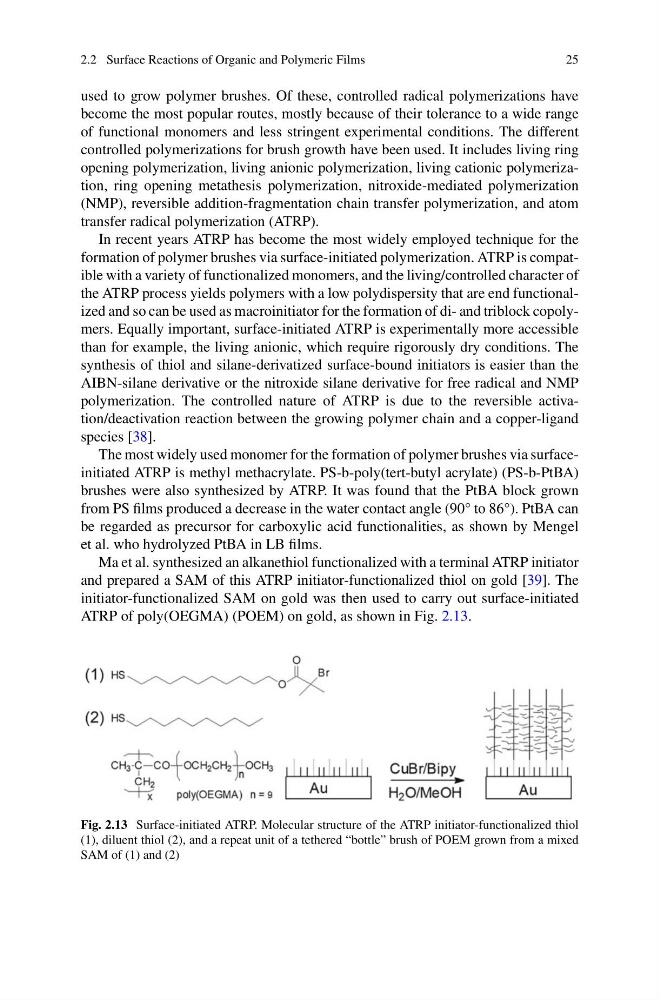
Ma et al. synthesized an alkanethiol functionalized with a terminal ATRP initiator
and prepared a SAM of this ATRP initiator-functionalized thiol on gold [39]. The
initiator-functionalized SAM on gold was then used to carry out surface-initiated
ATRP of poly(OEGMA) (POEM) on gold, as shown in Fig. 2.13.
Fig. 2.13 Surface-initiated ATRP. Molecular structure of the ATRP initiator-functionalized thiol
(1), diluent thiol (2), and a repeat unit of a tethered “bottle” brush of POEM grown from a mixed
SAM of (1) and (2)
25
used to grow polymer brushes. Of these, controlled radical polymerizations have
become the most popular routes, mostly because of their tolerance to a wide range
of functional monomers and less stringent experimental conditions. The different
controlled polymerizations for brush growth have been used. It includes living ring
opening polymerization, living anionic polymerization, living cationic polymerization, ring opening metathesis polymerization, nitroxide-mediated polymerization
(NMP), reversible addition-fragmentation chain transfer polymerization, and atom
transfer radical polymerization (ATRP).
In recent years ATRP has become the most widely employed technique for the
formation of polymer brushes via surface-initiated polymerization. ATRP is compatible with a variety of functionalized monomers, and the living/controlled character of
the ATRP process yields polymers with a low polydispersity that are end functionalized and so can be used as macroinitiator for the formation of di- and triblock copolymers. Equally important, surface-initiated ATRP is experimentally more accessible
than for example, the living anionic, which require rigorously dry conditions. The
synthesis of thiol and silane-derivatized surface-bound initiators is easier than the
AIBN-silane derivative or the nitroxide silane derivative for free radical and NMP
polymerization. The controlled nature of ATRP is due to the reversible activation/deactivation reaction between the growing polymer chain and a copper-ligand
species [38].
The most widely used monomer for the formation of polymer brushes via surfaceinitiated ATRP is methyl methacrylate. PS-b-poly(tert-butyl acrylate) (PS-b-PtBA)
brushes were also synthesized by ATRP. It was found that the PtBA block grown
from PS films produced a decrease in the water contact angle (90° to 86°). PtBA can
be regarded as precursor for carboxylic acid functionalities, as shown by Mengel
et al. who hydrolyzed PtBA in LB films.
Ma et al. synthesized an alkanethiol functionalized with a terminal ATRP initiator
and prepared a SAM of this ATRP initiator-functionalized thiol on gold [39]. The
initiator-functionalized SAM on gold was then used to carry out surface-initiated
ATRP of poly(OEGMA) (POEM) on gold, as shown in Fig. 2.13.
Fig. 2.13 Surface-initiated ATRP. Molecular structure of the ATRP initiator-functionalized thiol
(1), diluent thiol (2), and a repeat unit of a tethered “bottle” brush of POEM grown from a mixed
SAM of (1) and (2)