

24
2 Surface Reactions and Fabrication of Bioreactive Platforms …
high impact materials, enhanced tensile strength, adhesives, improved metal adhesion, controlled wettability, better pigment dispersion, enhanced thermal stability,
thermoplastic elastomers, etc.
Ionic polymerization techniques permit a very good control of the graft copolymer
structure although they require stringent conditions, such as complete absence of
moisture and other acidic impurities. Most graft polymers are prepared by free
radical polymerization. There are two graft polymerization methods, “grafting to”
and “grafting from”.
Grafting to approach: Polymer chains can be covalently tethered to the surface
using the so-called “grafting to” approach. The “grafting to” approach refers to
covalently linking an end-functionalized polymer to a surface that presents complementary reactive groups. This approach results in low grafting density (e.g., in the
range of ~10–40 mg/mm
2 ) because the immobilized polymer chains sterically hinder
the diffusion of polymer molecules from solution to the reactive sites at the surface.
Furthermore, depending upon the surface density of the polymer and the interaction forces between the polymer and underlying surface, the thickness and density
of the polymer graft is difficult to control due to the various conformations of the
polymer at the surface. This limitation is especially important in the fabrication of a
non-fouling surface using poly(ethylene glycol) (PEG) that is grafted from solution,
because protein resistance of grafted PEG depends on both the surface density and
the chain length of the PEG chains.
Grafting from: An alternative approach to grafting surfaces with polymers is the
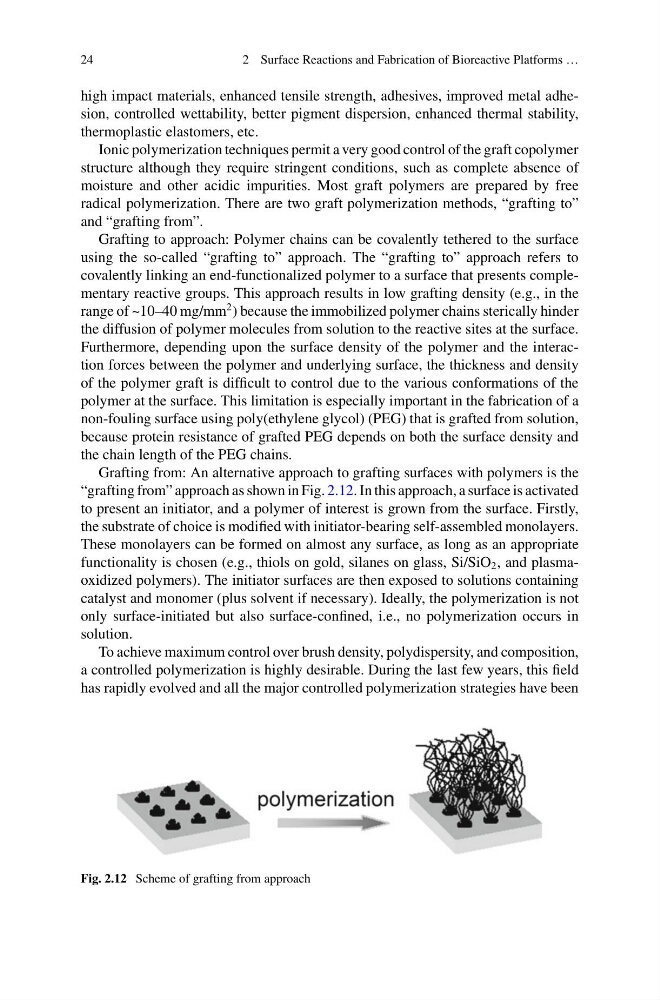
“grafting from” approach as shown in Fig. 2.12. In this approach, a surface is activated
to present an initiator, and a polymer of interest is grown from the surface. Firstly,
the substrate of choice is modified with initiator-bearing self-assembled monolayers.
These monolayers can be formed on almost any surface, as long as an appropriate
functionality is chosen (e.g., thiols on gold, silanes on glass, Si/SiO 2 , and plasmaoxidized polymers). The initiator surfaces are then exposed to solutions containing
catalyst and monomer (plus solvent if necessary). Ideally, the polymerization is not
only surface-initiated but also surface-confined, i.e., no polymerization occurs in
solution.
To achieve maximum control over brush density, polydispersity, and composition,
a controlled polymerization is highly desirable. During the last few years, this field
has rapidly evolved and all the major controlled polymerization strategies have been
Fig. 2.12 Scheme of grafting from approach
2 Surface Reactions and Fabrication of Bioreactive Platforms …
high impact materials, enhanced tensile strength, adhesives, improved metal adhesion, controlled wettability, better pigment dispersion, enhanced thermal stability,
thermoplastic elastomers, etc.
Ionic polymerization techniques permit a very good control of the graft copolymer
structure although they require stringent conditions, such as complete absence of
moisture and other acidic impurities. Most graft polymers are prepared by free
radical polymerization. There are two graft polymerization methods, “grafting to”
and “grafting from”.
Grafting to approach: Polymer chains can be covalently tethered to the surface
using the so-called “grafting to” approach. The “grafting to” approach refers to
covalently linking an end-functionalized polymer to a surface that presents complementary reactive groups. This approach results in low grafting density (e.g., in the
range of ~10–40 mg/mm
2 ) because the immobilized polymer chains sterically hinder
the diffusion of polymer molecules from solution to the reactive sites at the surface.
Furthermore, depending upon the surface density of the polymer and the interaction forces between the polymer and underlying surface, the thickness and density
of the polymer graft is difficult to control due to the various conformations of the
polymer at the surface. This limitation is especially important in the fabrication of a
non-fouling surface using poly(ethylene glycol) (PEG) that is grafted from solution,
because protein resistance of grafted PEG depends on both the surface density and
the chain length of the PEG chains.
Grafting from: An alternative approach to grafting surfaces with polymers is the
“grafting from” approach as shown in Fig. 2.12. In this approach, a surface is activated
to present an initiator, and a polymer of interest is grown from the surface. Firstly,
the substrate of choice is modified with initiator-bearing self-assembled monolayers.
These monolayers can be formed on almost any surface, as long as an appropriate
functionality is chosen (e.g., thiols on gold, silanes on glass, Si/SiO 2 , and plasmaoxidized polymers). The initiator surfaces are then exposed to solutions containing
catalyst and monomer (plus solvent if necessary). Ideally, the polymerization is not
only surface-initiated but also surface-confined, i.e., no polymerization occurs in
solution.
To achieve maximum control over brush density, polydispersity, and composition,
a controlled polymerization is highly desirable. During the last few years, this field
has rapidly evolved and all the major controlled polymerization strategies have been
Fig. 2.12 Scheme of grafting from approach