

8.4 Area-Selective Functionalization of Block Copolymer-Based …
157
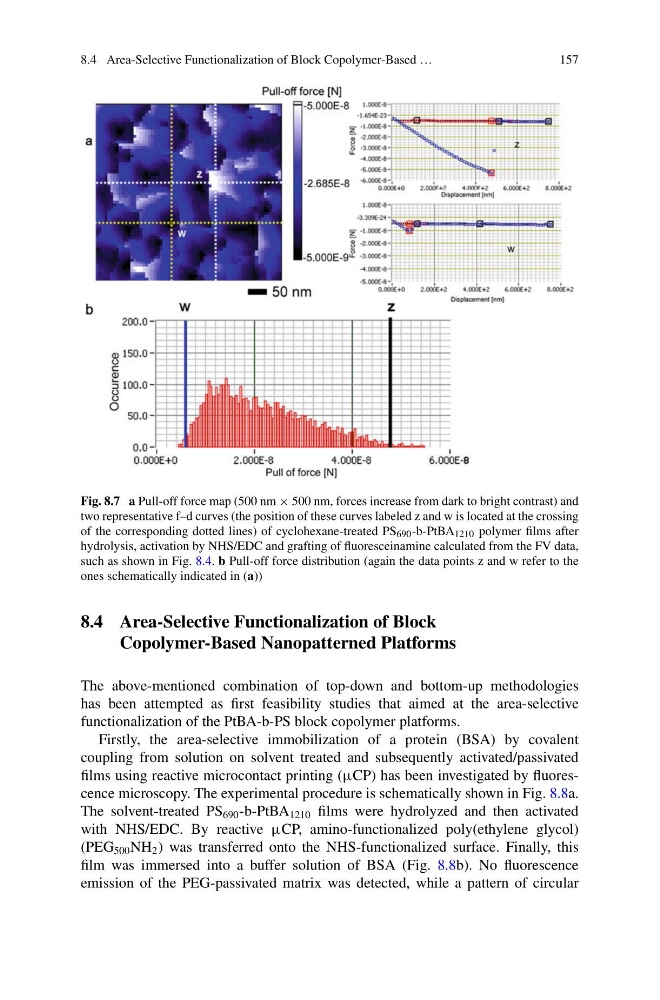
Fig. 8.7 a Pull-off force map (500 nm × 500 nm, forces increase from dark to bright contrast) and
two representative f–d curves (the position of these curves labeled z and w is located at the crossing
of the corresponding dotted lines) of cyclohexane-treated PS 690 -b-PtBA 1210 polymer films after
hydrolysis, activation by NHS/EDC and grafting of fluoresceinamine calculated from the FV data,
such as shown in Fig. 8.4. b Pull-off force distribution (again the data points z and w refer to the
ones schematically indicated in (a))
8.4 Area-Selective Functionalization of Block
Copolymer-Based Nanopatterned Platforms
The above-mentioned combination of top-down and bottom-up methodologies
has been attempted as first feasibility studies that aimed at the area-selective
functionalization of the PtBA-b-PS block copolymer platforms.
Firstly, the area-selective immobilization of a protein (BSA) by covalent
coupling from solution on solvent treated and subsequently activated/passivated
films using reactive microcontact printing (μCP) has been investigated by fluorescence microscopy. The experimental procedure is schematically shown in Fig. 8.8a.
The solvent-treated PS 690 -b-PtBA 1210 films were hydrolyzed and then activated
with NHS/EDC. By reactive μCP, amino-functionalized poly(ethylene glycol)
(PEG 500 NH 2 ) was transferred onto the NHS-functionalized surface. Finally, this
film was immersed into a buffer solution of BSA (Fig. 8.8b). No fluorescence
emission of the PEG-passivated matrix was detected, while a pattern of circular
157
Fig. 8.7 a Pull-off force map (500 nm × 500 nm, forces increase from dark to bright contrast) and
two representative f–d curves (the position of these curves labeled z and w is located at the crossing
of the corresponding dotted lines) of cyclohexane-treated PS 690 -b-PtBA 1210 polymer films after
hydrolysis, activation by NHS/EDC and grafting of fluoresceinamine calculated from the FV data,
such as shown in Fig. 8.4. b Pull-off force distribution (again the data points z and w refer to the
ones schematically indicated in (a))
8.4 Area-Selective Functionalization of Block
Copolymer-Based Nanopatterned Platforms
The above-mentioned combination of top-down and bottom-up methodologies
has been attempted as first feasibility studies that aimed at the area-selective
functionalization of the PtBA-b-PS block copolymer platforms.
Firstly, the area-selective immobilization of a protein (BSA) by covalent
coupling from solution on solvent treated and subsequently activated/passivated
films using reactive microcontact printing (μCP) has been investigated by fluorescence microscopy. The experimental procedure is schematically shown in Fig. 8.8a.
The solvent-treated PS 690 -b-PtBA 1210 films were hydrolyzed and then activated
with NHS/EDC. By reactive μCP, amino-functionalized poly(ethylene glycol)
(PEG 500 NH 2 ) was transferred onto the NHS-functionalized surface. Finally, this
film was immersed into a buffer solution of BSA (Fig. 8.8b). No fluorescence
emission of the PEG-passivated matrix was detected, while a pattern of circular