

7.4 Strategy C: Local Deprotection of PS 690 -b-PtBA 1210 Films
143
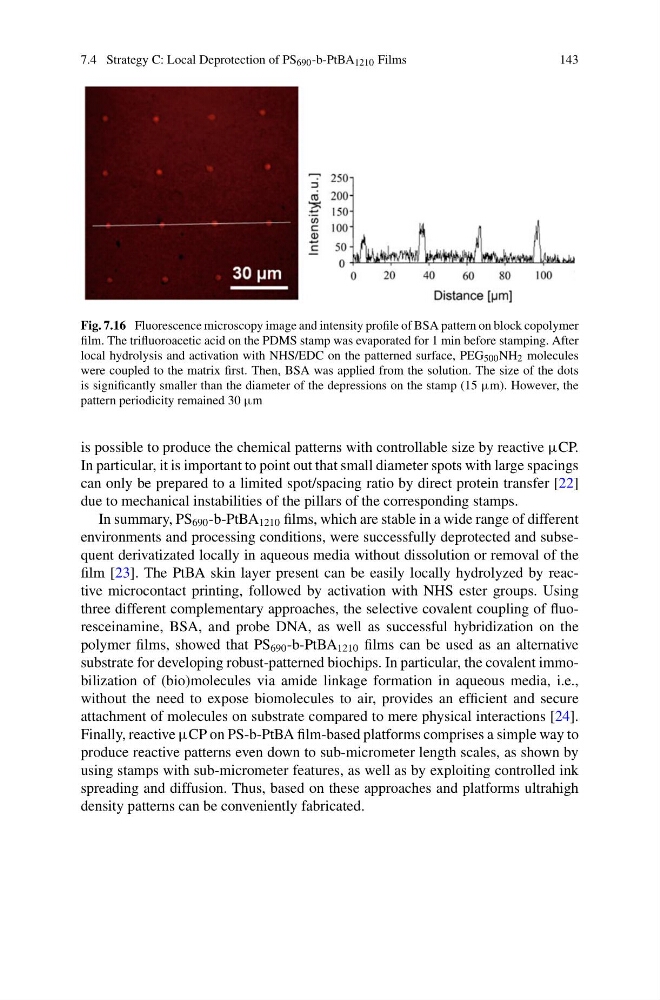
Fig. 7.16 Fluorescence microscopy image and intensity profile of BSA pattern on block copolymer
film. The trifluoroacetic acid on the PDMS stamp was evaporated for 1 min before stamping. After
local hydrolysis and activation with NHS/EDC on the patterned surface, PEG 500 NH 2 molecules
were coupled to the matrix first. Then, BSA was applied from the solution. The size of the dots
is significantly smaller than the diameter of the depressions on the stamp (15 μm). However, the
pattern periodicity remained 30 μm
is possible to produce the chemical patterns with controllable size by reactive μCP.
In particular, it is important to point out that small diameter spots with large spacings
can only be prepared to a limited spot/spacing ratio by direct protein transfer [22]
due to mechanical instabilities of the pillars of the corresponding stamps.
In summary, PS 690 -b-PtBA 1210 films, which are stable in a wide range of different
environments and processing conditions, were successfully deprotected and subsequent derivatizated locally in aqueous media without dissolution or removal of the
film [23]. The PtBA skin layer present can be easily locally hydrolyzed by reactive microcontact printing, followed by activation with NHS ester groups. Using
three different complementary approaches, the selective covalent coupling of fluoresceinamine, BSA, and probe DNA, as well as successful hybridization on the
polymer films, showed that PS 690 -b-PtBA 1210 films can be used as an alternative
substrate for developing robust-patterned biochips. In particular, the covalent immobilization of (bio)molecules via amide linkage formation in aqueous media, i.e.,
without the need to expose biomolecules to air, provides an efficient and secure
attachment of molecules on substrate compared to mere physical interactions [24].
Finally, reactive μCP on PS-b-PtBA film-based platforms comprises a simple way to
produce reactive patterns even down to sub-micrometer length scales, as shown by
using stamps with sub-micrometer features, as well as by exploiting controlled ink
spreading and diffusion. Thus, based on these approaches and platforms ultrahigh
density patterns can be conveniently fabricated.
143
Fig. 7.16 Fluorescence microscopy image and intensity profile of BSA pattern on block copolymer
film. The trifluoroacetic acid on the PDMS stamp was evaporated for 1 min before stamping. After
local hydrolysis and activation with NHS/EDC on the patterned surface, PEG 500 NH 2 molecules
were coupled to the matrix first. Then, BSA was applied from the solution. The size of the dots
is significantly smaller than the diameter of the depressions on the stamp (15 μm). However, the
pattern periodicity remained 30 μm
is possible to produce the chemical patterns with controllable size by reactive μCP.
In particular, it is important to point out that small diameter spots with large spacings
can only be prepared to a limited spot/spacing ratio by direct protein transfer [22]
due to mechanical instabilities of the pillars of the corresponding stamps.
In summary, PS 690 -b-PtBA 1210 films, which are stable in a wide range of different
environments and processing conditions, were successfully deprotected and subsequent derivatizated locally in aqueous media without dissolution or removal of the
film [23]. The PtBA skin layer present can be easily locally hydrolyzed by reactive microcontact printing, followed by activation with NHS ester groups. Using
three different complementary approaches, the selective covalent coupling of fluoresceinamine, BSA, and probe DNA, as well as successful hybridization on the
polymer films, showed that PS 690 -b-PtBA 1210 films can be used as an alternative
substrate for developing robust-patterned biochips. In particular, the covalent immobilization of (bio)molecules via amide linkage formation in aqueous media, i.e.,
without the need to expose biomolecules to air, provides an efficient and secure
attachment of molecules on substrate compared to mere physical interactions [24].
Finally, reactive μCP on PS-b-PtBA film-based platforms comprises a simple way to
produce reactive patterns even down to sub-micrometer length scales, as shown by
using stamps with sub-micrometer features, as well as by exploiting controlled ink
spreading and diffusion. Thus, based on these approaches and platforms ultrahigh
density patterns can be conveniently fabricated.