

128
7 Reactive μCP on Ultrathin Block Copolymer Films …
a passivation layer of PEG 500 NH 2 was locally transferred onto NHS activated PS 690 -
b-PtBA 1210 films. The covalent coupling of fluoresceinamine and BSA, confined
to the remaining activated NHS functionalized areas, was then carried out from
solution. In approach (C), reactive μCP was used to locally hydrolyze PS 690 -bPtBA 1210 films followed by activation and bioconjugation from buffer. This approach
represents an interesting tool to produce (bio)reactive patterns based on polymeric
film platforms down to sub-micrometer length scales, and thus lays the foundations
for the fabrication of ultrahigh density biomolecular arrays.
7.2 Strategy A: Fabrication of Multimolecular Arrays
by Direct Molecular Transfer
The direct transfer of biomolecules using μCP approaches is an established micropatterning strategy [14]. We first demonstrate that the PS-b-PtBA platform is fully
compatible with this approach and yields robust assemblies owing to the covalent
attachment. For this purpose, two different kinds of molecules were transferred and
coupled to the same PS 690 -b-PtBA 1210 film. The films were initially homogeneously
hydrolyzed with trifluoroacetic acid solution and then activated with NHS/ EDC.
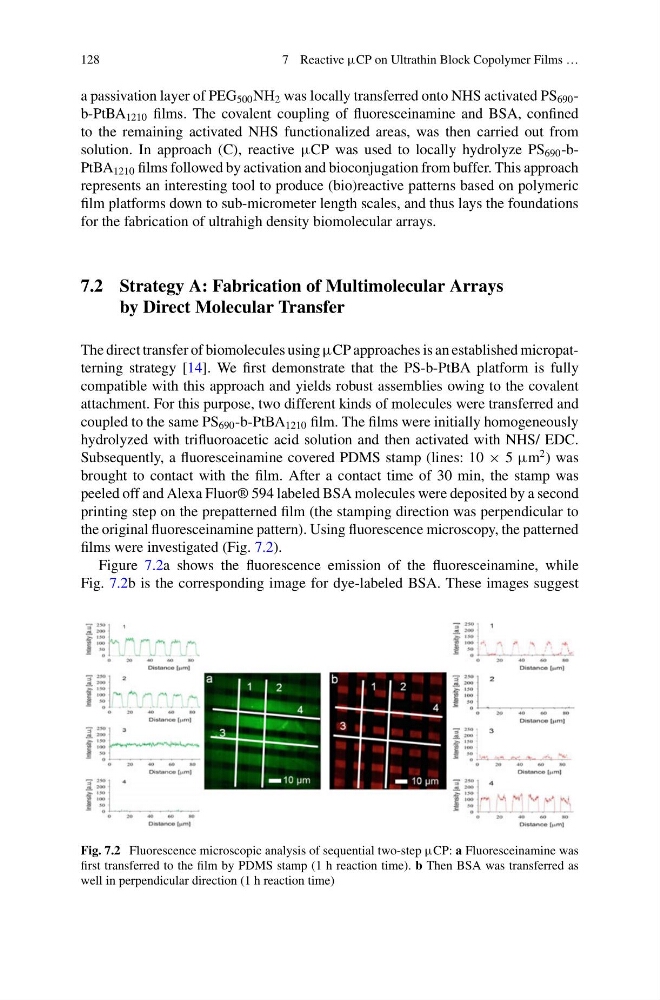
Subsequently, a fluoresceinamine covered PDMS stamp (lines: 10 × 5 μm
2 ) was
brought to contact with the film. After a contact time of 30 min, the stamp was
peeled off and Alexa Fluor® 594 labeled BSA molecules were deposited by a second
printing step on the prepatterned film (the stamping direction was perpendicular to
the original fluoresceinamine pattern). Using fluorescence microscopy, the patterned
films were investigated (Fig. 7.2).
Figure 7.2a shows the fluorescence emission of the fluoresceinamine, while
Fig. 7.2b is the corresponding image for dye-labeled BSA. These images suggest
Fig. 7.2 Fluorescence microscopic analysis of sequential two-step μCP: a Fluoresceinamine was
first transferred to the film by PDMS stamp (1 h reaction time). b Then BSA was transferred as
well in perpendicular direction (1 h reaction time)
7 Reactive μCP on Ultrathin Block Copolymer Films …
a passivation layer of PEG 500 NH 2 was locally transferred onto NHS activated PS 690 -
b-PtBA 1210 films. The covalent coupling of fluoresceinamine and BSA, confined
to the remaining activated NHS functionalized areas, was then carried out from
solution. In approach (C), reactive μCP was used to locally hydrolyze PS 690 -bPtBA 1210 films followed by activation and bioconjugation from buffer. This approach
represents an interesting tool to produce (bio)reactive patterns based on polymeric
film platforms down to sub-micrometer length scales, and thus lays the foundations
for the fabrication of ultrahigh density biomolecular arrays.
7.2 Strategy A: Fabrication of Multimolecular Arrays
by Direct Molecular Transfer
The direct transfer of biomolecules using μCP approaches is an established micropatterning strategy [14]. We first demonstrate that the PS-b-PtBA platform is fully
compatible with this approach and yields robust assemblies owing to the covalent
attachment. For this purpose, two different kinds of molecules were transferred and
coupled to the same PS 690 -b-PtBA 1210 film. The films were initially homogeneously
hydrolyzed with trifluoroacetic acid solution and then activated with NHS/ EDC.
Subsequently, a fluoresceinamine covered PDMS stamp (lines: 10 × 5 μm
2 ) was
brought to contact with the film. After a contact time of 30 min, the stamp was
peeled off and Alexa Fluor® 594 labeled BSA molecules were deposited by a second
printing step on the prepatterned film (the stamping direction was perpendicular to
the original fluoresceinamine pattern). Using fluorescence microscopy, the patterned
films were investigated (Fig. 7.2).
Figure 7.2a shows the fluorescence emission of the fluoresceinamine, while
Fig. 7.2b is the corresponding image for dye-labeled BSA. These images suggest
Fig. 7.2 Fluorescence microscopic analysis of sequential two-step μCP: a Fluoresceinamine was
first transferred to the film by PDMS stamp (1 h reaction time). b Then BSA was transferred as
well in perpendicular direction (1 h reaction time)