

7.1 Introduction
127
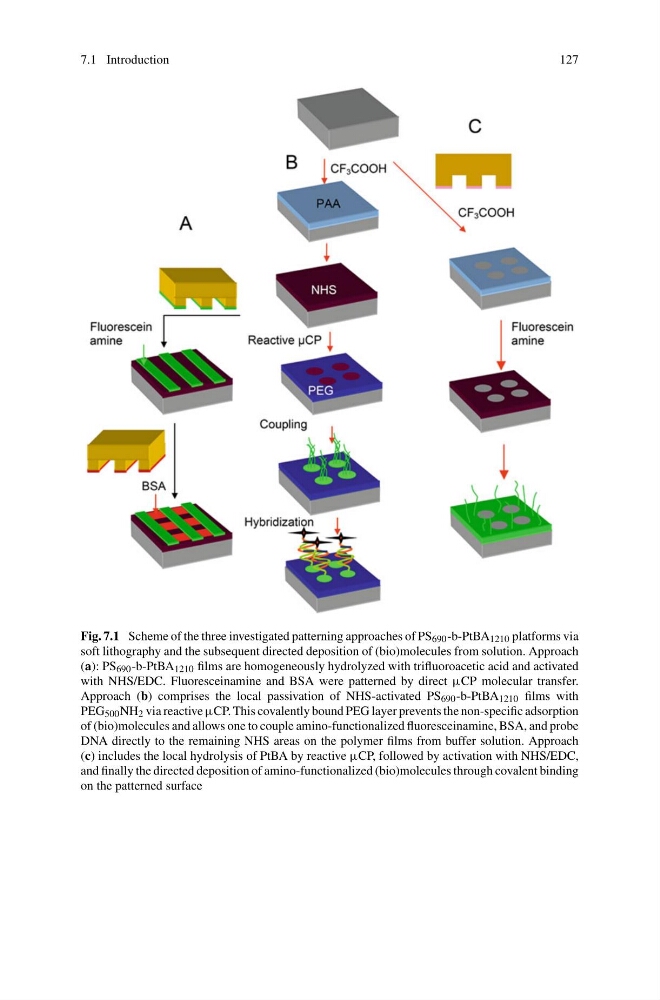
Fig. 7.1 Scheme of the three investigated patterning approaches of PS 690 -b-PtBA 1210 platforms via
soft lithography and the subsequent directed deposition of (bio)molecules from solution. Approach
(a): PS 690 -b-PtBA 1210 films are homogeneously hydrolyzed with trifluoroacetic acid and activated
with NHS/EDC. Fluoresceinamine and BSA were patterned by direct μCP molecular transfer.
Approach (b) comprises the local passivation of NHS-activated PS 690 -b-PtBA 1210 films with
PEG 500 NH 2 via reactive μCP. This covalently bound PEG layer prevents the non-specific adsorption
of (bio)molecules and allows one to couple amino-functionalized fluoresceinamine, BSA, and probe
DNA directly to the remaining NHS areas on the polymer films from buffer solution. Approach
(c) includes the local hydrolysis of PtBA by reactive μCP, followed by activation with NHS/EDC,
and finally the directed deposition of amino-functionalized (bio)molecules through covalent binding
on the patterned surface
127
Fig. 7.1 Scheme of the three investigated patterning approaches of PS 690 -b-PtBA 1210 platforms via
soft lithography and the subsequent directed deposition of (bio)molecules from solution. Approach
(a): PS 690 -b-PtBA 1210 films are homogeneously hydrolyzed with trifluoroacetic acid and activated
with NHS/EDC. Fluoresceinamine and BSA were patterned by direct μCP molecular transfer.
Approach (b) comprises the local passivation of NHS-activated PS 690 -b-PtBA 1210 films with
PEG 500 NH 2 via reactive μCP. This covalently bound PEG layer prevents the non-specific adsorption
of (bio)molecules and allows one to couple amino-functionalized fluoresceinamine, BSA, and probe
DNA directly to the remaining NHS areas on the polymer films from buffer solution. Approach
(c) includes the local hydrolysis of PtBA by reactive μCP, followed by activation with NHS/EDC,
and finally the directed deposition of amino-functionalized (bio)molecules through covalent binding
on the patterned surface