

104
5 Tailored Biointerfaces via Derivatization of Polystyrene-b-Poly …
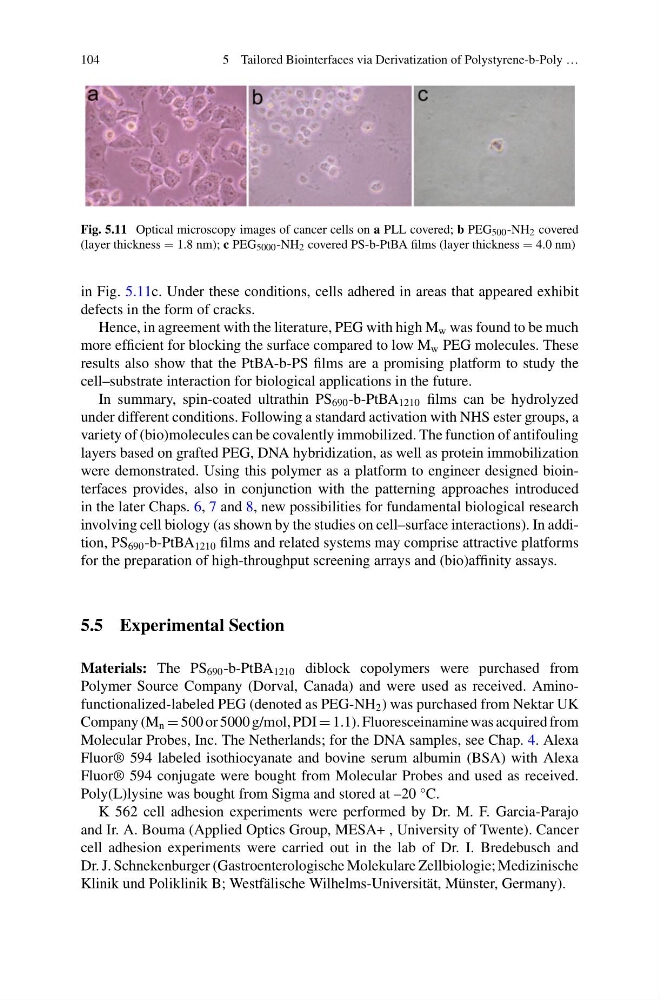
Fig. 5.11 Optical microscopy images of cancer cells on a PLL covered; b PEG 500 -NH 2 covered
(layer thickness = 1.8 nm); c PEG 5000 -NH 2 covered PS-b-PtBA films (layer thickness = 4.0 nm)
in Fig. 5.11c. Under these conditions, cells adhered in areas that appeared exhibit
defects in the form of cracks.
Hence, in agreement with the literature, PEG with high M w was found to be much
more efficient for blocking the surface compared to low M w PEG molecules. These
results also show that the PtBA-b-PS films are a promising platform to study the
cell–substrate interaction for biological applications in the future.
In summary, spin-coated ultrathin PS 690 -b-PtBA 1210 films can be hydrolyzed
under different conditions. Following a standard activation with NHS ester groups, a
variety of (bio)molecules can be covalently immobilized. The function of antifouling
layers based on grafted PEG, DNA hybridization, as well as protein immobilization
were demonstrated. Using this polymer as a platform to engineer designed biointerfaces provides, also in conjunction with the patterning approaches introduced
in the later Chaps. 6, 7 and 8, new possibilities for fundamental biological research
involving cell biology (as shown by the studies on cell–surface interactions). In addition, PS 690 -b-PtBA 1210 films and related systems may comprise attractive platforms
for the preparation of high-throughput screening arrays and (bio)affinity assays.
5.5 Experimental Section
Materials: The PS 690 -b-PtBA 1210 diblock copolymers were purchased from
Polymer Source Company (Dorval, Canada) and were used as received. Aminofunctionalized-labeled PEG (denoted as PEG-NH 2 ) was purchased from Nektar UK
Company (M n = 500 or 5000 g/mol, PDI = 1.1). Fluoresceinamine was acquired from
Molecular Probes, Inc. The Netherlands; for the DNA samples, see Chap. 4. Alexa
Fluor® 594 labeled isothiocyanate and bovine serum albumin (BSA) with Alexa
Fluor® 594 conjugate were bought from Molecular Probes and used as received.
Poly(L)lysine was bought from Sigma and stored at –20 °C.
K 562 cell adhesion experiments were performed by Dr. M. F. Garcia-Parajo
and Ir. A. Bouma (Applied Optics Group, MESA+ , University of Twente). Cancer
cell adhesion experiments were carried out in the lab of Dr. I. Bredebusch and
Dr. J. Schnekenburger (Gastroenterologische Molekulare Zellbiologie; Medizinische
Klinik und Poliklinik B; Westfälische Wilhelms-Universität, Münster, Germany).
5 Tailored Biointerfaces via Derivatization of Polystyrene-b-Poly …
Fig. 5.11 Optical microscopy images of cancer cells on a PLL covered; b PEG 500 -NH 2 covered
(layer thickness = 1.8 nm); c PEG 5000 -NH 2 covered PS-b-PtBA films (layer thickness = 4.0 nm)
in Fig. 5.11c. Under these conditions, cells adhered in areas that appeared exhibit
defects in the form of cracks.
Hence, in agreement with the literature, PEG with high M w was found to be much
more efficient for blocking the surface compared to low M w PEG molecules. These
results also show that the PtBA-b-PS films are a promising platform to study the
cell–substrate interaction for biological applications in the future.
In summary, spin-coated ultrathin PS 690 -b-PtBA 1210 films can be hydrolyzed
under different conditions. Following a standard activation with NHS ester groups, a
variety of (bio)molecules can be covalently immobilized. The function of antifouling
layers based on grafted PEG, DNA hybridization, as well as protein immobilization
were demonstrated. Using this polymer as a platform to engineer designed biointerfaces provides, also in conjunction with the patterning approaches introduced
in the later Chaps. 6, 7 and 8, new possibilities for fundamental biological research
involving cell biology (as shown by the studies on cell–surface interactions). In addition, PS 690 -b-PtBA 1210 films and related systems may comprise attractive platforms
for the preparation of high-throughput screening arrays and (bio)affinity assays.
5.5 Experimental Section
Materials: The PS 690 -b-PtBA 1210 diblock copolymers were purchased from
Polymer Source Company (Dorval, Canada) and were used as received. Aminofunctionalized-labeled PEG (denoted as PEG-NH 2 ) was purchased from Nektar UK
Company (M n = 500 or 5000 g/mol, PDI = 1.1). Fluoresceinamine was acquired from
Molecular Probes, Inc. The Netherlands; for the DNA samples, see Chap. 4. Alexa
Fluor® 594 labeled isothiocyanate and bovine serum albumin (BSA) with Alexa
Fluor® 594 conjugate were bought from Molecular Probes and used as received.
Poly(L)lysine was bought from Sigma and stored at –20 °C.
K 562 cell adhesion experiments were performed by Dr. M. F. Garcia-Parajo
and Ir. A. Bouma (Applied Optics Group, MESA+ , University of Twente). Cancer
cell adhesion experiments were carried out in the lab of Dr. I. Bredebusch and
Dr. J. Schnekenburger (Gastroenterologische Molekulare Zellbiologie; Medizinische
Klinik und Poliklinik B; Westfälische Wilhelms-Universität, Münster, Germany).