

Runoff Prediction Using Artificial Neural Network …
37
0
500
1000
1500
2000
2500
3000
Rainfall/Runoff depth (mm)
Year
Annual rainfall
Annual runoff
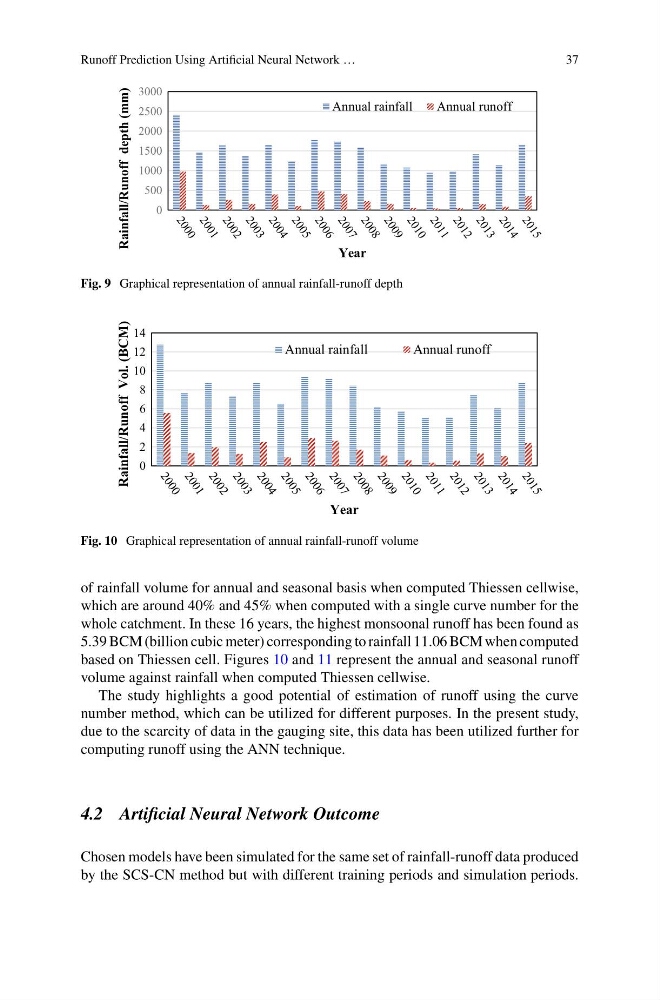
Fig. 9 Graphical representation of annual rainfall-runoff depth
0
2
4
6
8
10
12
14
Rainfall/Runoff Vol. (BCM)
Year
Annual rainfall
Annual runoff
Fig. 10 Graphical representation of annual rainfall-runoff volume
of rainfall volume for annual and seasonal basis when computed Thiessen cellwise,
which are around 40% and 45% when computed with a single curve number for the
whole catchment. In these 16 years, the highest monsoonal runoff has been found as
5.39 BCM (billion cubic meter) corresponding to rainfall 11.06 BCM when computed
based on Thiessen cell. Figures 10 and 11 represent the annual and seasonal runoff
volume against rainfall when computed Thiessen cellwise.
The study highlights a good potential of estimation of runoff using the curve
number method, which can be utilized for different purposes. In the present study,
due to the scarcity of data in the gauging site, this data has been utilized further for
computing runoff using the ANN technique.
4.2 Artificial Neural Network Outcome
Chosen models have been simulated for the same set of rainfall-runoff data produced
by the SCS-CN method but with different training periods and simulation periods.
37
0
500
1000
1500
2000
2500
3000
Rainfall/Runoff depth (mm)
Year
Annual rainfall
Annual runoff
Fig. 9 Graphical representation of annual rainfall-runoff depth
0
2
4
6
8
10
12
14
Rainfall/Runoff Vol. (BCM)
Year
Annual rainfall
Annual runoff
Fig. 10 Graphical representation of annual rainfall-runoff volume
of rainfall volume for annual and seasonal basis when computed Thiessen cellwise,
which are around 40% and 45% when computed with a single curve number for the
whole catchment. In these 16 years, the highest monsoonal runoff has been found as
5.39 BCM (billion cubic meter) corresponding to rainfall 11.06 BCM when computed
based on Thiessen cell. Figures 10 and 11 represent the annual and seasonal runoff
volume against rainfall when computed Thiessen cellwise.
The study highlights a good potential of estimation of runoff using the curve
number method, which can be utilized for different purposes. In the present study,
due to the scarcity of data in the gauging site, this data has been utilized further for
computing runoff using the ANN technique.
4.2 Artificial Neural Network Outcome
Chosen models have been simulated for the same set of rainfall-runoff data produced
by the SCS-CN method but with different training periods and simulation periods.