

Contamination of Arsenic in Groundwater …
21
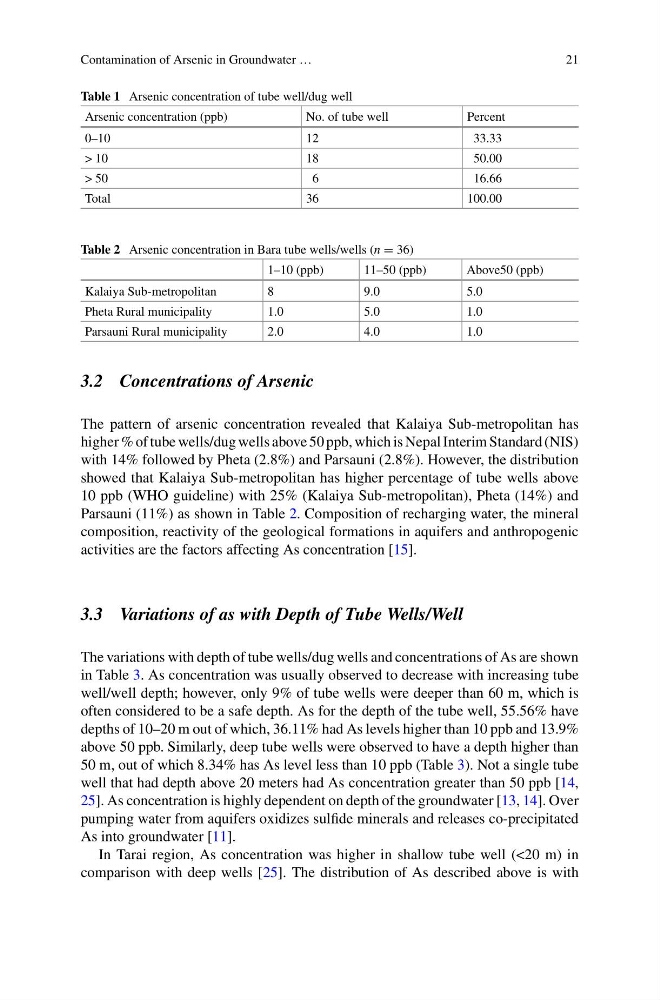
Table 1 Arsenic concentration of tube well/dug well
Arsenic concentration (ppb)
No. of tube well
Percent
0–10
12
33.33
> 10
18
50.00
> 50
6
16.66
Total
36
100.00
Table 2 Arsenic concentration in Bara tube wells/wells (n = 36)
1–10 (ppb)
11–50 (ppb)
Above50 (ppb)
Kalaiya Sub-metropolitan
8
9.0
5.0
Pheta Rural municipality
1.0
5.0
1.0
Parsauni Rural municipality
2.0
4.0
1.0
3.2 Concentrations of Arsenic
The pattern of arsenic concentration revealed that Kalaiya Sub-metropolitan has
higher % of tube wells/dug wells above 50 ppb, which is Nepal Interim Standard (NIS)
with 14% followed by Pheta (2.8%) and Parsauni (2.8%). However, the distribution
showed that Kalaiya Sub-metropolitan has higher percentage of tube wells above
10 ppb (WHO guideline) with 25% (Kalaiya Sub-metropolitan), Pheta (14%) and
Parsauni (11%) as shown in Table 2. Composition of recharging water, the mineral
composition, reactivity of the geological formations in aquifers and anthropogenic
activities are the factors affecting As concentration [15].
3.3 Variations of as with Depth of Tube Wells/Well
The variations with depth of tube wells/dug wells and concentrations of As are shown
in Table 3. As concentration was usually observed to decrease with increasing tube
well/well depth; however, only 9% of tube wells were deeper than 60 m, which is
often considered to be a safe depth. As for the depth of the tube well, 55.56% have
depths of 10–20 m out of which, 36.11% had As levels higher than 10 ppb and 13.9%
above 50 ppb. Similarly, deep tube wells were observed to have a depth higher than
50 m, out of which 8.34% has As level less than 10 ppb (Table 3). Not a single tube
well that had depth above 20 meters had As concentration greater than 50 ppb [14,
25]. As concentration is highly dependent on depth of the groundwater [13, 14]. Over
pumping water from aquifers oxidizes sulfide minerals and releases co-precipitated
As into groundwater [11].
In Tarai region, As concentration was higher in shallow tube well (<20 m) in
comparison with deep wells [25]. The distribution of As described above is with
21
Table 1 Arsenic concentration of tube well/dug well
Arsenic concentration (ppb)
No. of tube well
Percent
0–10
12
33.33
> 10
18
50.00
> 50
6
16.66
Total
36
100.00
Table 2 Arsenic concentration in Bara tube wells/wells (n = 36)
1–10 (ppb)
11–50 (ppb)
Above50 (ppb)
Kalaiya Sub-metropolitan
8
9.0
5.0
Pheta Rural municipality
1.0
5.0
1.0
Parsauni Rural municipality
2.0
4.0
1.0
3.2 Concentrations of Arsenic
The pattern of arsenic concentration revealed that Kalaiya Sub-metropolitan has
higher % of tube wells/dug wells above 50 ppb, which is Nepal Interim Standard (NIS)
with 14% followed by Pheta (2.8%) and Parsauni (2.8%). However, the distribution
showed that Kalaiya Sub-metropolitan has higher percentage of tube wells above
10 ppb (WHO guideline) with 25% (Kalaiya Sub-metropolitan), Pheta (14%) and
Parsauni (11%) as shown in Table 2. Composition of recharging water, the mineral
composition, reactivity of the geological formations in aquifers and anthropogenic
activities are the factors affecting As concentration [15].
3.3 Variations of as with Depth of Tube Wells/Well
The variations with depth of tube wells/dug wells and concentrations of As are shown
in Table 3. As concentration was usually observed to decrease with increasing tube
well/well depth; however, only 9% of tube wells were deeper than 60 m, which is
often considered to be a safe depth. As for the depth of the tube well, 55.56% have
depths of 10–20 m out of which, 36.11% had As levels higher than 10 ppb and 13.9%
above 50 ppb. Similarly, deep tube wells were observed to have a depth higher than
50 m, out of which 8.34% has As level less than 10 ppb (Table 3). Not a single tube
well that had depth above 20 meters had As concentration greater than 50 ppb [14,
25]. As concentration is highly dependent on depth of the groundwater [13, 14]. Over
pumping water from aquifers oxidizes sulfide minerals and releases co-precipitated
As into groundwater [11].
In Tarai region, As concentration was higher in shallow tube well (<20 m) in
comparison with deep wells [25]. The distribution of As described above is with