

278
V. Singh and S. Chakraborty
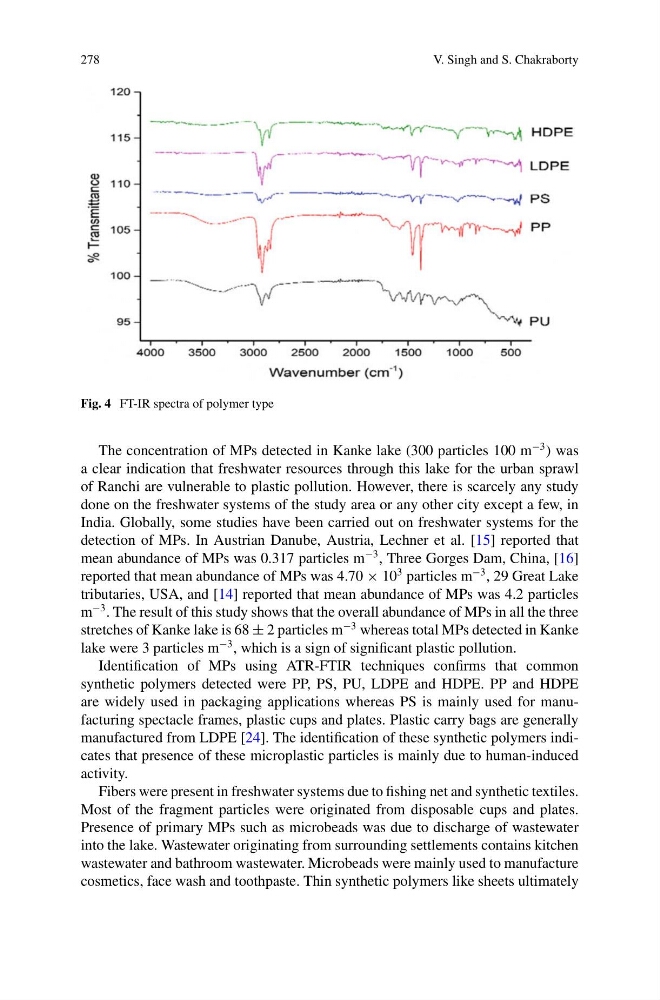
Fig. 4 FT-IR spectra of polymer type
The concentration of MPs detected in Kanke lake (300 particles 100 m
−3 ) was
a clear indication that freshwater resources through this lake for the urban sprawl
of Ranchi are vulnerable to plastic pollution. However, there is scarcely any study
done on the freshwater systems of the study area or any other city except a few, in
India. Globally, some studies have been carried out on freshwater systems for the
detection of MPs. In Austrian Danube, Austria, Lechner et al. [15] reported that
mean abundance of MPs was 0.317 particles m
−3 , Three Gorges Dam, China, [16]
reported that mean abundance of MPs was 4.70 × 10
3 particles m
−3 , 29 Great Lake
tributaries, USA, and [14] reported that mean abundance of MPs was 4.2 particles
m
−3 . The result of this study shows that the overall abundance of MPs in all the three
stretches of Kanke lake is 68 ± 2 particles m
−3 whereas total MPs detected in Kanke
lake were 3 particles m
−3 , which is a sign of significant plastic pollution.
Identification of MPs using ATR-FTIR techniques confirms that common
synthetic polymers detected were PP, PS, PU, LDPE and HDPE. PP and HDPE
are widely used in packaging applications whereas PS is mainly used for manufacturing spectacle frames, plastic cups and plates. Plastic carry bags are generally
manufactured from LDPE [24]. The identification of these synthetic polymers indicates that presence of these microplastic particles is mainly due to human-induced
activity.
Fibers were present in freshwater systems due to fishing net and synthetic textiles.
Most of the fragment particles were originated from disposable cups and plates.
Presence of primary MPs such as microbeads was due to discharge of wastewater
into the lake. Wastewater originating from surrounding settlements contains kitchen
wastewater and bathroom wastewater. Microbeads were mainly used to manufacture
cosmetics, face wash and toothpaste. Thin synthetic polymers like sheets ultimately
V. Singh and S. Chakraborty
Fig. 4 FT-IR spectra of polymer type
The concentration of MPs detected in Kanke lake (300 particles 100 m
−3 ) was
a clear indication that freshwater resources through this lake for the urban sprawl
of Ranchi are vulnerable to plastic pollution. However, there is scarcely any study
done on the freshwater systems of the study area or any other city except a few, in
India. Globally, some studies have been carried out on freshwater systems for the
detection of MPs. In Austrian Danube, Austria, Lechner et al. [15] reported that
mean abundance of MPs was 0.317 particles m
−3 , Three Gorges Dam, China, [16]
reported that mean abundance of MPs was 4.70 × 10
3 particles m
−3 , 29 Great Lake
tributaries, USA, and [14] reported that mean abundance of MPs was 4.2 particles
m
−3 . The result of this study shows that the overall abundance of MPs in all the three
stretches of Kanke lake is 68 ± 2 particles m
−3 whereas total MPs detected in Kanke
lake were 3 particles m
−3 , which is a sign of significant plastic pollution.
Identification of MPs using ATR-FTIR techniques confirms that common
synthetic polymers detected were PP, PS, PU, LDPE and HDPE. PP and HDPE
are widely used in packaging applications whereas PS is mainly used for manufacturing spectacle frames, plastic cups and plates. Plastic carry bags are generally
manufactured from LDPE [24]. The identification of these synthetic polymers indicates that presence of these microplastic particles is mainly due to human-induced
activity.
Fibers were present in freshwater systems due to fishing net and synthetic textiles.
Most of the fragment particles were originated from disposable cups and plates.
Presence of primary MPs such as microbeads was due to discharge of wastewater
into the lake. Wastewater originating from surrounding settlements contains kitchen
wastewater and bathroom wastewater. Microbeads were mainly used to manufacture
cosmetics, face wash and toothpaste. Thin synthetic polymers like sheets ultimately