

Quantification and Characterization of Microplastics …
277
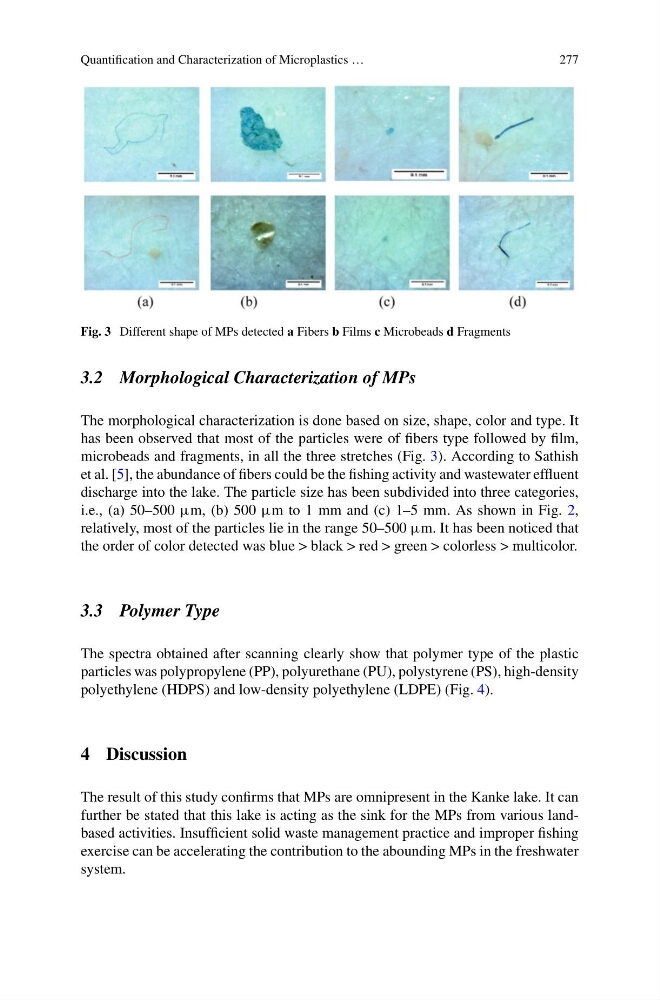
Fig. 3 Different shape of MPs detected a Fibers b Films c Microbeads d Fragments
3.2 Morphological Characterization of MPs
The morphological characterization is done based on size, shape, color and type. It
has been observed that most of the particles were of fibers type followed by film,
microbeads and fragments, in all the three stretches (Fig. 3). According to Sathish
et al. [5], the abundance of fibers could be the fishing activity and wastewater effluent
discharge into the lake. The particle size has been subdivided into three categories,
i.e., (a) 50–500 µm, (b) 500 µm to 1 mm and (c) 1–5 mm. As shown in Fig. 2,
relatively, most of the particles lie in the range 50–500 µm. It has been noticed that
the order of color detected was blue > black > red > green > colorless > multicolor.
3.3 Polymer Type
The spectra obtained after scanning clearly show that polymer type of the plastic
particles was polypropylene (PP), polyurethane (PU), polystyrene (PS), high-density
polyethylene (HDPS) and low-density polyethylene (LDPE) (Fig. 4).
4 Discussion
The result of this study confirms that MPs are omnipresent in the Kanke lake. It can
further be stated that this lake is acting as the sink for the MPs from various landbased activities. Insufficient solid waste management practice and improper fishing
exercise can be accelerating the contribution to the abounding MPs in the freshwater
system.
277
Fig. 3 Different shape of MPs detected a Fibers b Films c Microbeads d Fragments
3.2 Morphological Characterization of MPs
The morphological characterization is done based on size, shape, color and type. It
has been observed that most of the particles were of fibers type followed by film,
microbeads and fragments, in all the three stretches (Fig. 3). According to Sathish
et al. [5], the abundance of fibers could be the fishing activity and wastewater effluent
discharge into the lake. The particle size has been subdivided into three categories,
i.e., (a) 50–500 µm, (b) 500 µm to 1 mm and (c) 1–5 mm. As shown in Fig. 2,
relatively, most of the particles lie in the range 50–500 µm. It has been noticed that
the order of color detected was blue > black > red > green > colorless > multicolor.
3.3 Polymer Type
The spectra obtained after scanning clearly show that polymer type of the plastic
particles was polypropylene (PP), polyurethane (PU), polystyrene (PS), high-density
polyethylene (HDPS) and low-density polyethylene (LDPE) (Fig. 4).
4 Discussion
The result of this study confirms that MPs are omnipresent in the Kanke lake. It can
further be stated that this lake is acting as the sink for the MPs from various landbased activities. Insufficient solid waste management practice and improper fishing
exercise can be accelerating the contribution to the abounding MPs in the freshwater
system.