

Control of Sediment Entry into Intake Canals …
211
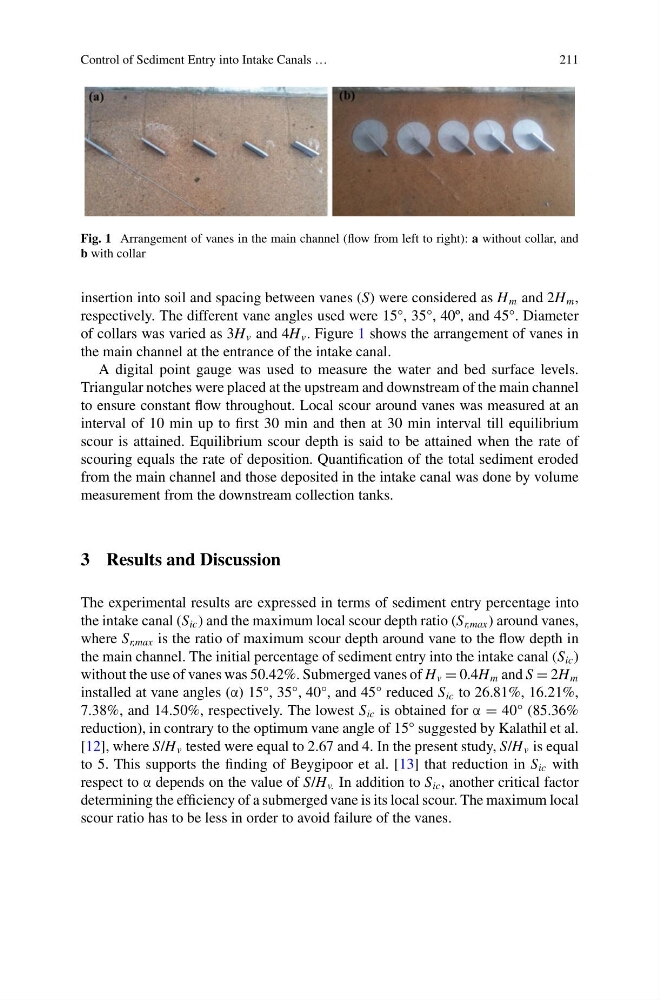
Fig. 1 Arrangement of vanes in the main channel (flow from left to right): a without collar, and
b with collar
insertion into soil and spacing between vanes (S) were considered as H m and 2H m ,
respectively. The different vane angles used were 15°, 35°, 40º, and 45°. Diameter
of collars was varied as 3H v and 4H v . Figure 1 shows the arrangement of vanes in
the main channel at the entrance of the intake canal.
A digital point gauge was used to measure the water and bed surface levels.
Triangular notches were placed at the upstream and downstream of the main channel
to ensure constant flow throughout. Local scour around vanes was measured at an
interval of 10 min up to first 30 min and then at 30 min interval till equilibrium
scour is attained. Equilibrium scour depth is said to be attained when the rate of
scouring equals the rate of deposition. Quantification of the total sediment eroded
from the main channel and those deposited in the intake canal was done by volume
measurement from the downstream collection tanks.
3 Results and Discussion
The experimental results are expressed in terms of sediment entry percentage into
the intake canal (S ic ) and the maximum local scour depth ratio (S r,max ) around vanes,
where S r,max is the ratio of maximum scour depth around vane to the flow depth in
the main channel. The initial percentage of sediment entry into the intake canal (S ic )
without the use of vanes was 50.42%. Submerged vanes of H v = 0.4H m and S = 2H m
installed at vane angles (α) 15°, 35°, 40°, and 45° reduced S ic to 26.81%, 16.21%,
7.38%, and 14.50%, respectively. The lowest S ic is obtained for α = 40° (85.36%
reduction), in contrary to the optimum vane angle of 15° suggested by Kalathil et al.
[12], where S/H v tested were equal to 2.67 and 4. In the present study, S/H v is equal
to 5. This supports the finding of Beygipoor et al. [13] that reduction in S ic with
respect to α depends on the value of S/H v. In addition to S ic , another critical factor
determining the efficiency of a submerged vane is its local scour. The maximum local
scour ratio has to be less in order to avoid failure of the vanes.
211
Fig. 1 Arrangement of vanes in the main channel (flow from left to right): a without collar, and
b with collar
insertion into soil and spacing between vanes (S) were considered as H m and 2H m ,
respectively. The different vane angles used were 15°, 35°, 40º, and 45°. Diameter
of collars was varied as 3H v and 4H v . Figure 1 shows the arrangement of vanes in
the main channel at the entrance of the intake canal.
A digital point gauge was used to measure the water and bed surface levels.
Triangular notches were placed at the upstream and downstream of the main channel
to ensure constant flow throughout. Local scour around vanes was measured at an
interval of 10 min up to first 30 min and then at 30 min interval till equilibrium
scour is attained. Equilibrium scour depth is said to be attained when the rate of
scouring equals the rate of deposition. Quantification of the total sediment eroded
from the main channel and those deposited in the intake canal was done by volume
measurement from the downstream collection tanks.
3 Results and Discussion
The experimental results are expressed in terms of sediment entry percentage into
the intake canal (S ic ) and the maximum local scour depth ratio (S r,max ) around vanes,
where S r,max is the ratio of maximum scour depth around vane to the flow depth in
the main channel. The initial percentage of sediment entry into the intake canal (S ic )
without the use of vanes was 50.42%. Submerged vanes of H v = 0.4H m and S = 2H m
installed at vane angles (α) 15°, 35°, 40°, and 45° reduced S ic to 26.81%, 16.21%,
7.38%, and 14.50%, respectively. The lowest S ic is obtained for α = 40° (85.36%
reduction), in contrary to the optimum vane angle of 15° suggested by Kalathil et al.
[12], where S/H v tested were equal to 2.67 and 4. In the present study, S/H v is equal
to 5. This supports the finding of Beygipoor et al. [13] that reduction in S ic with
respect to α depends on the value of S/H v. In addition to S ic , another critical factor
determining the efficiency of a submerged vane is its local scour. The maximum local
scour ratio has to be less in order to avoid failure of the vanes.