

196
S. K. Lahiri et al.
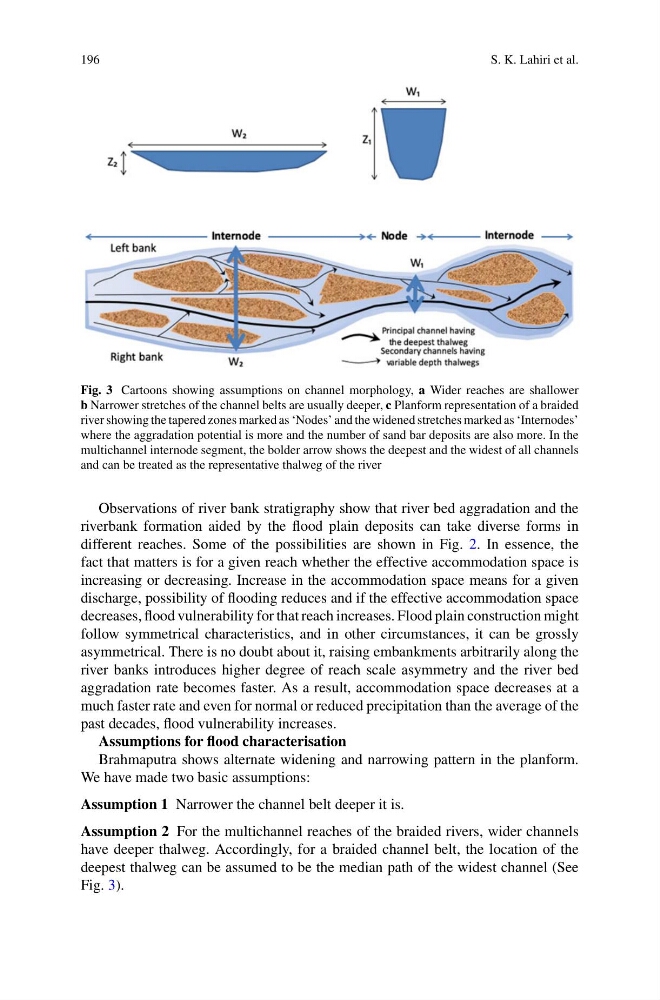
Fig. 3 Cartoons showing assumptions on channel morphology, a Wider reaches are shallower
b Narrower stretches of the channel belts are usually deeper, c Planform representation of a braided
river showing the tapered zones marked as ‘Nodes’ and the widened stretches marked as ‘Internodes’
where the aggradation potential is more and the number of sand bar deposits are also more. In the
multichannel internode segment, the bolder arrow shows the deepest and the widest of all channels
and can be treated as the representative thalweg of the river
Observations of river bank stratigraphy show that river bed aggradation and the
riverbank formation aided by the flood plain deposits can take diverse forms in
different reaches. Some of the possibilities are shown in Fig. 2. In essence, the
fact that matters is for a given reach whether the effective accommodation space is
increasing or decreasing. Increase in the accommodation space means for a given
discharge, possibility of flooding reduces and if the effective accommodation space
decreases, flood vulnerability for that reach increases. Flood plain construction might
follow symmetrical characteristics, and in other circumstances, it can be grossly
asymmetrical. There is no doubt about it, raising embankments arbitrarily along the
river banks introduces higher degree of reach scale asymmetry and the river bed
aggradation rate becomes faster. As a result, accommodation space decreases at a
much faster rate and even for normal or reduced precipitation than the average of the
past decades, flood vulnerability increases.
Assumptions for flood characterisation
Brahmaputra shows alternate widening and narrowing pattern in the planform.
We have made two basic assumptions:
Assumption 1 Narrower the channel belt deeper it is.
Assumption 2 For the multichannel reaches of the braided rivers, wider channels
have deeper thalweg. Accordingly, for a braided channel belt, the location of the
deepest thalweg can be assumed to be the median path of the widest channel (See
Fig. 3).
S. K. Lahiri et al.
Fig. 3 Cartoons showing assumptions on channel morphology, a Wider reaches are shallower
b Narrower stretches of the channel belts are usually deeper, c Planform representation of a braided
river showing the tapered zones marked as ‘Nodes’ and the widened stretches marked as ‘Internodes’
where the aggradation potential is more and the number of sand bar deposits are also more. In the
multichannel internode segment, the bolder arrow shows the deepest and the widest of all channels
and can be treated as the representative thalweg of the river
Observations of river bank stratigraphy show that river bed aggradation and the
riverbank formation aided by the flood plain deposits can take diverse forms in
different reaches. Some of the possibilities are shown in Fig. 2. In essence, the
fact that matters is for a given reach whether the effective accommodation space is
increasing or decreasing. Increase in the accommodation space means for a given
discharge, possibility of flooding reduces and if the effective accommodation space
decreases, flood vulnerability for that reach increases. Flood plain construction might
follow symmetrical characteristics, and in other circumstances, it can be grossly
asymmetrical. There is no doubt about it, raising embankments arbitrarily along the
river banks introduces higher degree of reach scale asymmetry and the river bed
aggradation rate becomes faster. As a result, accommodation space decreases at a
much faster rate and even for normal or reduced precipitation than the average of the
past decades, flood vulnerability increases.
Assumptions for flood characterisation
Brahmaputra shows alternate widening and narrowing pattern in the planform.
We have made two basic assumptions:
Assumption 1 Narrower the channel belt deeper it is.
Assumption 2 For the multichannel reaches of the braided rivers, wider channels
have deeper thalweg. Accordingly, for a braided channel belt, the location of the
deepest thalweg can be assumed to be the median path of the widest channel (See
Fig. 3).