

Spatial Disparity in Access to Improved Source …
171
locations of concern. This preliminary study aims at mapping that will further assist
in the formulation and implementation of tailored strategies.
2 Objective
The study aims to assess the presence of spatial clustering in the proportion of
households with an access to improved source of drinking water and sanitation facility
in the districts of India, using the data from national surveys. The study also aims
at the temporal assessment of the clustering pattern during the period of 2007–2008
and 2015–2016.
3 Materials and Methods
This is an ecological study that utilized aggregate level data from District-Level
Household and Facility Survey-3 (DLHS-3) conducted during 2007–2008 and
National Family Health Survey-4 (NFHS-4) conducted during 2015–2016. Data on
Nagaland is not available for the period of 2007–2008 (DLHS-3) and hence not
included in the analysis.
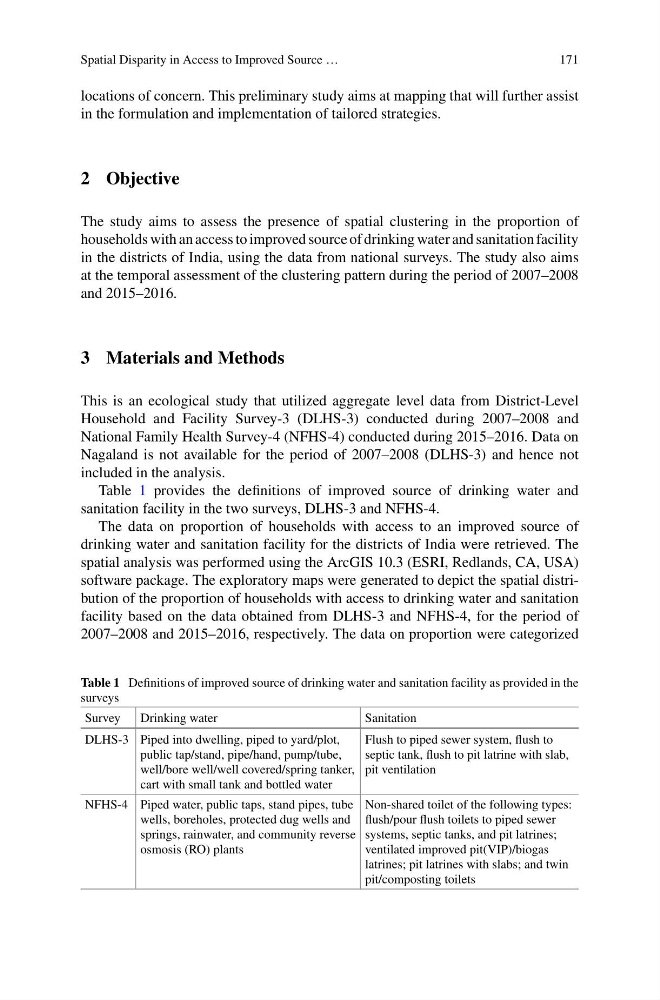
Table 1 provides the definitions of improved source of drinking water and
sanitation facility in the two surveys, DLHS-3 and NFHS-4.
The data on proportion of households with access to an improved source of
drinking water and sanitation facility for the districts of India were retrieved. The
spatial analysis was performed using the ArcGIS 10.3 (ESRI, Redlands, CA, USA)
software package. The exploratory maps were generated to depict the spatial distribution of the proportion of households with access to drinking water and sanitation
facility based on the data obtained from DLHS-3 and NFHS-4, for the period of
2007–2008 and 2015–2016, respectively. The data on proportion were categorized
Table 1 Definitions of improved source of drinking water and sanitation facility as provided in the
surveys
Survey
Drinking water
Sanitation
DLHS-3 Piped into dwelling, piped to yard/plot,
public tap/stand, pipe/hand, pump/tube,
well/bore well/well covered/spring tanker,
cart with small tank and bottled water
Flush to piped sewer system, flush to
septic tank, flush to pit latrine with slab,
pit ventilation
NFHS-4 Piped water, public taps, stand pipes, tube
wells, boreholes, protected dug wells and
springs, rainwater, and community reverse
osmosis (RO) plants
Non-shared toilet of the following types:
flush/pour flush toilets to piped sewer
systems, septic tanks, and pit latrines;
ventilated improved pit(VIP)/biogas
latrines; pit latrines with slabs; and twin
pit/composting toilets
171
locations of concern. This preliminary study aims at mapping that will further assist
in the formulation and implementation of tailored strategies.
2 Objective
The study aims to assess the presence of spatial clustering in the proportion of
households with an access to improved source of drinking water and sanitation facility
in the districts of India, using the data from national surveys. The study also aims
at the temporal assessment of the clustering pattern during the period of 2007–2008
and 2015–2016.
3 Materials and Methods
This is an ecological study that utilized aggregate level data from District-Level
Household and Facility Survey-3 (DLHS-3) conducted during 2007–2008 and
National Family Health Survey-4 (NFHS-4) conducted during 2015–2016. Data on
Nagaland is not available for the period of 2007–2008 (DLHS-3) and hence not
included in the analysis.
Table 1 provides the definitions of improved source of drinking water and
sanitation facility in the two surveys, DLHS-3 and NFHS-4.
The data on proportion of households with access to an improved source of
drinking water and sanitation facility for the districts of India were retrieved. The
spatial analysis was performed using the ArcGIS 10.3 (ESRI, Redlands, CA, USA)
software package. The exploratory maps were generated to depict the spatial distribution of the proportion of households with access to drinking water and sanitation
facility based on the data obtained from DLHS-3 and NFHS-4, for the period of
2007–2008 and 2015–2016, respectively. The data on proportion were categorized
Table 1 Definitions of improved source of drinking water and sanitation facility as provided in the
surveys
Survey
Drinking water
Sanitation
DLHS-3 Piped into dwelling, piped to yard/plot,
public tap/stand, pipe/hand, pump/tube,
well/bore well/well covered/spring tanker,
cart with small tank and bottled water
Flush to piped sewer system, flush to
septic tank, flush to pit latrine with slab,
pit ventilation
NFHS-4 Piped water, public taps, stand pipes, tube
wells, boreholes, protected dug wells and
springs, rainwater, and community reverse
osmosis (RO) plants
Non-shared toilet of the following types:
flush/pour flush toilets to piped sewer
systems, septic tanks, and pit latrines;
ventilated improved pit(VIP)/biogas
latrines; pit latrines with slabs; and twin
pit/composting toilets