

Predicting Meander Migration of the Barak River by Empirical …
119
Further, if the circles inscribed and channel positions on a particular bend are
recorded in year 1, 2 and 3 with the corresponding period of A and B, then the
predicted radius of curvature of the outer bank in the year 4 is given by Lagasse et al.
[20]
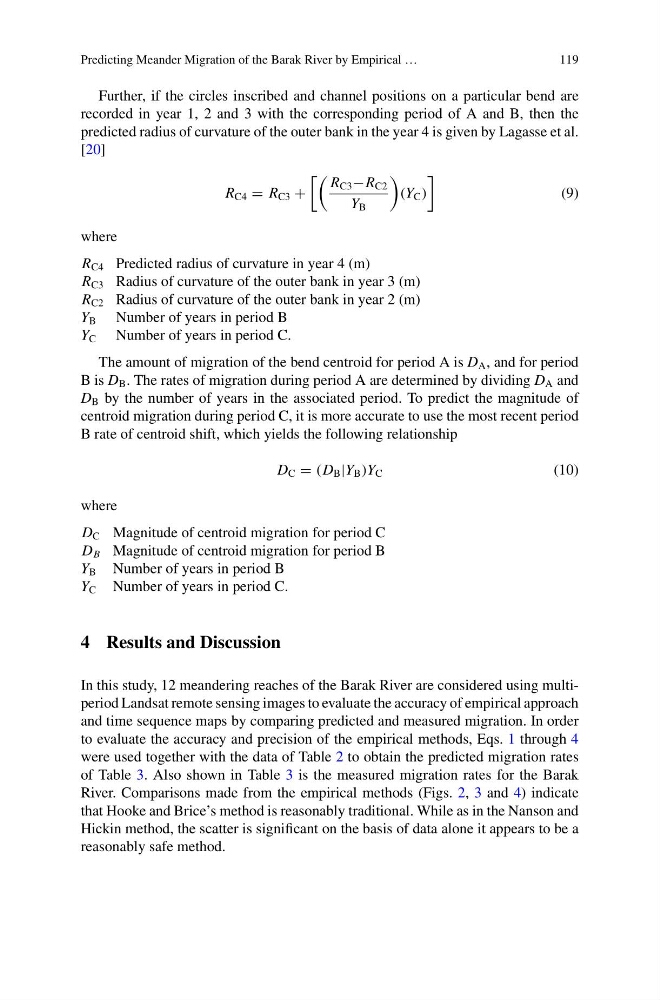
R C4 = R C3 +
R C3 −R C2
Y B
(Y C )
(9)
where
R C4 Predicted radius of curvature in year 4 (m)
R C3 Radius of curvature of the outer bank in year 3 (m)
R C2 Radius of curvature of the outer bank in year 2 (m)
Y B Number of years in period B
Y C Number of years in period C.
The amount of migration of the bend centroid for period A is D A , and for period
B is D B . The rates of migration during period A are determined by dividing D A and
D B by the number of years in the associated period. To predict the magnitude of
centroid migration during period C, it is more accurate to use the most recent period
B rate of centroid shift, which yields the following relationship
D C = (D B |Y B )Y C
(10)
where
D C Magnitude of centroid migration for period C
D B Magnitude of centroid migration for period B
Y B Number of years in period B
Y C Number of years in period C.
4 Results and Discussion
In this study, 12 meandering reaches of the Barak River are considered using multiperiod Landsat remote sensing images to evaluate the accuracy of empirical approach
and time sequence maps by comparing predicted and measured migration. In order
to evaluate the accuracy and precision of the empirical methods, Eqs. 1 through 4
were used together with the data of Table 2 to obtain the predicted migration rates
of Table 3. Also shown in Table 3 is the measured migration rates for the Barak
River. Comparisons made from the empirical methods (Figs. 2, 3 and 4) indicate
that Hooke and Brice’s method is reasonably traditional. While as in the Nanson and
Hickin method, the scatter is significant on the basis of data alone it appears to be a
reasonably safe method.
119
Further, if the circles inscribed and channel positions on a particular bend are
recorded in year 1, 2 and 3 with the corresponding period of A and B, then the
predicted radius of curvature of the outer bank in the year 4 is given by Lagasse et al.
[20]
R C4 = R C3 +
R C3 −R C2
Y B
(Y C )
(9)
where
R C4 Predicted radius of curvature in year 4 (m)
R C3 Radius of curvature of the outer bank in year 3 (m)
R C2 Radius of curvature of the outer bank in year 2 (m)
Y B Number of years in period B
Y C Number of years in period C.
The amount of migration of the bend centroid for period A is D A , and for period
B is D B . The rates of migration during period A are determined by dividing D A and
D B by the number of years in the associated period. To predict the magnitude of
centroid migration during period C, it is more accurate to use the most recent period
B rate of centroid shift, which yields the following relationship
D C = (D B |Y B )Y C
(10)
where
D C Magnitude of centroid migration for period C
D B Magnitude of centroid migration for period B
Y B Number of years in period B
Y C Number of years in period C.
4 Results and Discussion
In this study, 12 meandering reaches of the Barak River are considered using multiperiod Landsat remote sensing images to evaluate the accuracy of empirical approach
and time sequence maps by comparing predicted and measured migration. In order
to evaluate the accuracy and precision of the empirical methods, Eqs. 1 through 4
were used together with the data of Table 2 to obtain the predicted migration rates
of Table 3. Also shown in Table 3 is the measured migration rates for the Barak
River. Comparisons made from the empirical methods (Figs. 2, 3 and 4) indicate
that Hooke and Brice’s method is reasonably traditional. While as in the Nanson and
Hickin method, the scatter is significant on the basis of data alone it appears to be a
reasonably safe method.