

106
V. Jain et al.
3 Case Study
Indira Gandhi Canal, the longest canal of India. The canal enters from Haryana,
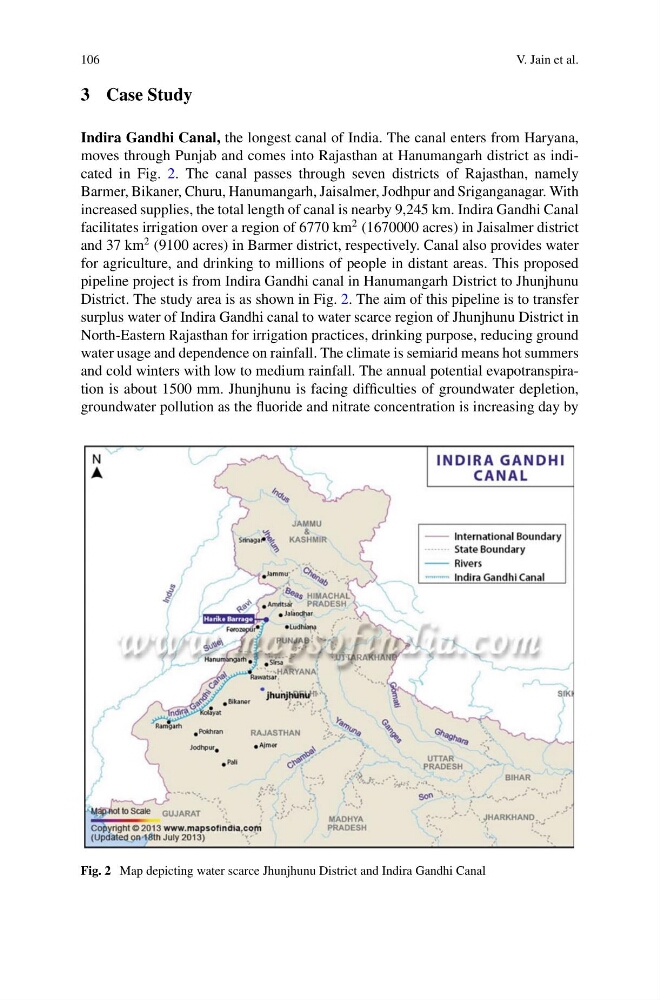
moves through Punjab and comes into Rajasthan at Hanumangarh district as indicated in Fig. 2. The canal passes through seven districts of Rajasthan, namely
Barmer, Bikaner, Churu, Hanumangarh, Jaisalmer, Jodhpur and Sriganganagar. With
increased supplies, the total length of canal is nearby 9,245 km. Indira Gandhi Canal
facilitates irrigation over a region of 6770 km
2 (1670000 acres) in Jaisalmer district
and 37 km
2 (9100 acres) in Barmer district, respectively. Canal also provides water
for agriculture, and drinking to millions of people in distant areas. This proposed
pipeline project is from Indira Gandhi canal in Hanumangarh District to Jhunjhunu
District. The study area is as shown in Fig. 2. The aim of this pipeline is to transfer
surplus water of Indira Gandhi canal to water scarce region of Jhunjhunu District in
North-Eastern Rajasthan for irrigation practices, drinking purpose, reducing ground
water usage and dependence on rainfall. The climate is semiarid means hot summers
and cold winters with low to medium rainfall. The annual potential evapotranspiration is about 1500 mm. Jhunjhunu is facing difficulties of groundwater depletion,
groundwater pollution as the fluoride and nitrate concentration is increasing day by
Fig. 2 Map depicting water scarce Jhunjhunu District and Indira Gandhi Canal
V. Jain et al.
3 Case Study
Indira Gandhi Canal, the longest canal of India. The canal enters from Haryana,
moves through Punjab and comes into Rajasthan at Hanumangarh district as indicated in Fig. 2. The canal passes through seven districts of Rajasthan, namely
Barmer, Bikaner, Churu, Hanumangarh, Jaisalmer, Jodhpur and Sriganganagar. With
increased supplies, the total length of canal is nearby 9,245 km. Indira Gandhi Canal
facilitates irrigation over a region of 6770 km
2 (1670000 acres) in Jaisalmer district
and 37 km
2 (9100 acres) in Barmer district, respectively. Canal also provides water
for agriculture, and drinking to millions of people in distant areas. This proposed
pipeline project is from Indira Gandhi canal in Hanumangarh District to Jhunjhunu
District. The study area is as shown in Fig. 2. The aim of this pipeline is to transfer
surplus water of Indira Gandhi canal to water scarce region of Jhunjhunu District in
North-Eastern Rajasthan for irrigation practices, drinking purpose, reducing ground
water usage and dependence on rainfall. The climate is semiarid means hot summers
and cold winters with low to medium rainfall. The annual potential evapotranspiration is about 1500 mm. Jhunjhunu is facing difficulties of groundwater depletion,
groundwater pollution as the fluoride and nitrate concentration is increasing day by
Fig. 2 Map depicting water scarce Jhunjhunu District and Indira Gandhi Canal