

88
D. Ghose et al.
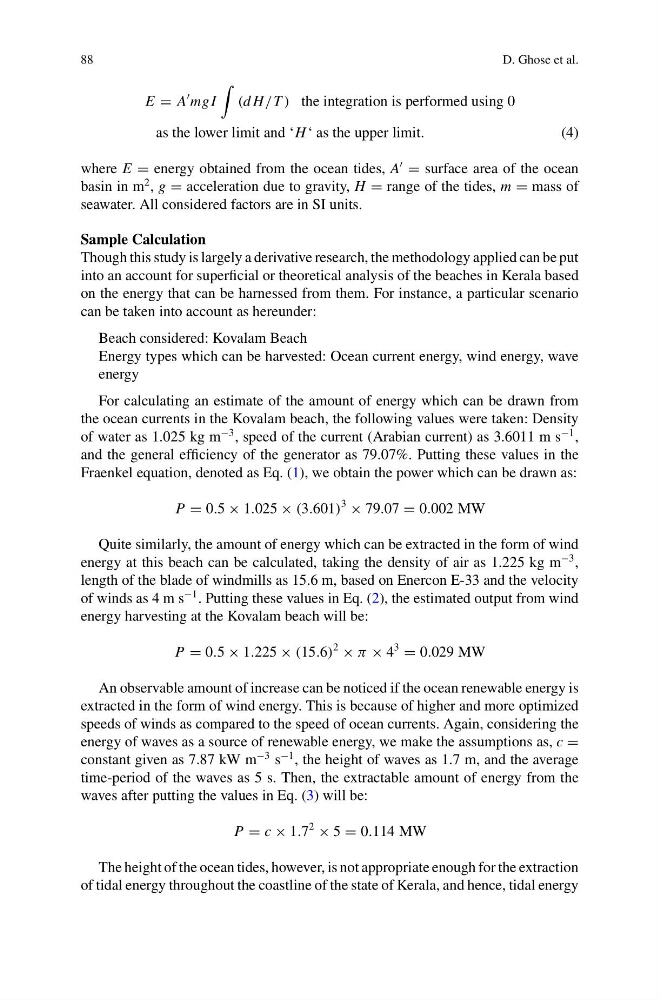
E = A
mg I
(d H/T ) the integration is performed using 0
as the lower limit and ‘H ‘ as the upper limit.
(4)
where E = energy obtained from the ocean tides, A
= surface area of the ocean
basin in m
2 , g = acceleration due to gravity, H = range of the tides, m = mass of
seawater. All considered factors are in SI units.
Sample Calculation
Though this study is largely a derivative research, the methodology applied can be put
into an account for superficial or theoretical analysis of the beaches in Kerala based
on the energy that can be harnessed from them. For instance, a particular scenario
can be taken into account as hereunder:
Beach considered: Kovalam Beach
Energy types which can be harvested: Ocean current energy, wind energy, wave
energy
For calculating an estimate of the amount of energy which can be drawn from
the ocean currents in the Kovalam beach, the following values were taken: Density
of water as 1.025 kg m
−3 , speed of the current (Arabian current) as 3.6011 m s
−1 ,
and the general efficiency of the generator as 79.07%. Putting these values in the
Fraenkel equation, denoted as Eq. (1), we obtain the power which can be drawn as:
P = 0.5 × 1.025 × (3.601)
3
× 79.07 = 0.002 MW
Quite similarly, the amount of energy which can be extracted in the form of wind
energy at this beach can be calculated, taking the density of air as 1.225 kg m
−3 ,
length of the blade of windmills as 15.6 m, based on Enercon E-33 and the velocity
of winds as 4 m s
−1 . Putting these values in Eq. (2), the estimated output from wind
energy harvesting at the Kovalam beach will be:
P = 0.5 × 1.225 × (15.6)
2
× π × 4
3
= 0.029 MW
An observable amount of increase can be noticed if the ocean renewable energy is
extracted in the form of wind energy. This is because of higher and more optimized
speeds of winds as compared to the speed of ocean currents. Again, considering the
energy of waves as a source of renewable energy, we make the assumptions as, c =
constant given as 7.87 kW m
−3 s
−1 , the height of waves as 1.7 m, and the average
time-period of the waves as 5 s. Then, the extractable amount of energy from the
waves after putting the values in Eq. (3) will be:
P = c × 1.7
2
× 5 = 0.114 MW
The height of the ocean tides, however, is not appropriate enough for the extraction
of tidal energy throughout the coastline of the state of Kerala, and hence, tidal energy
D. Ghose et al.
E = A
mg I
(d H/T ) the integration is performed using 0
as the lower limit and ‘H ‘ as the upper limit.
(4)
where E = energy obtained from the ocean tides, A
= surface area of the ocean
basin in m
2 , g = acceleration due to gravity, H = range of the tides, m = mass of
seawater. All considered factors are in SI units.
Sample Calculation
Though this study is largely a derivative research, the methodology applied can be put
into an account for superficial or theoretical analysis of the beaches in Kerala based
on the energy that can be harnessed from them. For instance, a particular scenario
can be taken into account as hereunder:
Beach considered: Kovalam Beach
Energy types which can be harvested: Ocean current energy, wind energy, wave
energy
For calculating an estimate of the amount of energy which can be drawn from
the ocean currents in the Kovalam beach, the following values were taken: Density
of water as 1.025 kg m
−3 , speed of the current (Arabian current) as 3.6011 m s
−1 ,
and the general efficiency of the generator as 79.07%. Putting these values in the
Fraenkel equation, denoted as Eq. (1), we obtain the power which can be drawn as:
P = 0.5 × 1.025 × (3.601)
3
× 79.07 = 0.002 MW
Quite similarly, the amount of energy which can be extracted in the form of wind
energy at this beach can be calculated, taking the density of air as 1.225 kg m
−3 ,
length of the blade of windmills as 15.6 m, based on Enercon E-33 and the velocity
of winds as 4 m s
−1 . Putting these values in Eq. (2), the estimated output from wind
energy harvesting at the Kovalam beach will be:
P = 0.5 × 1.225 × (15.6)
2
× π × 4
3
= 0.029 MW
An observable amount of increase can be noticed if the ocean renewable energy is
extracted in the form of wind energy. This is because of higher and more optimized
speeds of winds as compared to the speed of ocean currents. Again, considering the
energy of waves as a source of renewable energy, we make the assumptions as, c =
constant given as 7.87 kW m
−3 s
−1 , the height of waves as 1.7 m, and the average
time-period of the waves as 5 s. Then, the extractable amount of energy from the
waves after putting the values in Eq. (3) will be:
P = c × 1.7
2
× 5 = 0.114 MW
The height of the ocean tides, however, is not appropriate enough for the extraction
of tidal energy throughout the coastline of the state of Kerala, and hence, tidal energy