

50
A. Acharyya et al.
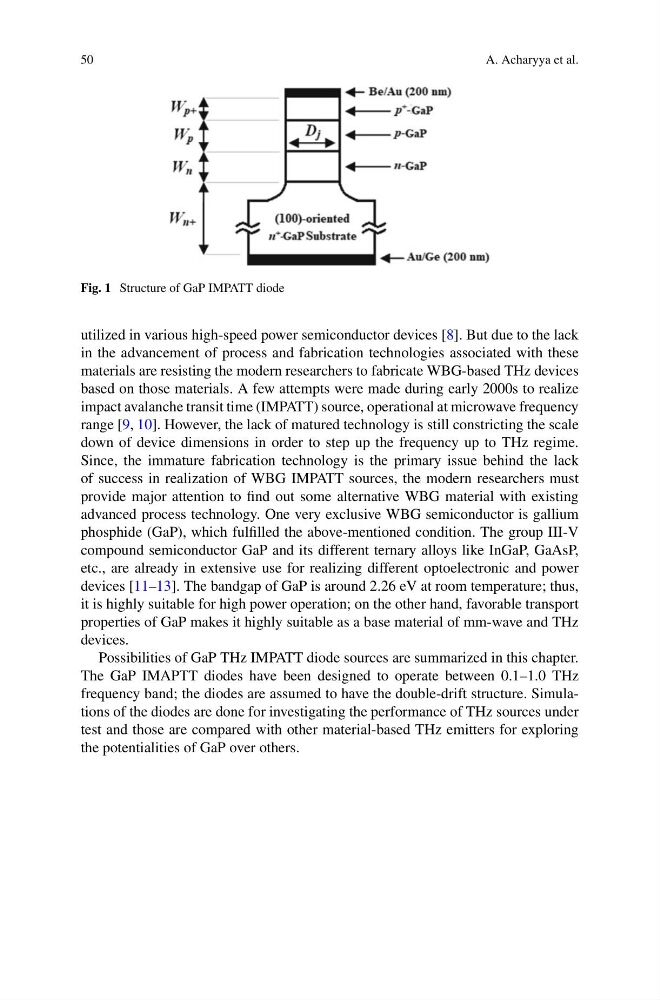
Fig. 1 Structure of GaP IMPATT diode
utilized in various high-speed power semiconductor devices [8]. But due to the lack
in the advancement of process and fabrication technologies associated with these
materials are resisting the modern researchers to fabricate WBG-based THz devices
based on those materials. A few attempts were made during early 2000s to realize
impact avalanche transit time (IMPATT) source, operational at microwave frequency
range [9, 10]. However, the lack of matured technology is still constricting the scale
down of device dimensions in order to step up the frequency up to THz regime.
Since, the immature fabrication technology is the primary issue behind the lack
of success in realization of WBG IMPATT sources, the modern researchers must
provide major attention to find out some alternative WBG material with existing
advanced process technology. One very exclusive WBG semiconductor is gallium
phosphide (GaP), which fulfilled the above-mentioned condition. The group III-V
compound semiconductor GaP and its different ternary alloys like InGaP, GaAsP,
etc., are already in extensive use for realizing different optoelectronic and power
devices [11–13]. The bandgap of GaP is around 2.26 eV at room temperature; thus,
it is highly suitable for high power operation; on the other hand, favorable transport
properties of GaP makes it highly suitable as a base material of mm-wave and THz
devices.
Possibilities of GaP THz IMPATT diode sources are summarized in this chapter.
The GaP IMAPTT diodes have been designed to operate between 0.1–1.0 THz
frequency band; the diodes are assumed to have the double-drift structure. Simulations of the diodes are done for investigating the performance of THz sources under
test and those are compared with other material-based THz emitters for exploring
the potentialities of GaP over others.
A. Acharyya et al.
Fig. 1 Structure of GaP IMPATT diode
utilized in various high-speed power semiconductor devices [8]. But due to the lack
in the advancement of process and fabrication technologies associated with these
materials are resisting the modern researchers to fabricate WBG-based THz devices
based on those materials. A few attempts were made during early 2000s to realize
impact avalanche transit time (IMPATT) source, operational at microwave frequency
range [9, 10]. However, the lack of matured technology is still constricting the scale
down of device dimensions in order to step up the frequency up to THz regime.
Since, the immature fabrication technology is the primary issue behind the lack
of success in realization of WBG IMPATT sources, the modern researchers must
provide major attention to find out some alternative WBG material with existing
advanced process technology. One very exclusive WBG semiconductor is gallium
phosphide (GaP), which fulfilled the above-mentioned condition. The group III-V
compound semiconductor GaP and its different ternary alloys like InGaP, GaAsP,
etc., are already in extensive use for realizing different optoelectronic and power
devices [11–13]. The bandgap of GaP is around 2.26 eV at room temperature; thus,
it is highly suitable for high power operation; on the other hand, favorable transport
properties of GaP makes it highly suitable as a base material of mm-wave and THz
devices.
Possibilities of GaP THz IMPATT diode sources are summarized in this chapter.
The GaP IMAPTT diodes have been designed to operate between 0.1–1.0 THz
frequency band; the diodes are assumed to have the double-drift structure. Simulations of the diodes are done for investigating the performance of THz sources under
test and those are compared with other material-based THz emitters for exploring
the potentialities of GaP over others.