

198
M. Singh et al.
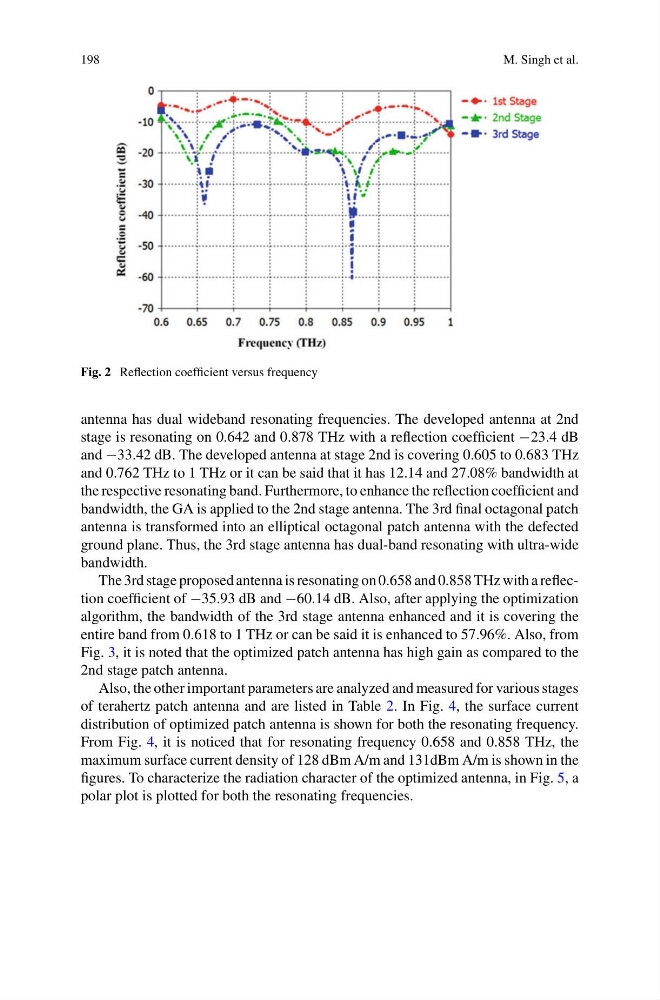
Fig. 2 Reflection coefficient versus frequency
antenna has dual wideband resonating frequencies. The developed antenna at 2nd
stage is resonating on 0.642 and 0.878 THz with a reflection coefficient −23.4 dB
and −33.42 dB. The developed antenna at stage 2nd is covering 0.605 to 0.683 THz
and 0.762 THz to 1 THz or it can be said that it has 12.14 and 27.08% bandwidth at
the respective resonating band. Furthermore, to enhance the reflection coefficient and
bandwidth, the GA is applied to the 2nd stage antenna. The 3rd final octagonal patch
antenna is transformed into an elliptical octagonal patch antenna with the defected
ground plane. Thus, the 3rd stage antenna has dual-band resonating with ultra-wide
bandwidth.
The 3rd stage proposed antenna is resonating on 0.658 and 0.858 THz with a reflection coefficient of −35.93 dB and −60.14 dB. Also, after applying the optimization
algorithm, the bandwidth of the 3rd stage antenna enhanced and it is covering the
entire band from 0.618 to 1 THz or can be said it is enhanced to 57.96%. Also, from
Fig. 3, it is noted that the optimized patch antenna has high gain as compared to the
2nd stage patch antenna.
Also, the other important parameters are analyzed and measured for various stages
of terahertz patch antenna and are listed in Table 2. In Fig. 4, the surface current
distribution of optimized patch antenna is shown for both the resonating frequency.
From Fig. 4, it is noticed that for resonating frequency 0.658 and 0.858 THz, the
maximum surface current density of 128 dBm A/m and 131dBm A/m is shown in the
figures. To characterize the radiation character of the optimized antenna, in Fig. 5, a
polar plot is plotted for both the resonating frequencies.
M. Singh et al.
Fig. 2 Reflection coefficient versus frequency
antenna has dual wideband resonating frequencies. The developed antenna at 2nd
stage is resonating on 0.642 and 0.878 THz with a reflection coefficient −23.4 dB
and −33.42 dB. The developed antenna at stage 2nd is covering 0.605 to 0.683 THz
and 0.762 THz to 1 THz or it can be said that it has 12.14 and 27.08% bandwidth at
the respective resonating band. Furthermore, to enhance the reflection coefficient and
bandwidth, the GA is applied to the 2nd stage antenna. The 3rd final octagonal patch
antenna is transformed into an elliptical octagonal patch antenna with the defected
ground plane. Thus, the 3rd stage antenna has dual-band resonating with ultra-wide
bandwidth.
The 3rd stage proposed antenna is resonating on 0.658 and 0.858 THz with a reflection coefficient of −35.93 dB and −60.14 dB. Also, after applying the optimization
algorithm, the bandwidth of the 3rd stage antenna enhanced and it is covering the
entire band from 0.618 to 1 THz or can be said it is enhanced to 57.96%. Also, from
Fig. 3, it is noted that the optimized patch antenna has high gain as compared to the
2nd stage patch antenna.
Also, the other important parameters are analyzed and measured for various stages
of terahertz patch antenna and are listed in Table 2. In Fig. 4, the surface current
distribution of optimized patch antenna is shown for both the resonating frequency.
From Fig. 4, it is noticed that for resonating frequency 0.658 and 0.858 THz, the
maximum surface current density of 128 dBm A/m and 131dBm A/m is shown in the
figures. To characterize the radiation character of the optimized antenna, in Fig. 5, a
polar plot is plotted for both the resonating frequencies.