

Highly Efficient Ultra-Wide Band MIMO Patch Antenna Array …
197
Table 1 The various dimension of patch antenna developed for terahertz communications (μm)
S a
400
P w
230.14
S b
400
R a
112.69
S c
392.98
R b
109.29
S d
376.12
F w
28.34
P l
271.11
F a
30.06
Here, M is an integer and h is the substrate thickness (Table 1).
2.2 Performance Evaluation of Proposed Antenna
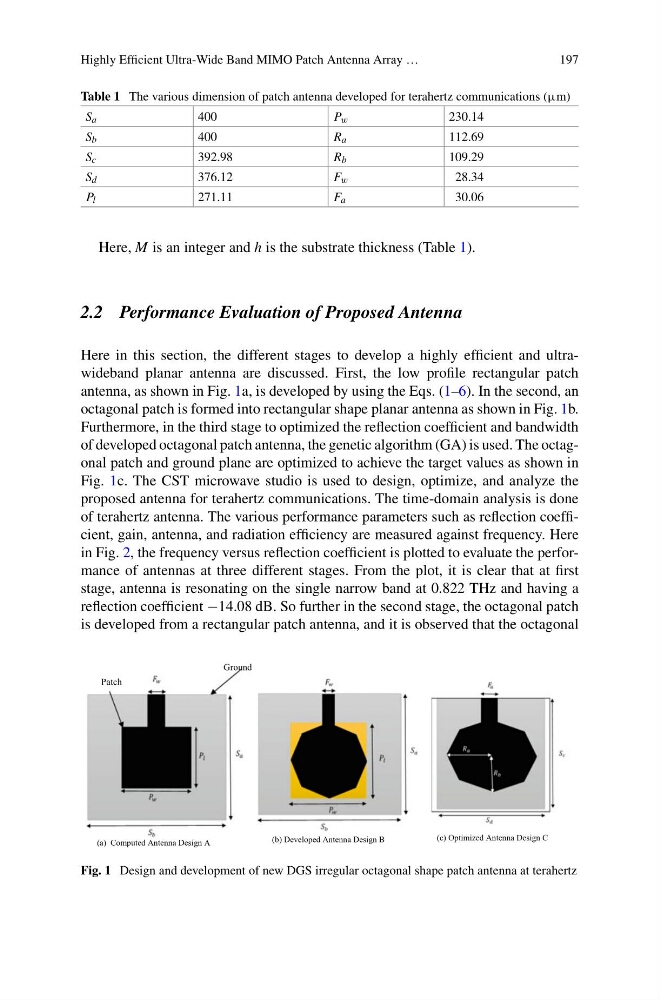
Here in this section, the different stages to develop a highly efficient and ultrawideband planar antenna are discussed. First, the low profile rectangular patch
antenna, as shown in Fig. 1a, is developed by using the Eqs. (1–6). In the second, an
octagonal patch is formed into rectangular shape planar antenna as shown in Fig. 1b.
Furthermore, in the third stage to optimized the reflection coefficient and bandwidth
of developed octagonal patch antenna, the genetic algorithm (GA) is used. The octagonal patch and ground plane are optimized to achieve the target values as shown in
Fig. 1c. The CST microwave studio is used to design, optimize, and analyze the
proposed antenna for terahertz communications. The time-domain analysis is done
of terahertz antenna. The various performance parameters such as reflection coefficient, gain, antenna, and radiation efficiency are measured against frequency. Here
in Fig. 2, the frequency versus reflection coefficient is plotted to evaluate the performance of antennas at three different stages. From the plot, it is clear that at first
stage, antenna is resonating on the single narrow band at 0.822 THz and having a
reflection coefficient −14.08 dB. So further in the second stage, the octagonal patch
is developed from a rectangular patch antenna, and it is observed that the octagonal
Ground
Patch
(a) Computed Antenna Design A
(b) Developed Antenna Design B
(c) Optimized Antenna Design C
Fig. 1 Design and development of new DGS irregular octagonal shape patch antenna at terahertz
197
Table 1 The various dimension of patch antenna developed for terahertz communications (μm)
S a
400
P w
230.14
S b
400
R a
112.69
S c
392.98
R b
109.29
S d
376.12
F w
28.34
P l
271.11
F a
30.06
Here, M is an integer and h is the substrate thickness (Table 1).
2.2 Performance Evaluation of Proposed Antenna
Here in this section, the different stages to develop a highly efficient and ultrawideband planar antenna are discussed. First, the low profile rectangular patch
antenna, as shown in Fig. 1a, is developed by using the Eqs. (1–6). In the second, an
octagonal patch is formed into rectangular shape planar antenna as shown in Fig. 1b.
Furthermore, in the third stage to optimized the reflection coefficient and bandwidth
of developed octagonal patch antenna, the genetic algorithm (GA) is used. The octagonal patch and ground plane are optimized to achieve the target values as shown in
Fig. 1c. The CST microwave studio is used to design, optimize, and analyze the
proposed antenna for terahertz communications. The time-domain analysis is done
of terahertz antenna. The various performance parameters such as reflection coefficient, gain, antenna, and radiation efficiency are measured against frequency. Here
in Fig. 2, the frequency versus reflection coefficient is plotted to evaluate the performance of antennas at three different stages. From the plot, it is clear that at first
stage, antenna is resonating on the single narrow band at 0.822 THz and having a
reflection coefficient −14.08 dB. So further in the second stage, the octagonal patch
is developed from a rectangular patch antenna, and it is observed that the octagonal
Ground
Patch
(a) Computed Antenna Design A
(b) Developed Antenna Design B
(c) Optimized Antenna Design C
Fig. 1 Design and development of new DGS irregular octagonal shape patch antenna at terahertz