

168
K. Mukherjee
TAND gate. In Sects. 4.1, 4.2 and 4.3, the designs of NOT, OR, and AND gates are
described. Section 5 deals with overall conclusions.
2 Working Principle of the TAND Gate
The cross-gain modulation (XGM) in QDSOA is the basic mechanism behind the
working of the proposed logic gate. This XGM results in inverted output at probe
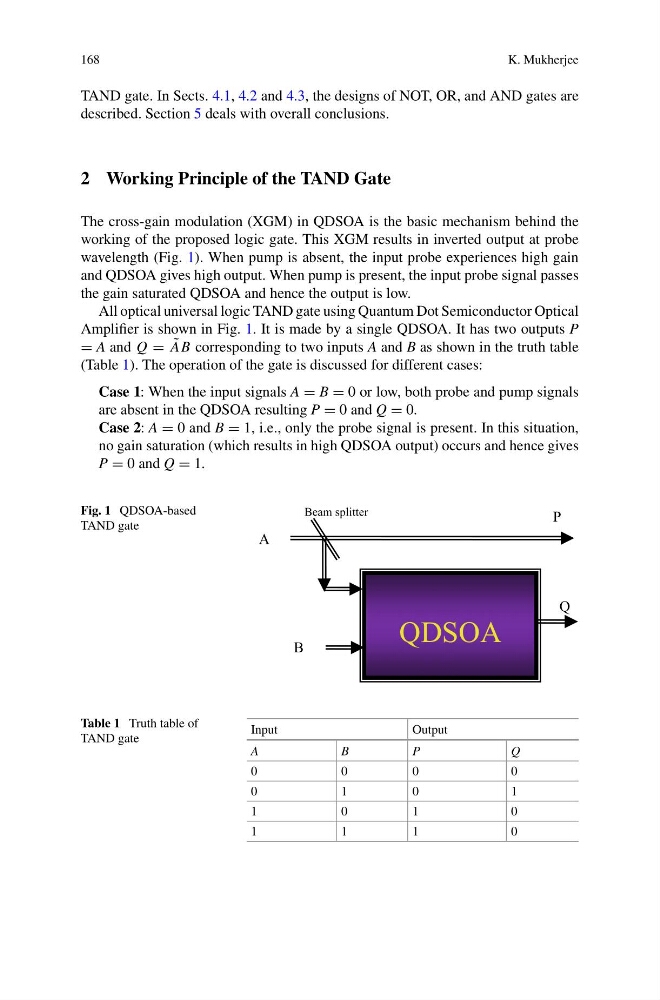
wavelength (Fig. 1). When pump is absent, the input probe experiences high gain
and QDSOA gives high output. When pump is present, the input probe signal passes
the gain saturated QDSOA and hence the output is low.
All optical universal logic TAND gate using Quantum Dot Semiconductor Optical
Amplifier is shown in Fig. 1. It is made by a single QDSOA. It has two outputs P
= A and Q = ˜
AB corresponding to two inputs A and B as shown in the truth table
(Table 1). The operation of the gate is discussed for different cases:
Case 1: When the input signals A = B = 0 or low, both probe and pump signals
are absent in the QDSOA resulting P = 0 and Q = 0.
Case 2: A = 0 and B = 1, i.e., only the probe signal is present. In this situation,
no gain saturation (which results in high QDSOA output) occurs and hence gives
P = 0 and Q = 1.
Fig. 1 QDSOA-based
TAND gate
A
P
B
QDSOA
Q
Beam splitter
Table 1 Truth table of
TAND gate
Input
Output
A
B
P
Q
0
0
0
0
0
1
0
1
1
0
1
0
1
1
1
0
K. Mukherjee
TAND gate. In Sects. 4.1, 4.2 and 4.3, the designs of NOT, OR, and AND gates are
described. Section 5 deals with overall conclusions.
2 Working Principle of the TAND Gate
The cross-gain modulation (XGM) in QDSOA is the basic mechanism behind the
working of the proposed logic gate. This XGM results in inverted output at probe
wavelength (Fig. 1). When pump is absent, the input probe experiences high gain
and QDSOA gives high output. When pump is present, the input probe signal passes
the gain saturated QDSOA and hence the output is low.
All optical universal logic TAND gate using Quantum Dot Semiconductor Optical
Amplifier is shown in Fig. 1. It is made by a single QDSOA. It has two outputs P
= A and Q = ˜
AB corresponding to two inputs A and B as shown in the truth table
(Table 1). The operation of the gate is discussed for different cases:
Case 1: When the input signals A = B = 0 or low, both probe and pump signals
are absent in the QDSOA resulting P = 0 and Q = 0.
Case 2: A = 0 and B = 1, i.e., only the probe signal is present. In this situation,
no gain saturation (which results in high QDSOA output) occurs and hence gives
P = 0 and Q = 1.
Fig. 1 QDSOA-based
TAND gate
A
P
B
QDSOA
Q
Beam splitter
Table 1 Truth table of
TAND gate
Input
Output
A
B
P
Q
0
0
0
0
0
1
0
1
1
0
1
0
1
1
1
0