

160
M. El Ghzaoui and S. Das
7.1.5 Robustness Against Noise
Unlike single-carrier modulations where noise can affect a the whole frame, in OFDM
system, the loss of a symbol due to significant noise does not disturb other data.
7.2 Drawbacks
Temporal characteristics of OFDM signal represent the main drawback of it in this
signal [24, 25]. Indeed, on the one hand, OFDM modulation uses a rectangular
frequency wave form which corresponds to a cardinal sine. Consequently, it is a
very badly located frequency spectrum. In addition, the first secondary lobe of the
DSP goes back to −13 dB which makes this modulation difficult to apply for THZ
channels, having a very strict emission mask. The idea is therefore to substitute in
OFDM a waveform having better localization properties and having, in particular,
a frequency response with a higher attenuation. To overcome the time-frequency
location problem associated with OFDM modulation, we can use the oversampled
OFDM modulation.
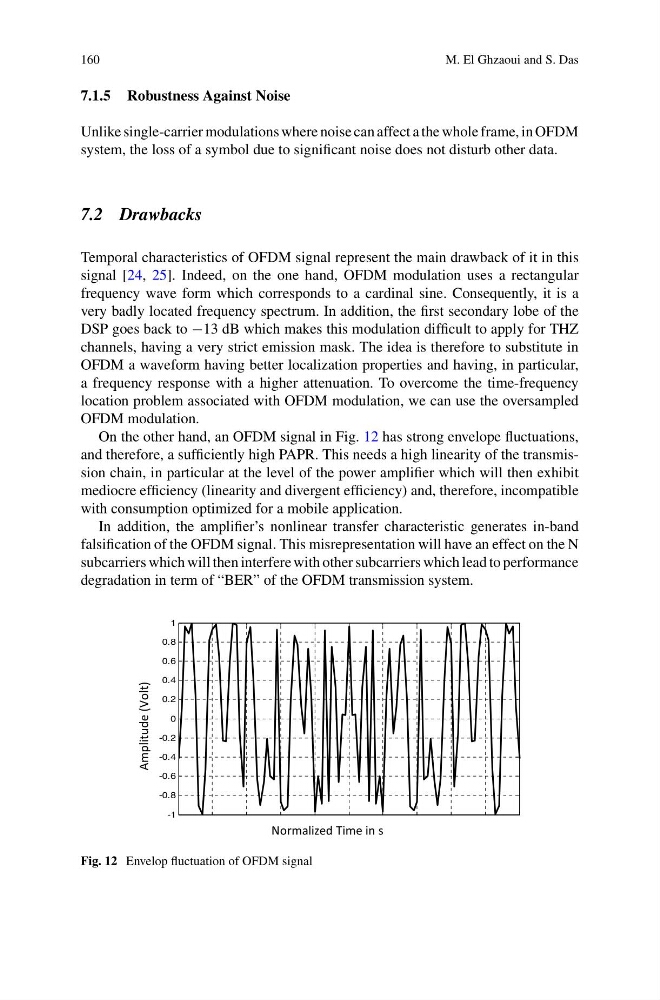
On the other hand, an OFDM signal in Fig. 12 has strong envelope fluctuations,
and therefore, a sufficiently high PAPR. This needs a high linearity of the transmission chain, in particular at the level of the power amplifier which will then exhibit
mediocre efficiency (linearity and divergent efficiency) and, therefore, incompatible
with consumption optimized for a mobile application.
In addition, the amplifier’s nonlinear transfer characteristic generates in-band
falsification of the OFDM signal. This misrepresentation will have an effect on the N
subcarriers which will then interfere with other subcarriers which lead to performance
degradation in term of “BER” of the OFDM transmission system.
-1
-0.8
-0.6
-0.4
-0.2
0
0.2
0.4
0.6
0.8
1
Normalized Time in s
Amplitude (Volt)
Fig. 12 Envelop fluctuation of OFDM signal
M. El Ghzaoui and S. Das
7.1.5 Robustness Against Noise
Unlike single-carrier modulations where noise can affect a the whole frame, in OFDM
system, the loss of a symbol due to significant noise does not disturb other data.
7.2 Drawbacks
Temporal characteristics of OFDM signal represent the main drawback of it in this
signal [24, 25]. Indeed, on the one hand, OFDM modulation uses a rectangular
frequency wave form which corresponds to a cardinal sine. Consequently, it is a
very badly located frequency spectrum. In addition, the first secondary lobe of the
DSP goes back to −13 dB which makes this modulation difficult to apply for THZ
channels, having a very strict emission mask. The idea is therefore to substitute in
OFDM a waveform having better localization properties and having, in particular,
a frequency response with a higher attenuation. To overcome the time-frequency
location problem associated with OFDM modulation, we can use the oversampled
OFDM modulation.
On the other hand, an OFDM signal in Fig. 12 has strong envelope fluctuations,
and therefore, a sufficiently high PAPR. This needs a high linearity of the transmission chain, in particular at the level of the power amplifier which will then exhibit
mediocre efficiency (linearity and divergent efficiency) and, therefore, incompatible
with consumption optimized for a mobile application.
In addition, the amplifier’s nonlinear transfer characteristic generates in-band
falsification of the OFDM signal. This misrepresentation will have an effect on the N
subcarriers which will then interfere with other subcarriers which lead to performance
degradation in term of “BER” of the OFDM transmission system.
-1
-0.8
-0.6
-0.4
-0.2
0
0.2
0.4
0.6
0.8
1
Normalized Time in s
Amplitude (Volt)
Fig. 12 Envelop fluctuation of OFDM signal