

OFDM for Terahertz Wireless Communication Systems
157
0
2
4
6
8
10
12
14
10
-4
10
-3
10
-2
10
-1
10
0
gama (dB)
Pr[CCDF(x) = PAPRx>gama]
J=1
J=2
J=4
J=8
J=16
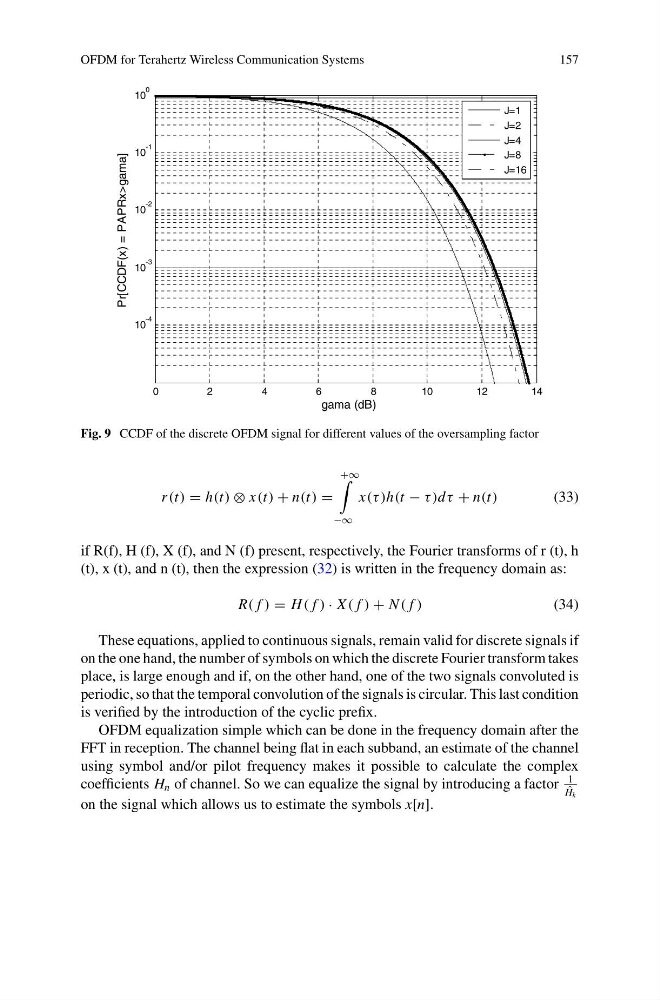
Fig. 9 CCDF of the discrete OFDM signal for different values of the oversampling factor
r (t) = h(t) ⊗ x(t) + n(t) =
+∞
−∞
x(τ )h(t − τ )dτ + n(t)
(33)
if R(f), H (f), X (f), and N (f) present, respectively, the Fourier transforms of r (t), h
(t), x (t), and n (t), then the expression (32) is written in the frequency domain as:
R( f ) = H ( f ) · X ( f ) + N ( f )
(34)
These equations, applied to continuous signals, remain valid for discrete signals if
on the one hand, the number of symbols on which the discrete Fourier transform takes
place, is large enough and if, on the other hand, one of the two signals convoluted is
periodic, so that the temporal convolution of the signals is circular. This last condition
is verified by the introduction of the cyclic prefix.
OFDM equalization simple which can be done in the frequency domain after the
FFT in reception. The channel being flat in each subband, an estimate of the channel
using symbol and/or pilot frequency makes it possible to calculate the complex
coefficients H n of channel. So we can equalize the signal by introducing a factor
1
ˆ
H k
on the signal which allows us to estimate the symbols x[n].
157
0
2
4
6
8
10
12
14
10
-4
10
-3
10
-2
10
-1
10
0
gama (dB)
Pr[CCDF(x) = PAPRx>gama]
J=1
J=2
J=4
J=8
J=16
Fig. 9 CCDF of the discrete OFDM signal for different values of the oversampling factor
r (t) = h(t) ⊗ x(t) + n(t) =
+∞
−∞
x(τ )h(t − τ )dτ + n(t)
(33)
if R(f), H (f), X (f), and N (f) present, respectively, the Fourier transforms of r (t), h
(t), x (t), and n (t), then the expression (32) is written in the frequency domain as:
R( f ) = H ( f ) · X ( f ) + N ( f )
(34)
These equations, applied to continuous signals, remain valid for discrete signals if
on the one hand, the number of symbols on which the discrete Fourier transform takes
place, is large enough and if, on the other hand, one of the two signals convoluted is
periodic, so that the temporal convolution of the signals is circular. This last condition
is verified by the introduction of the cyclic prefix.
OFDM equalization simple which can be done in the frequency domain after the
FFT in reception. The channel being flat in each subband, an estimate of the channel
using symbol and/or pilot frequency makes it possible to calculate the complex
coefficients H n of channel. So we can equalize the signal by introducing a factor
1
ˆ
H k
on the signal which allows us to estimate the symbols x[n].