

156
M. El Ghzaoui and S. Das
Number of subcarriers N
0
200
400
600
800
1000
1200
1400
1600
0
1
2
3
4
5
6
7
8
E[PAPR] (dB)
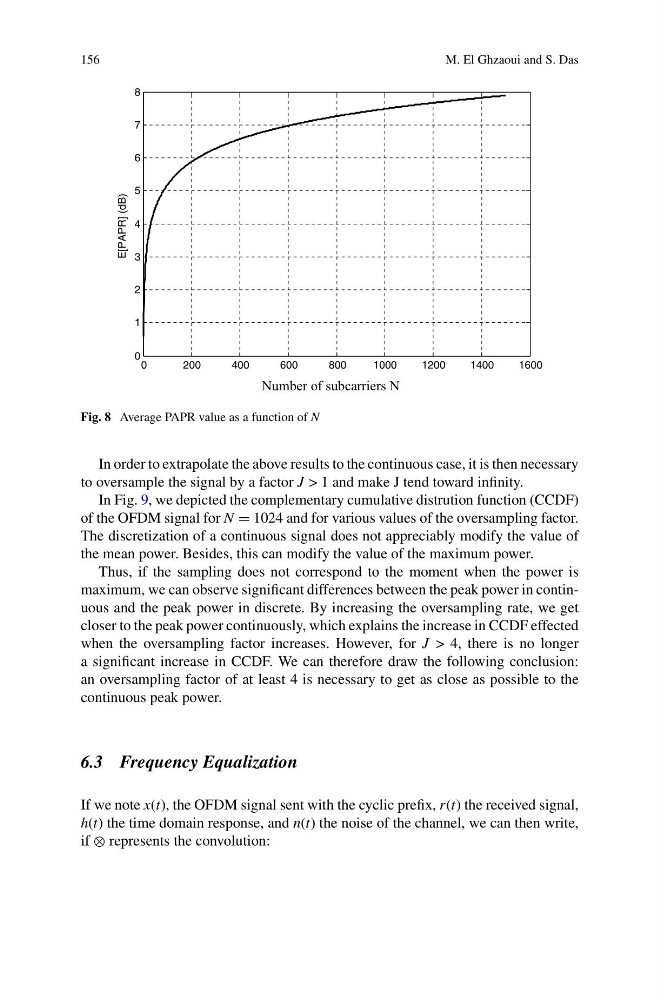
Fig. 8 Average PAPR value as a function of N
In order to extrapolate the above results to the continuous case, it is then necessary
to oversample the signal by a factor J > 1 and make J tend toward infinity.
In Fig. 9, we depicted the complementary cumulative distrution function (CCDF)
of the OFDM signal for N = 1024 and for various values of the oversampling factor.
The discretization of a continuous signal does not appreciably modify the value of
the mean power. Besides, this can modify the value of the maximum power.
Thus, if the sampling does not correspond to the moment when the power is
maximum, we can observe significant differences between the peak power in continuous and the peak power in discrete. By increasing the oversampling rate, we get
closer to the peak power continuously, which explains the increase in CCDF effected
when the oversampling factor increases. However, for J > 4, there is no longer
a significant increase in CCDF. We can therefore draw the following conclusion:
an oversampling factor of at least 4 is necessary to get as close as possible to the
continuous peak power.
6.3 Frequency Equalization
If we note x(t), the OFDM signal sent with the cyclic prefix, r(t) the received signal,
h(t) the time domain response, and n(t) the noise of the channel, we can then write,
if ⊗ represents the convolution:
M. El Ghzaoui and S. Das
Number of subcarriers N
0
200
400
600
800
1000
1200
1400
1600
0
1
2
3
4
5
6
7
8
E[PAPR] (dB)
Fig. 8 Average PAPR value as a function of N
In order to extrapolate the above results to the continuous case, it is then necessary
to oversample the signal by a factor J > 1 and make J tend toward infinity.
In Fig. 9, we depicted the complementary cumulative distrution function (CCDF)
of the OFDM signal for N = 1024 and for various values of the oversampling factor.
The discretization of a continuous signal does not appreciably modify the value of
the mean power. Besides, this can modify the value of the maximum power.
Thus, if the sampling does not correspond to the moment when the power is
maximum, we can observe significant differences between the peak power in continuous and the peak power in discrete. By increasing the oversampling rate, we get
closer to the peak power continuously, which explains the increase in CCDF effected
when the oversampling factor increases. However, for J > 4, there is no longer
a significant increase in CCDF. We can therefore draw the following conclusion:
an oversampling factor of at least 4 is necessary to get as close as possible to the
continuous peak power.
6.3 Frequency Equalization
If we note x(t), the OFDM signal sent with the cyclic prefix, r(t) the received signal,
h(t) the time domain response, and n(t) the noise of the channel, we can then write,
if ⊗ represents the convolution: