

The Carrier Statistics, Terahertz Frequency …
109
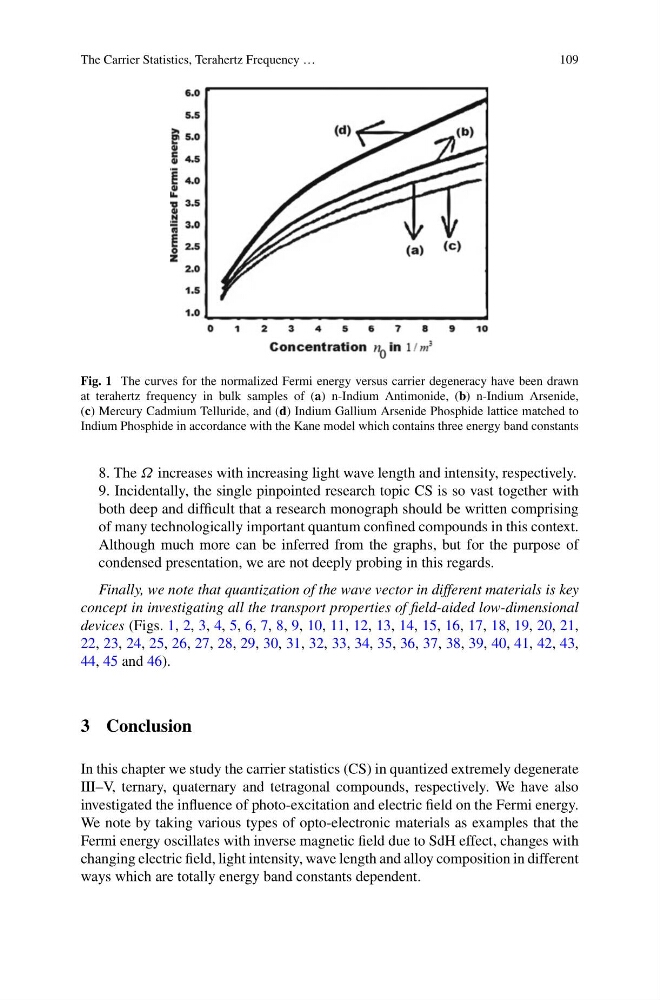
Fig. 1 The curves for the normalized Fermi energy versus carrier degeneracy have been drawn
at terahertz frequency in bulk samples of (a) n-Indium Antimonide, (b) n-Indium Arsenide,
(c) Mercury Cadmium Telluride, and (d) Indium Gallium Arsenide Phosphide lattice matched to
Indium Phosphide in accordance with the Kane model which contains three energy band constants
8. The Ω increases with increasing light wave length and intensity, respectively.
9. Incidentally, the single pinpointed research topic CS is so vast together with
both deep and difficult that a research monograph should be written comprising
of many technologically important quantum confined compounds in this context.
Although much more can be inferred from the graphs, but for the purpose of
condensed presentation, we are not deeply probing in this regards.
Finally, we note that quantization of the wave vector in different materials is key
concept in investigating all the transport properties of field-aided low-dimensional
devices (Figs. 1, 2, 3, 4, 5, 6, 7, 8, 9, 10, 11, 12, 13, 14, 15, 16, 17, 18, 19, 20, 21,
22, 23, 24, 25, 26, 27, 28, 29, 30, 31, 32, 33, 34, 35, 36, 37, 38, 39, 40, 41, 42, 43,
44, 45 and 46).
3 Conclusion
In this chapter we study the carrier statistics (CS) in quantized extremely degenerate
III–V, ternary, quaternary and tetragonal compounds, respectively. We have also
investigated the influence of photo-excitation and electric field on the Fermi energy.
We note by taking various types of opto-electronic materials as examples that the
Fermi energy oscillates with inverse magnetic field due to SdH effect, changes with
changing electric field, light intensity, wave length and alloy composition in different
ways which are totally energy band constants dependent.
109
Fig. 1 The curves for the normalized Fermi energy versus carrier degeneracy have been drawn
at terahertz frequency in bulk samples of (a) n-Indium Antimonide, (b) n-Indium Arsenide,
(c) Mercury Cadmium Telluride, and (d) Indium Gallium Arsenide Phosphide lattice matched to
Indium Phosphide in accordance with the Kane model which contains three energy band constants
8. The Ω increases with increasing light wave length and intensity, respectively.
9. Incidentally, the single pinpointed research topic CS is so vast together with
both deep and difficult that a research monograph should be written comprising
of many technologically important quantum confined compounds in this context.
Although much more can be inferred from the graphs, but for the purpose of
condensed presentation, we are not deeply probing in this regards.
Finally, we note that quantization of the wave vector in different materials is key
concept in investigating all the transport properties of field-aided low-dimensional
devices (Figs. 1, 2, 3, 4, 5, 6, 7, 8, 9, 10, 11, 12, 13, 14, 15, 16, 17, 18, 19, 20, 21,
22, 23, 24, 25, 26, 27, 28, 29, 30, 31, 32, 33, 34, 35, 36, 37, 38, 39, 40, 41, 42, 43,
44, 45 and 46).
3 Conclusion
In this chapter we study the carrier statistics (CS) in quantized extremely degenerate
III–V, ternary, quaternary and tetragonal compounds, respectively. We have also
investigated the influence of photo-excitation and electric field on the Fermi energy.
We note by taking various types of opto-electronic materials as examples that the
Fermi energy oscillates with inverse magnetic field due to SdH effect, changes with
changing electric field, light intensity, wave length and alloy composition in different
ways which are totally energy band constants dependent.