

64
Other microbial species also produce hydrogen but on low amounts that are considered unsuitable for high-scale dark fermentation units (Vibrionaceae sp.,
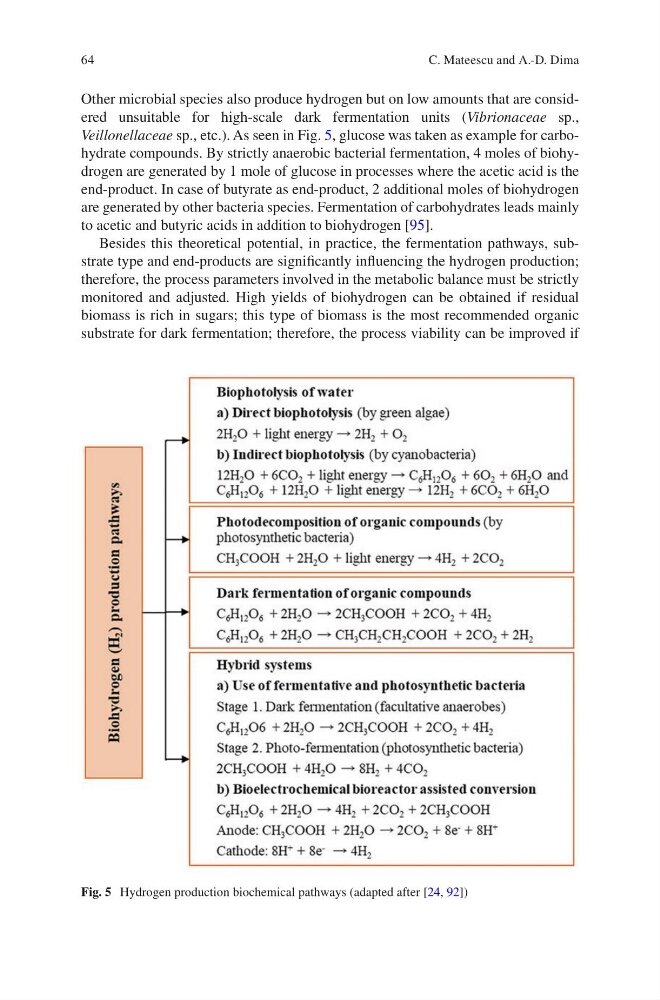
Veillonellaceae sp., etc.). As seen in Fig. 5, glucose was taken as example for carbohydrate compounds. By strictly anaerobic bacterial fermentation, 4 moles of biohydrogen are generated by 1 mole of glucose in processes where the acetic acid is the
end-product. In case of butyrate as end-product, 2 additional moles of biohydrogen
are generated by other bacteria species. Fermentation of carbohydrates leads mainly
to acetic and butyric acids in addition to biohydrogen [95].
Besides this theoretical potential, in practice, the fermentation pathways, substrate type and end-products are significantly influencing the hydrogen production;
therefore, the process parameters involved in the metabolic balance must be strictly
monitored and adjusted. High yields of biohydrogen can be obtained if residual
biomass is rich in sugars; this type of biomass is the most recommended organic
substrate for dark fermentation; therefore, the process viability can be improved if
Fig. 5 Hydrogen production biochemical pathways (adapted after [24, 92])
C. Mateescu and A.-D. Dima
Other microbial species also produce hydrogen but on low amounts that are considered unsuitable for high-scale dark fermentation units (Vibrionaceae sp.,
Veillonellaceae sp., etc.). As seen in Fig. 5, glucose was taken as example for carbohydrate compounds. By strictly anaerobic bacterial fermentation, 4 moles of biohydrogen are generated by 1 mole of glucose in processes where the acetic acid is the
end-product. In case of butyrate as end-product, 2 additional moles of biohydrogen
are generated by other bacteria species. Fermentation of carbohydrates leads mainly
to acetic and butyric acids in addition to biohydrogen [95].
Besides this theoretical potential, in practice, the fermentation pathways, substrate type and end-products are significantly influencing the hydrogen production;
therefore, the process parameters involved in the metabolic balance must be strictly
monitored and adjusted. High yields of biohydrogen can be obtained if residual
biomass is rich in sugars; this type of biomass is the most recommended organic
substrate for dark fermentation; therefore, the process viability can be improved if
Fig. 5 Hydrogen production biochemical pathways (adapted after [24, 92])
C. Mateescu and A.-D. Dima