

716
alumina as well. Higher temperature is required for high conversion in the case of
alumina; on the contrary, lower reactivity of the Lewis acid sites helps in selective
yield of furfuryl alcohol instead of converting all the way to MTHF, 2-MF, etc. [29].
Similarly, He et al. came up with low-cost mixed metal oxides by applying them
widely with catalysis in addition with renewables due to their adjustable physicochemical properties [30]. They introduced solid catalysts with magnetic properties
due to easy separation and recycling of the catalyst from the liquid mixture by
applying an external magnetic field. They used bifunctional magnetic Al 7 Zr 3 @
Fe 3 O 4 oxide catalysts and observed conversion of furfural up to ~100% but at a very
high temperature of 180 °C [30]. Interestingly, readily available potassium fluoride
(KF) was able to give a yield of 76% of furfuryl alcohol by converting 76% of FUR
at room temperature in just 5 min [31]. This was probably due to the high nucleophilicity of fluoride, which would have been favourable for FUR conversion. But
the toxicity and corrosive nature of fluoride do make this process neither a favourable nor a sustainable one. Due to their lower stabilisation possibility of silicon
atoms, using polyhydrosiloxane (which is very expensive) may have led to high
conversion of FUR to furfuryl alcohol [31]. Bimetallic systems of catalysts were
also used for hydrogenation of furfural by controlled surface reaction to reduce
unwanted side reactions [32]. Vetere et al. tried using Pt, Rh and Ni catalysts promoted with tin and got FUR conversion of 31% at 100 °C with selectivity of furfuryl
alcohol of 97% with Ni being an attractive option due to its low cost.
Merlo et al. tried with Pt-based bimetallic catalyst for furfural conversion. They
got the highest conversion of 100% FUR with the lowest Sn/Pt atomic ratio. It was
concluded that Pt-Sn systems were more active than the monometallic catalyst. And
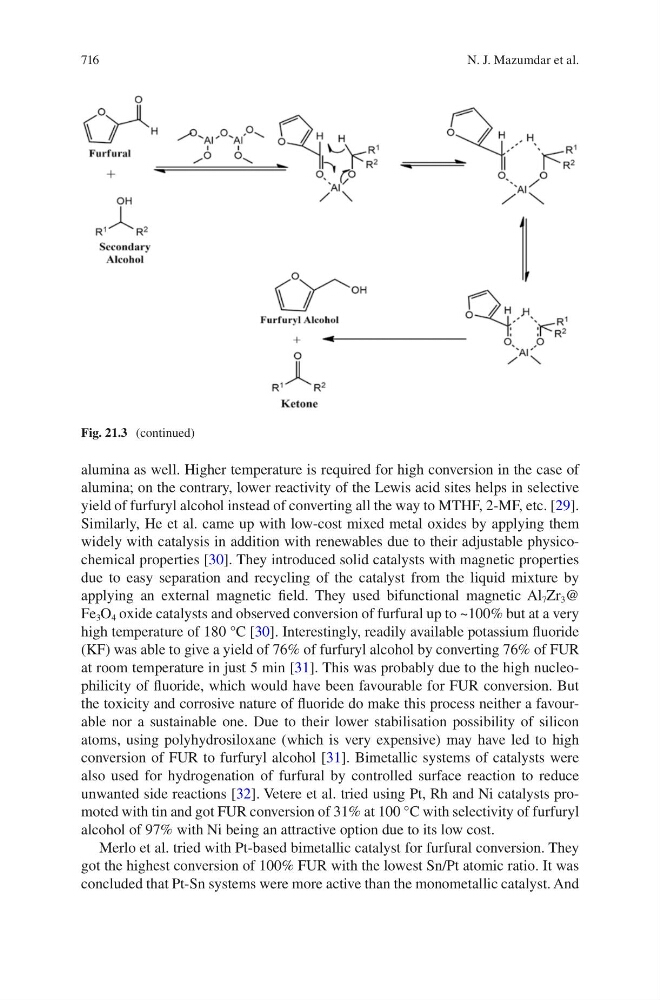
Fig. 21.3 (continued)
N. J. Mazumdar et al.